Crevice Spiny Lizard
Sceloporus poinsettii
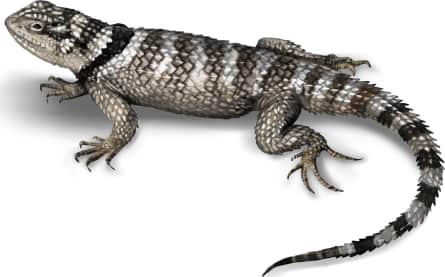
This lizard is distinguished by the spiny scales on its legs and tail, unique banded pattern, and thick black collar outlined in white across its shoulders. Its sides and…
How to identify
This lizard is distinguished by the spiny scales on its legs and tail, unique banded pattern, and thick black collar outlined in white across its shoulders. Its sides and legs are light grey while its back has darker grey centralized bands with faded edges that get darker towards the tail and turn into solid black bands part way down the tail. It has a row of spiked scales that line the back of its head, and down each side of the neck. Males often have blue patches on the ventral sides of their belly. Can reach 12 inches in total length.
Range
The Chihuahuan Desert from central Texas through the panhandle, and into southern New Mexico and north central Mexico.
Habitat
These lizards are found in semi-arid rocky areas with lots of crevices for hiding.
Variations
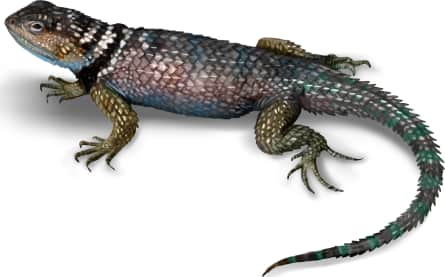
Grey & black bands may have blue highlights. Their overall coloration may be shades of brown and tan, rather than black and grey.
Similar species
Similar to the crevice swift (*Sceloporus torquatus*) or blue spiny lizard (*Sceloporus cyanogenys*) which are often more colorful and lack distinct banding patterns. These species are not likely to overlap in range.
Name and etymology
Genus
Sceloporus
Greek for leg (skelos) pores (porus), referencing femoral pores on back legs.
Origin
Sources
- Wiegmann, 1828. Isis von Oken, Vol. 21, p. 369 ↗
Sceloporus. Wiegmann, 1828 - Isis von Oken, Vol. 21, p. 369
Species epithet
poinsettii
Honoring Joel R. Poinsett.
Origin
Honors
Sources
- Baird and Girard, 1852. Proc. Acad. Nat. Sci. Philadelphia, Vol. 6, p. 126 ↗
Sceloporus poinsettii. Baird and Girard, 1852 - Proc. Acad. Nat. Sci. Philadelphia, Vol. 6, p. 126
Explore more names in the etymology index.
At a glance
Range
The Chihuahuan Desert from central Texas through the panhandle, and into southern New Mexico and north central Mexico.
Habitat
These lizards are found in semi-arid rocky areas with lots of crevices for hiding.
Guide
Reptiles and Amphibians of North America
Range map
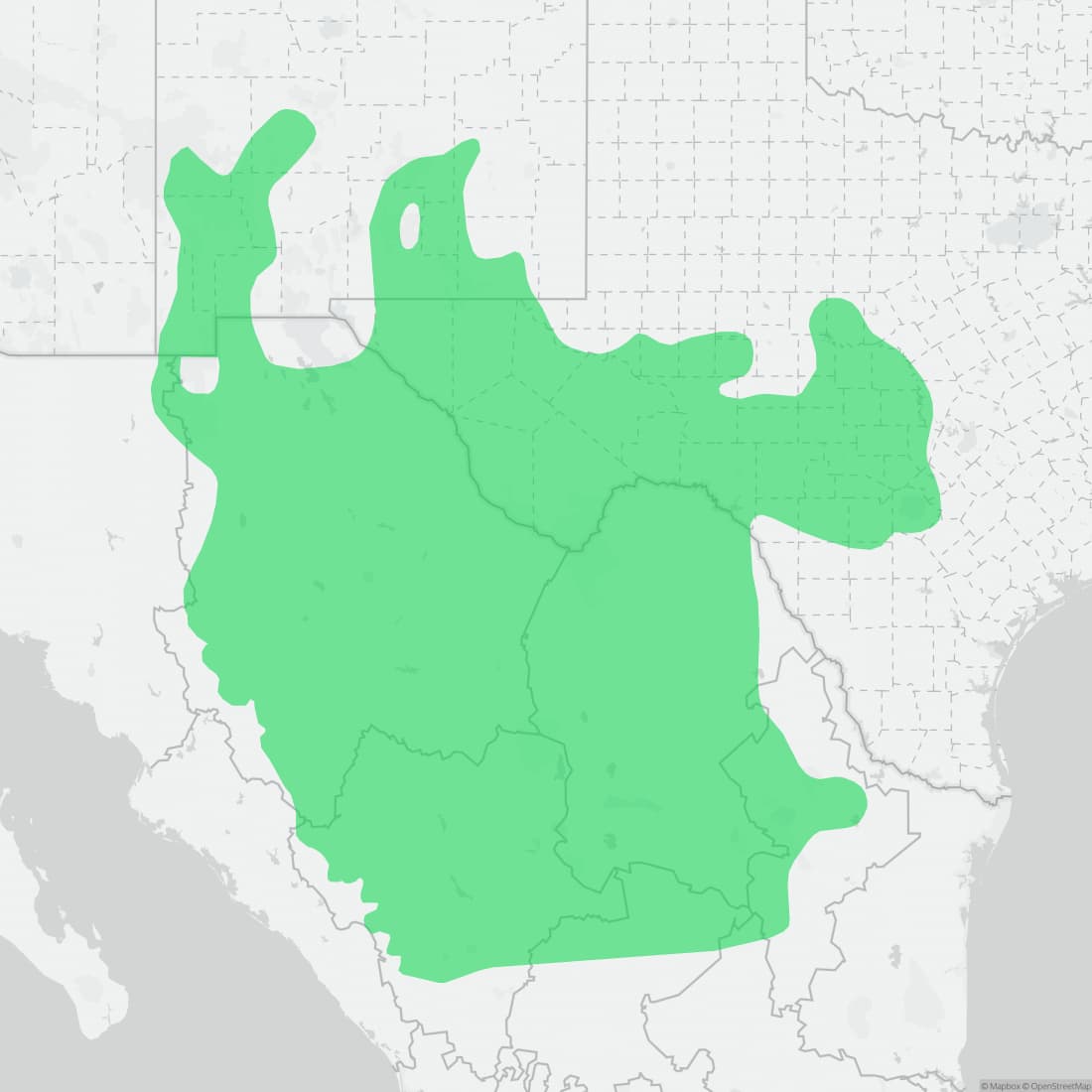
Approximate range. © Mapbox © OpenStreetMap