Peninsular Leaf-toed Gecko
Phyllodactylus nocticolus
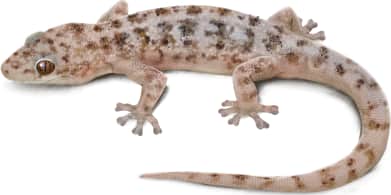
This gecko averages 4-6.3 cm from snout to vent. It has a narrow tail that is round in cross-section. Its head is also somewhat narrow with an elongated, pointed snout. I…
How to identify
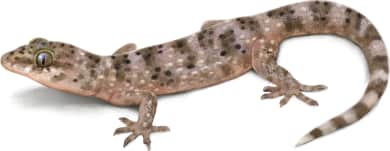
This gecko averages 4-6.3 cm from snout to vent. It has a narrow tail that is round in cross-section. Its head is also somewhat narrow with an elongated, pointed snout. It has large, golden-flecked eyes with vertical, slit-like pupils. It lacks movable eyelids. Its scales are soft and granular, with some small bumps down the sides of its back. It is pinkish-white with a mottled, dark grey pattern on its dorsal surfaces, resembling the surface of granite. Its ventrum is white and unmarked, and mildly translucent. The tips of its toes are bi-lobed with specialized plantar scales for gripping almost any surface.
Range
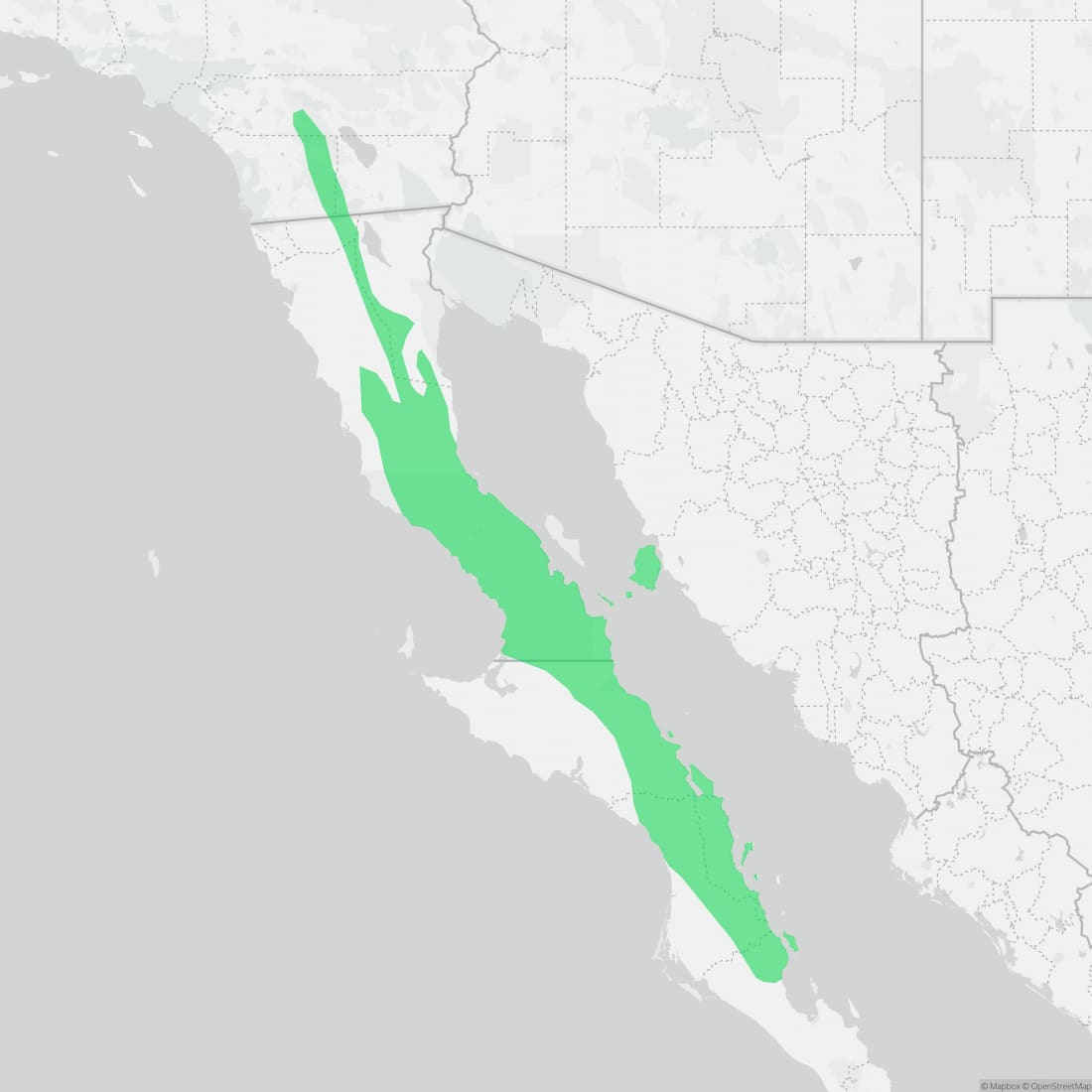
Ranges through most of the Baja Peninsula, and a small strip of south central California.
Habitat
This gecko prefers rocky areas within desert scrub and chaparral habitats. It often hides in rock crevices and between slabs of deteriorating rock. It especially likes large boulder piles in canyons or near springs and streams.
Variations
Some have very pale, faint markings and appear mostly white and more translucent. Some have a grey background color and are darker all over.
Similar species
Most likely to be mistaken for the non-native Mediterranean house gecko (*Hemidactylus turcicus*).
Name and etymology
Genus
Phyllodactylus
Greek for leaf (phyllon) fingers (daktylos).
Origin
Sources
- Gray, 1830. Spicileg. Zool., p. 3
Phyllodactylus. Gray, 1830 - Spicileg. Zool., p. 3
Species epithet
nocticolus
Latin for of the night or nocturnal.
Origin
Sources
- Dixon, 1964. New Mexico State Univ. Sci. Bull, Vol. 64, No. 1, p. 55
Phyllodactylus nocticolus. Dixon, 1964 - New Mexico State Univ. Sci. Bull, Vol. 64, No. 1, p. 55
Explore more names in the etymology index.
At a glance
Range
Ranges through most of the Baja Peninsula, and a small strip of south central California.
Habitat
This gecko prefers rocky areas within desert scrub and chaparral habitats. It often hides in rock crevices and between slabs…
Guide
Reptiles and Amphibians of North America
Range map
Approximate range. © Mapbox © OpenStreetMap