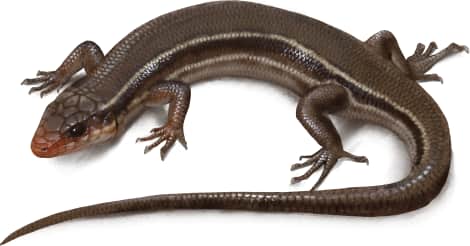
Common Five-lined Skink
Plestiodon fasciatus
Growing to a total length of 5-8.5 inches, this skink is more colorful and patterned when it's young. They start out dark brown with 5 distinct light lines running the le…
How to identify
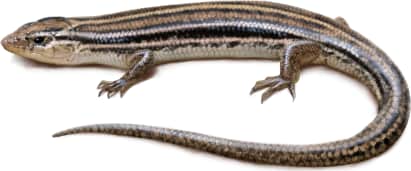
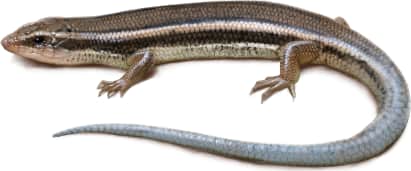
Growing to a total length of 5-8.5 inches, this skink is more colorful and patterned when it's young. They start out dark brown with 5 distinct light lines running the length of their body, merging at the end of their bright blue tail. With age, they transform into a uniform brown and the lines often fade, but they develop an orange-red throat and face.
Range
Common throughout most of the eastern half of the United States, and southeastern Ontario, Canada.
Habitat
Found in moist, partially wooded areas with lots of debris for taking cover on the ground. They can also be found hiding in the walls of buildings, or in rocky habitats.
Variations
The blue coloration sometimes appears in the lines on their body, in addition to their tail. The light lines vary from white to yellow.
Similar species
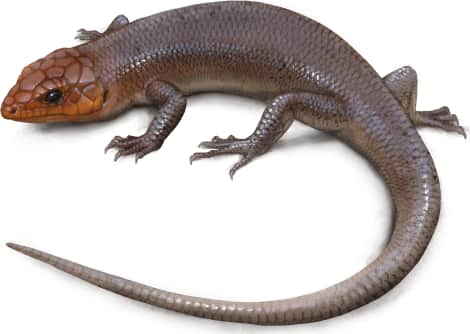
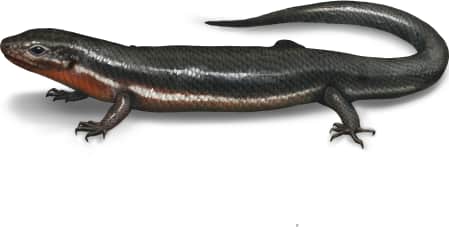
There are several other North American species of skink that have similar colors and patterns, including the Southeastern five-lined skink (*Plestiodon inexpectatus*), broadhead skink (*Plestiodon laticeps*), coal skink (*Plestiodon anthracinus*), and prairie skink (*Plestiodon septentrionalis*) which can overlap in range, or the western skink (*Plestiodon skiltonianus*) which does not overlap.
Name and etymology
Genus
Plestiodon
Greek for most (pleistos) teeth (odontos).
Origin
Sources
- Wiegmann, 1834. Herp. Mex., p. 36
Eumeces. Wiegmann, 1834 - Herp. Mex., p. 36
Species epithet
fasciatus
Latin for banded or striped.
Origin
Sources
- (Linnaeus, 1758). Syst. Nat., 10th ed., Vol. 1, p. 209 ↗
Eumeces fasciatus. (Linnaeus, 1758) - Syst. Nat., 10th ed., Vol. 1, p. 209
Explore more names in the etymology index.
More illustrations
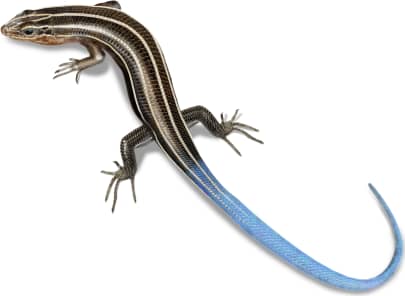
Juvenile Five-lined Skink
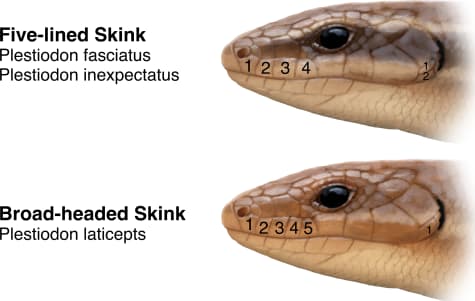
Broad-headed vs Five-lined Skinks
At a glance
Size
12.7 to 21.6 cm
Range
Common throughout most of the eastern half of the United States, and southeastern Ontario, Canada.
Habitat
Found in moist, partially wooded areas with lots of debris for taking cover on the ground. They can also be found hiding in t…
Range map
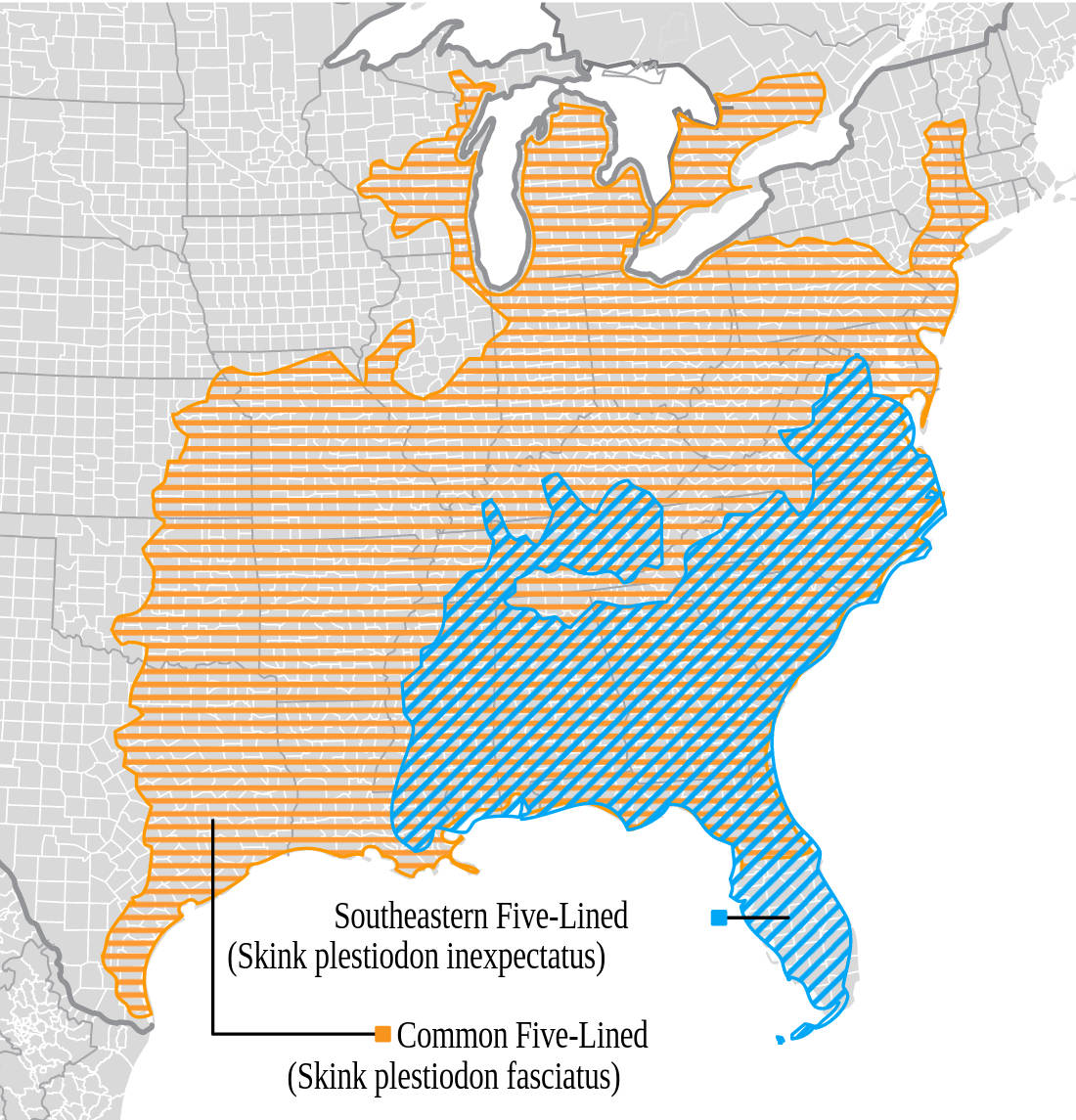
Approximate range. © Mapbox © OpenStreetMap