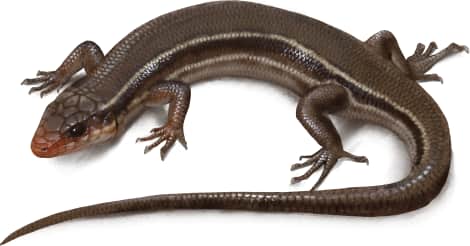
Southeastern Five-lined Skink
Plestiodon inexpectatus
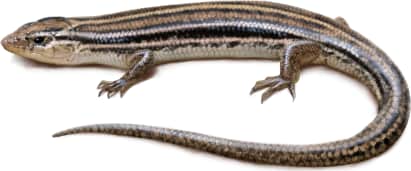
Usually range from 5.5 to 8.5 inches in length. Bodies display five thin lines that run vertically; lines can be either cream, orange, or white in color. Dorsum can be b…
How to identify
Usually range from 5.5 to 8.5 inches in length. Bodies display five thin lines that run vertically; lines can be either cream, orange, or white in color. Dorsum can be brown or black. During breeding season, sexually mature males exhibit orangish hues on head. Clutches usually range from 3 to 10 eggs.
Range
Southeastern and south-central United States; southern Maryland south through Florida and spanning westward to eastern Louisiana, Mississippi, Tennessee, and Kentucky.
Habitat
Inhabits sandy areas, islands, woodlands, scrub, and sometimes empty buildings. Usually hide under logs, rocks, stumps, and general vegetative debris. Females also use these natural covers to lay eggs. Can live in areas without fresh water and any vegetation.
Variations
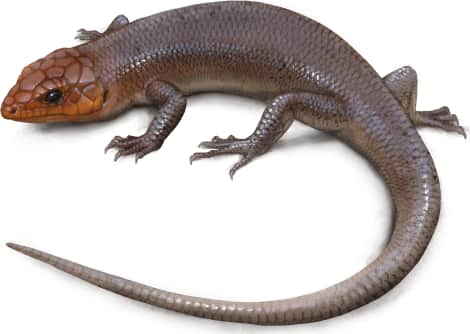
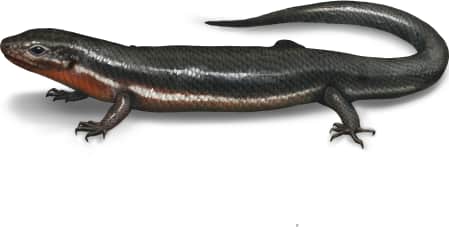
Younger individuals exhibit darker stripes than older individuals; areas between stripes are black in younger individuals but become brown in color as they age. Young exhibit blue-colored tail that can last into maturity.
Similar species
Name and etymology
Genus
Plestiodon
Greek for most (pleistos) teeth (odontos).
Origin
Sources
- Wiegmann, 1834. Herp. Mex., p. 36
Eumeces. Wiegmann, 1834 - Herp. Mex., p. 36
Species epithet
inexpectatus
Latin for unexpected, possibly referencing the unexpected discovery almost 175 years after Plestiodon fasciatus was described, commonly known as the American five-lined skink.
Origin
Sources
- Taylor, 1932. Sci. Bull. Univ. Kansas, Vol. 20, No. 13, p. 251
Eumeces inexpectatus. Taylor, 1932 - Sci. Bull. Univ. Kansas, Vol. 20, No. 13, p. 251
Explore more names in the etymology index.
More illustrations
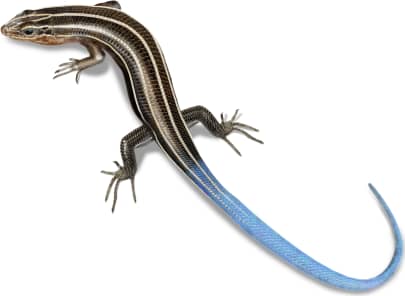
Juvenile Five-lined Skink
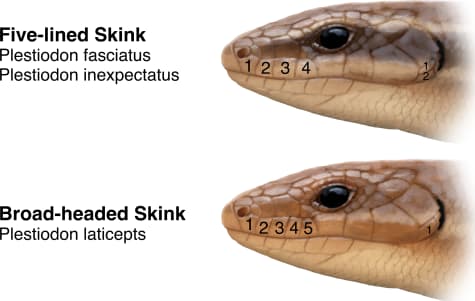
Broad-headed vs Five-lined Skinks
At a glance
Range
Southeastern and south-central United States; southern Maryland south through Florida and spanning westward to eastern Louisi…
Habitat
Inhabits sandy areas, islands, woodlands, scrub, and sometimes empty buildings. Usually hide under logs, rocks, stumps, and g…
Guide
Reptiles and Amphibians of North America
Range map
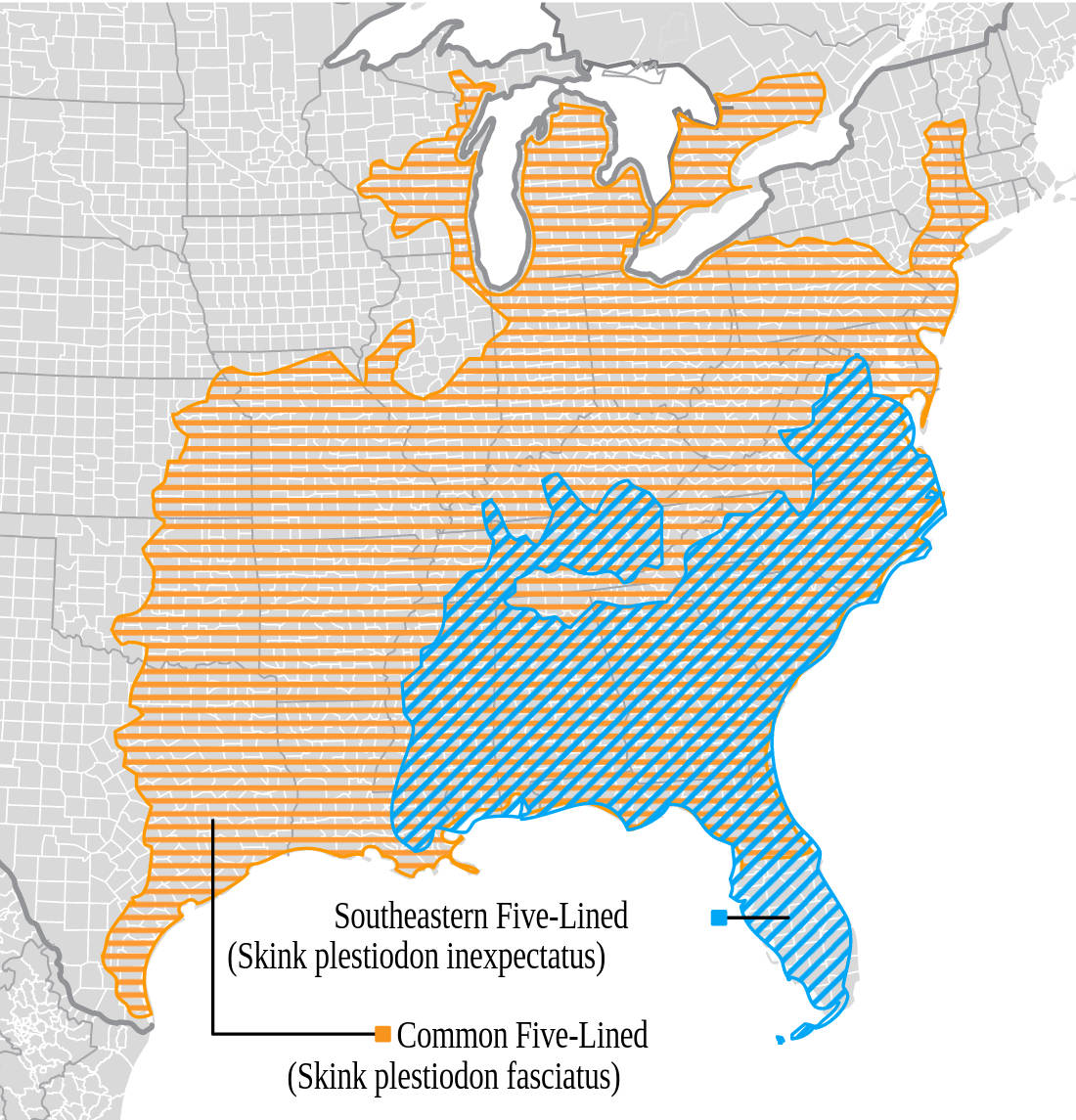
Approximate range. © Mapbox © OpenStreetMap