Many-lined Skink
Plestiodon multivirgatus
This mid-sized skink averages 7.5 inches in total length. It is known for its long tail that can be twice its body length, and its numerous black longitudinal stripes. Li…
How to identify
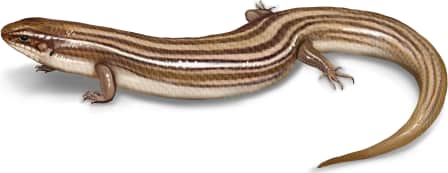
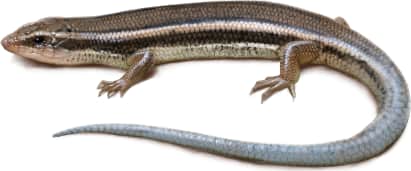
This mid-sized skink averages 7.5 inches in total length. It is known for its long tail that can be twice its body length, and its numerous black longitudinal stripes. Like most skinks, it has a thick torpedo-like body with small legs set far apart, and smooth shiny scales. One subspecies is olive grey with multiple black lines, while the other subspecies has 2 white dorsolateral stripes in addition to the many black lines. Juveniles have a bright blue tail that fades to olive grey and develops black lines with age.
Range
In the central plains region, this species ranges from southern South Dakota through western Nebraska, southeastern Wyoming, and northeastern Colorado. Range then stretches to southwestern Colorado into southeastern Utah, northeastern Arizona, most of New Mexico, and into west Texas.
Habitat
The subspecies *P. m. multivirgatus* is found in the northern plains region and prefers sandy substrate. The other subspecies, *P. m. epipleurotus*, lives in the southwest region and is found in rocky areas at higher elevations. It often hides beneath ground debris and can be found in grasslands and wooded areas.
Variations
The black lines can be faded or absent in some individuals. Some lines appear more like rows of speckles, rather than distinct stripes. Some breeding males develop orange coloration around their lips.
Similar species
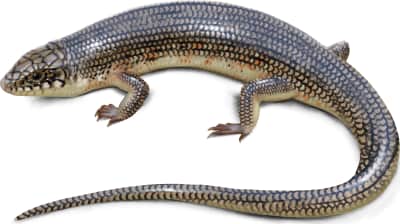
Most likely to be confused with the great plains skink (*Plestiodon obsoletus*), which shares much of the same range. It could also be mistaken for the western skink (*Plestiodon skiltonianus*), which may overlap in the southwest.
Name and etymology
Genus
Plestiodon
Greek for most (pleistos) teeth (odontos).
Origin
Sources
- Wiegmann, 1834. Herp. Mex., p. 36
Eumeces. Wiegmann, 1834 - Herp. Mex., p. 36
Species epithet
multivirgatus
Latin for many (multi) stripes (virgatus), referencing its many longitudinal stripes.
Origin
Sources
- (Hallowell, 1857). Proc. Acad. Nat. Sci. Philadelphia, Vol. 9, p. 215 ↗
Eumeces multivirgatus. (Hallowell, 1857) - Proc. Acad. Nat. Sci. Philadelphia, Vol. 9, p. 215
Explore more names in the etymology index.
At a glance
Range
In the central plains region, this species ranges from southern South Dakota through western Nebraska, southeastern Wyoming,…
Habitat
The subspecies *P. m. multivirgatus* is found in the northern plains region and prefers sandy substrate. The other subspecies…
Guide
Reptiles and Amphibians of North America
Range map
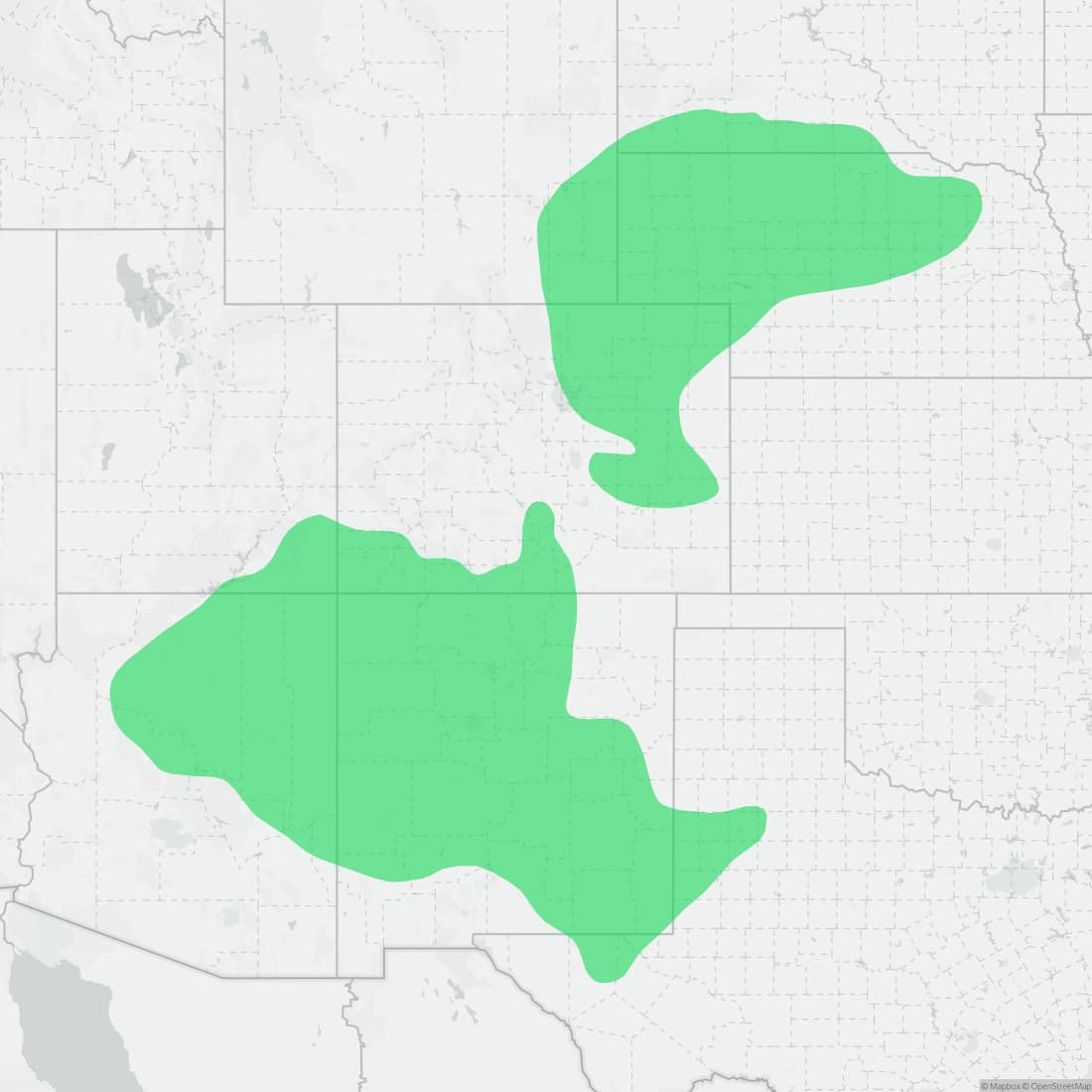
Approximate range. © Mapbox © OpenStreetMap