Great Plains Skink
Plestiodon obsoletus
The Great Plains skink is one of the biggest skinks in the Plestiodon genus with average length ranges of 3.94 – 5.51 inches (snout-to-vent length). The lizard is stout w…
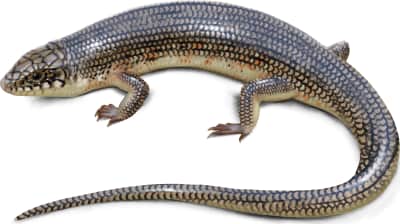
How to identify
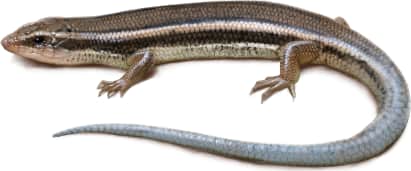
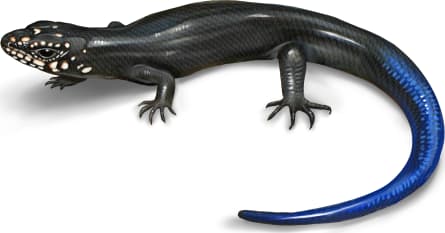
The Great Plains skink is one of the biggest skinks in the Plestiodon genus with average length ranges of 3.94 – 5.51 inches (snout-to-vent length). The lizard is stout with a thick tail and short limbs. It has a shiny body with a ground color of cream, light gray, olive, beige or tan. They possess conspicuously clawed toes and feet covered in scales. Dark markings shaped like crescents form a net-like pattern over most of the body excluding the head. Some specimens have the black markings resembling flecks or spots or even grouping to form patches. There is a yellow or yellow-orange tint on the tail and limbs and orange spots at the lower sides of the body. The underside has a cream coloration. Juveniles are black with a blue tail and white or pale yellow spots on the lips. Juveniles have a gray underside.
Range
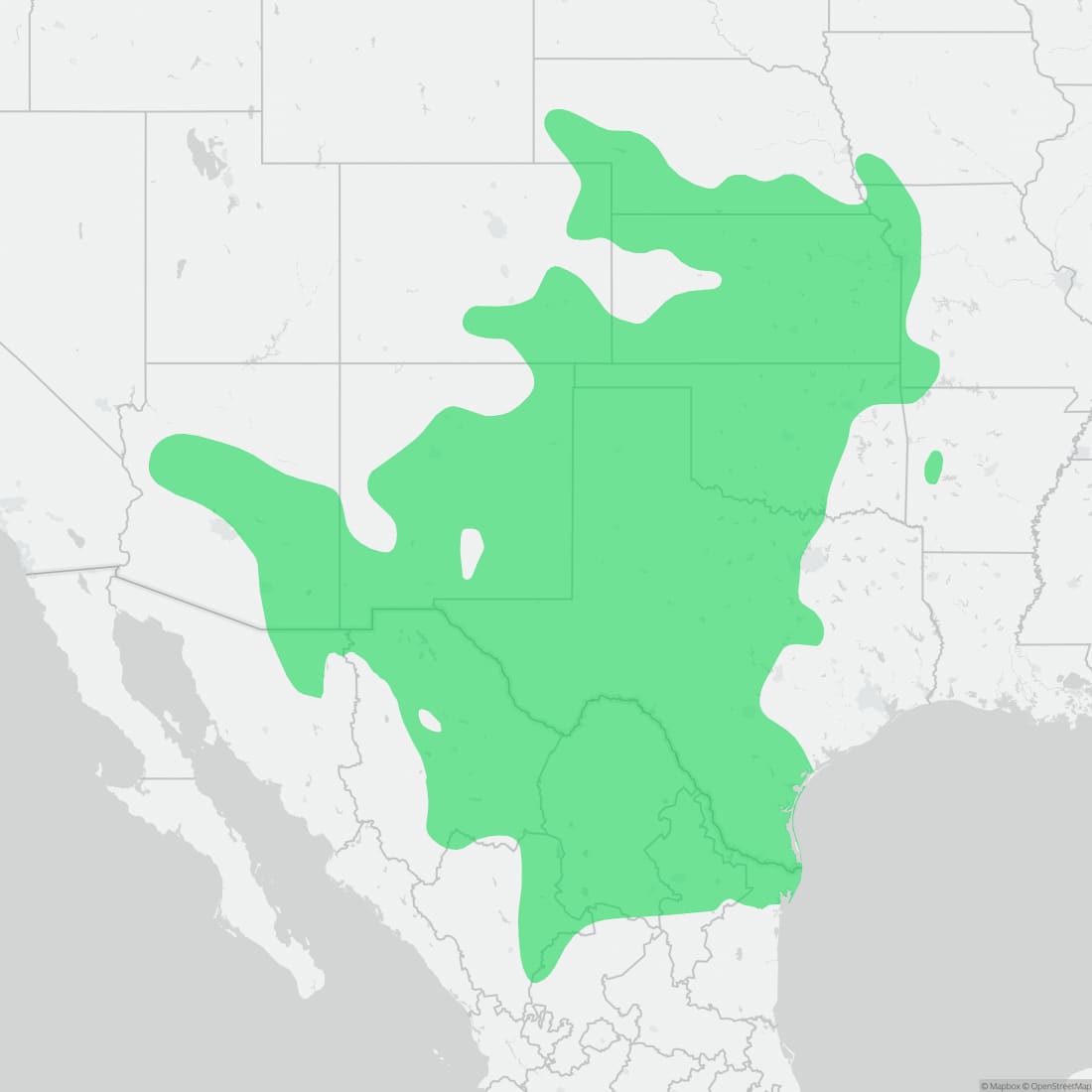
The range of the Great Plains skink starts at the west of Missouri and extends to northwest Arkansas and runs into southeastern and eastern Arizona. This skink can be found in southern parts of Nebraska and its range stops in northern Mexico. In summary, this skink’s range includes Nebraska, Arizona, New Mexico, Colorado, Missouri, Oklahoma, Texas, and Arkansas.
Habitat
These skinks can be found in a variety of diverse habitat including semi-desert grasslands, mixed woodland, forests, canyons, mountain slopes, and open hillsides. They seem to prefer moist places but are not limited to just those environments. Specimens in the southwest mostly thrive in rocky terrain. When rocks or cover is absent, Great Plains skins will burrow or use other mammal burrows for shelter. Their diet consists only of invertebrates including insects, arachnids, gastropods, and arthropods. They consume grasshoppers, crickets, beetles and insect larvae. Mating occurs in late April and early May. The eggs are laid in June (clutches of 7 – 24 eggs) and take 40 days to hatch.
Similar species
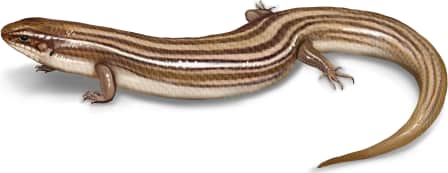
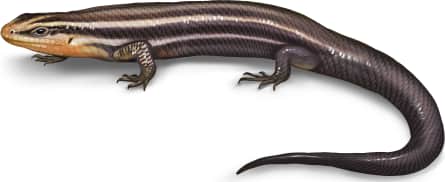
The Four-lined Skink or Plestiodon tetragrammus has two major subspecies that still resemble the P. obsoletus especially with the shiny scales and the blue-tailed juveniles. However, the brown-favored coloration of the P. tetragrammus is one crucial difference. Another is the pattern of light stripes that run from the eyes to the forelegs. The Many-lined Skink or Plestiodon multivirgatus while also having similar shiny scales and olive-brown coloration, is unmistakably smaller at 3.0 inches (snout-to-vent length). It also has black stripes that run the length of the body and tail. Western Skink or Plestiodon skiltonianus is much smaller with a pattern of broad, brown or black band that starts at the side of the head and extends past its hind legs.
Name and etymology
Genus
Plestiodon
Greek for most (pleistos) teeth (odontos).
Origin
Sources
- Wiegmann, 1834. Herp. Mex., p. 36
Eumeces. Wiegmann, 1834 - Herp. Mex., p. 36
Species epithet
obsoletus
Latin for worn out, referencing its absence of dorsal lines.
Origin
Sources
- (Baird and Girard, 1852). Proc. Acad. Nat. Sci. Philadelphia, Vol. 6, p. 129 ↗
Eumeces obsoletus. (Baird and Girard, 1852) - Proc. Acad. Nat. Sci. Philadelphia, Vol. 6, p. 129
Explore more names in the etymology index.
More illustrations
Juvenile
At a glance
Size
100 to 140 mm
Range
The range of the Great Plains skink starts at the west of Missouri and extends to northwest Arkansas and runs into southeaste…
Habitat
These skinks can be found in a variety of diverse habitat including semi-desert grasslands, mixed woodland, forests, canyons,…
Range map
Approximate range. © Mapbox © OpenStreetMap