Northern Slimy Salamander
Plethodon glutinosus
A somewhat thick-bodied salamander averaging 5-7 inches in total length. It has 16-17 costal grooves and a wide, flat head. Its legs are well-developed but thin, and its…
How to identify
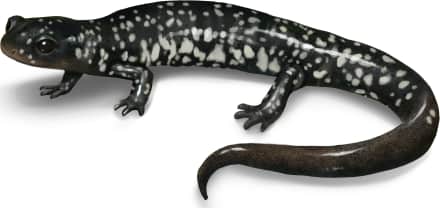
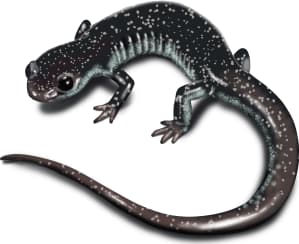
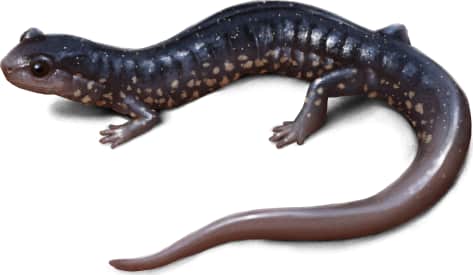
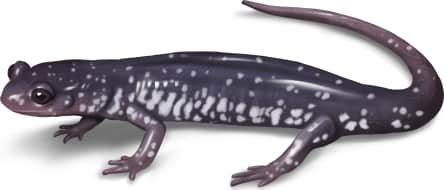
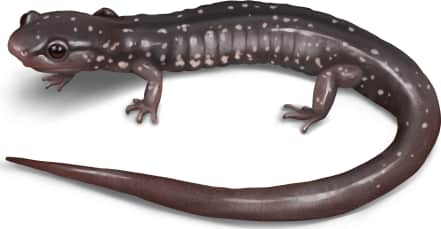
A somewhat thick-bodied salamander averaging 5-7 inches in total length. It has 16-17 costal grooves and a wide, flat head. Its legs are well-developed but thin, and its tail is round in cross-section. It is dark grey to black with whitish spots and blotches all over its body. These light markings tend to be more numerous on its sides.
Range
Wide-ranging in the eastern United States from central New York to central Alabama and Georgia, west to southern Illinois, and excluding most of the coastal states from Delaware to South Carolina. Disjunct populations exist in southern New Hampshire and northwestern Connecticut.
Habitat
Like many salamanders, this species is most often found in moist leaf litter, under rotting logs or rocks, or within abandoned burrows near bodies of fresh water. It prefers habitat within mature hardwood forests and old pine stands.
Variations
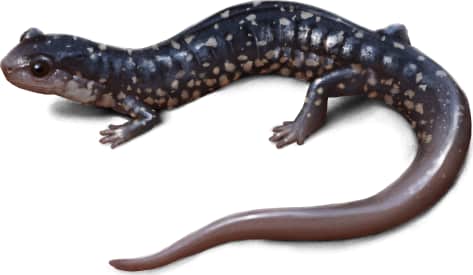
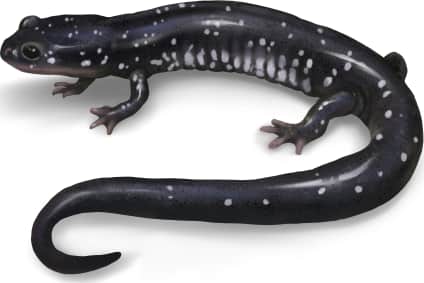
Spots range in color from white to silver to gold. Some are heavily spotted, while others have sparse patterning.
Similar species
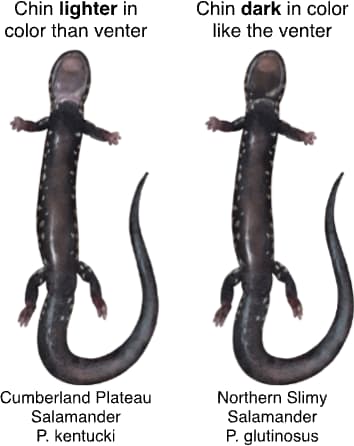
Many other species within the *Plethodon* genus are similar in appearance, including but not limited to the white-spotted slimy salamander (*Plethodon cylindraceus*), Mississippi slimy salamander (*Plethodon cylindraceus*), southern Appalachian salamander (*Plethodon teyahalee*), Cumberland Plateau salamander (*Plethodon kentucki*), southeastern slimy salamander (*Plethodon grobmani*), Atlantic coast slimy salamander (*Plethodon chlorobryonis*), and Tellico salamander (*Plethodon aureolus*).
Name and etymology
Genus
Plethodon
Greek for full of (plethore) teeth (odon).
Origin
Sources
- Tschudi, "1838" 1839. reprinted in Classif. Batr., Mem. Soc. Sci. Nat. Neuchatel, p. 92 ↗
Plethodon. Tschudi, "1838" 1839 - reprinted in Classif. Batr., Mem. Soc. Sci. Nat. Neuchatel, p. 92
Species epithet
glutinosus
Latin for gluey, referencing its sticky skin.
Origin
Sources
- (Green, 1818). Journ. Acad. Nat. Sci. Philadelphia, Vol. 1, No. 1, p. 357 ↗
Plethodon glutinosus. (Green, 1818) - Journ. Acad. Nat. Sci. Philadelphia, Vol. 1, No. 1, p. 357
Explore more names in the etymology index.
More illustrations
At a glance
Range
Wide-ranging in the eastern United States from central New York to central Alabama and Georgia, west to southern Illinois, an…
Habitat
Like many salamanders, this species is most often found in moist leaf litter, under rotting logs or rocks, or within abandone…
Guide
Reptiles and Amphibians of North America
Range map
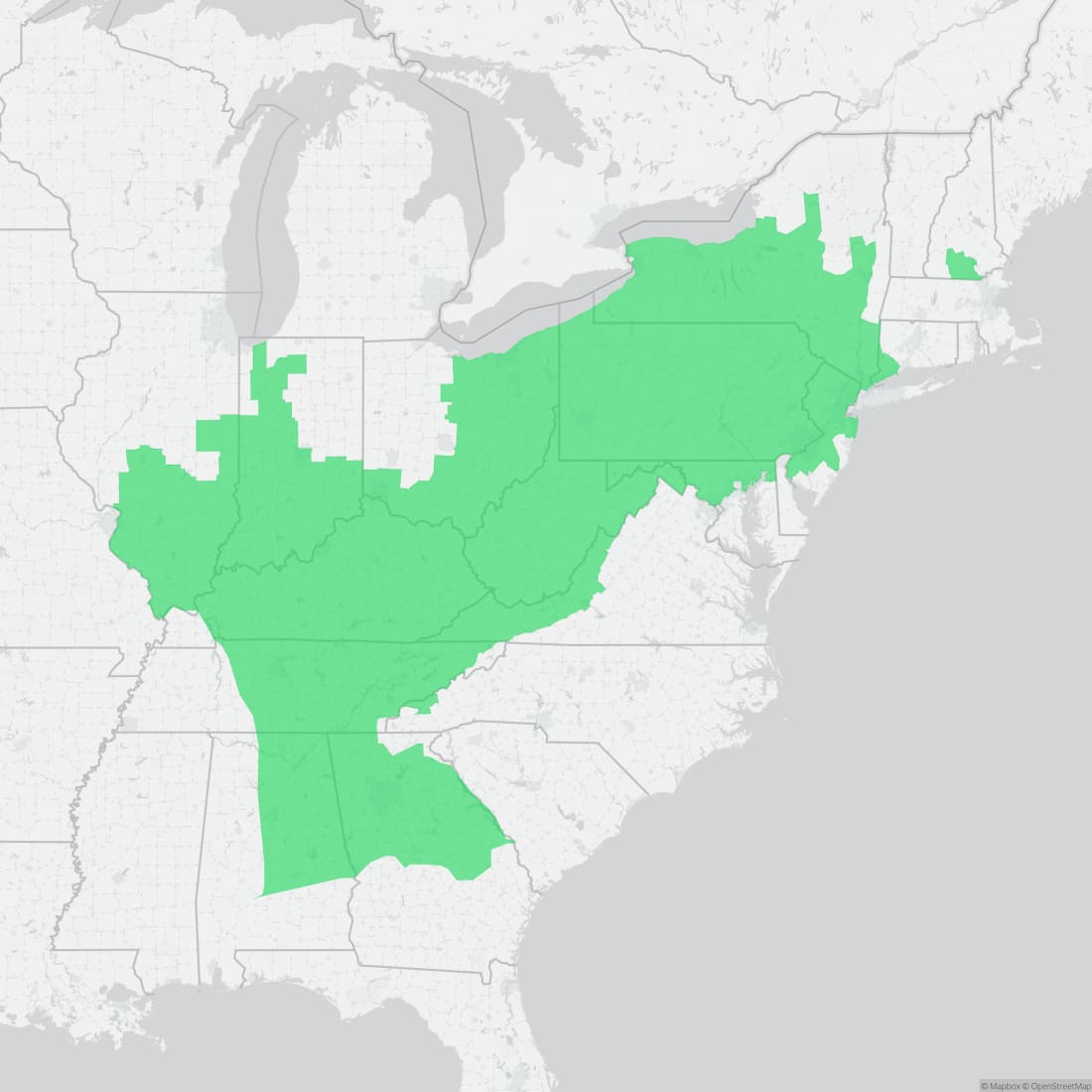
Approximate range. © Mapbox © OpenStreetMap