Ravine Salamander
Plethodon richmondi
This salamander appears as a “worm with legs”. It is very long and slender but has short legs and the tail makes up to half of its total body length. When it reaches adul…
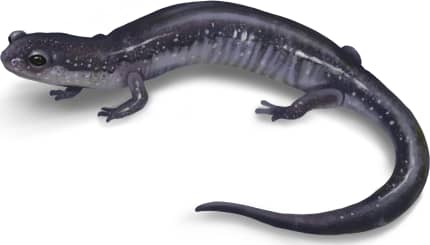
How to identify
This salamander appears as a “worm with legs”. It is very long and slender but has short legs and the tail makes up to half of its total body length. When it reaches adult stage, it can grow up to 75mm to 140mm. The male is distinct from the female by being larger in size and also having a conspicuous mental gland on its chin. The color of the dorsum is seal brown to a near black and sprinkled with silvery-white and bronze speckles. Its sides have very small irregular white blotches and presence of about 20- 33 coastal grooves. The underbelly is dark gray with lighter gray speckles and this feature causes the chin to look heavily mottled. It is also ectothermic
Range
It ranges from western Pennsylvania to Indiana, southern West Virginia, western Virginia, northwestern North Carolina and northeastern Tennessee in the United States of America.
Habitat
It is associated with the temperate slopes of woodland ravine and valleys and gets its general name from this. It can be found under a flat rock, and during hot summers they burrow deep into the ground. The ravine salamander resumes its mating period in autumn through early spring. Its female reproduces biennially, it oviposits (around June) in deep underground passageways and will brood their eggs till they hatch. When its eggs hatch in late summer (August and September) the hatchlings will stay underground and usually move up to ground in the following spring. When rattled or uncovered in a field, they camouflage by pretending to be dead or motionless in order to convince an intruder that it isn’t there. This species feeds mainly on small insects, the likes of ants and beetles but they are prey to reptiles like the ringneck snake, their major predator. It aestivates in July and August and in February it hibernates.
Similar species
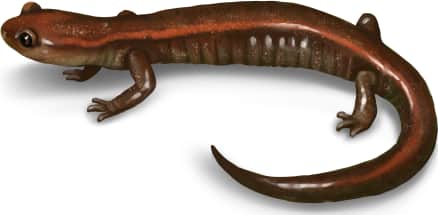
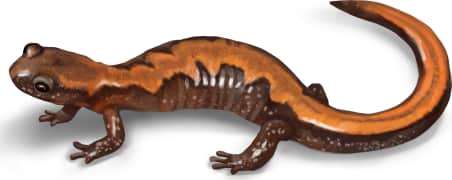
California slender salamander or Butrachoseps attenuatus is typically 70mm- 130mm in total length. There are about 18-22 costal grooves on this species and although conspicuous, they help give it its worm-like characteristic look. Dorsal color is black and has a stripe that looks reddish or brownish. It's ventral color is dark but has whitish spotting patterning it. Northern Ravine Salamander or Plethodon electromorphus is small and has short-legs and similar in both shape and size to certain other salamanders like the red Zigzag salamander because it also has a worm-like body feature. It can grow up to 105mm in adult stage. It has a gray black or a dark brown coloration and lacks a dorsal stripe. The Zigzag Salamander or Plethodon dorsalis characteristics include a reddish or yellowish back stripe which is broadly zigzagging down it's dorsum. It has 16-18 coastal groves and grows to a total length of 110mm in adult life.
Name and etymology
Genus
Plethodon
Greek for full of (plethore) teeth (odon).
Origin
Sources
- Tschudi, "1838" 1839. reprinted in Classif. Batr., Mem. Soc. Sci. Nat. Neuchatel, p. 92 ↗
Plethodon. Tschudi, "1838" 1839 - reprinted in Classif. Batr., Mem. Soc. Sci. Nat. Neuchatel, p. 92
Species epithet
richmondi
Honoring Neil Dwight Richmond.
Origin
Honors
Sources
- Netting and Mittleman, 1938. Ann. Carnegie Mus., Vol. 27, p. 288, pl. 30, fig. 1 ↗
Plethodon richmondi. Netting and Mittleman, 1938 - Ann. Carnegie Mus., Vol. 27, p. 288, pl. 30, fig. 1
Explore more names in the etymology index.
At a glance
Range
It ranges from western Pennsylvania to Indiana, southern West Virginia, western Virginia, northwestern North Carolina and nor…
Habitat
It is associated with the temperate slopes of woodland ravine and valleys and gets its general name from this. It can be foun…
Guide
Reptiles and Amphibians of North America
Range map
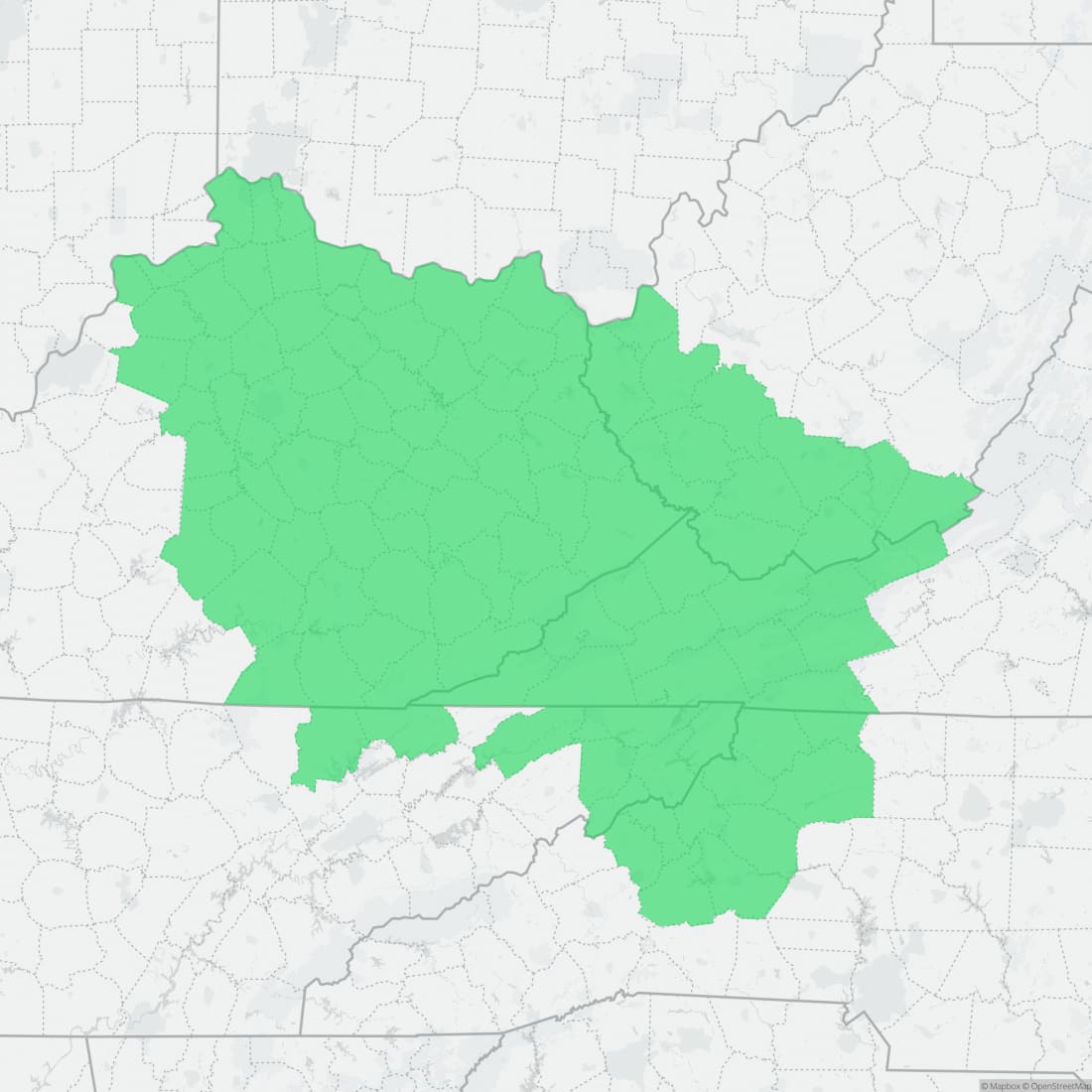
Approximate range. © Mapbox © OpenStreetMap