Northern Zigzag Salamander
Plethodon dorsalis
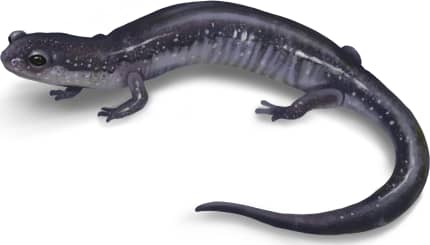
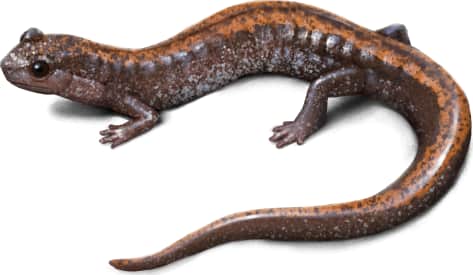
A small, slender salamander that averages 3.5-5 cm in snout to vent length. Some individuals have a zigzag-shaped dorsal stripe, for which the species is named. It has sl…
How to identify
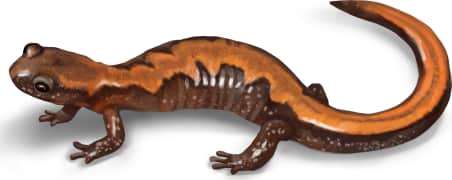
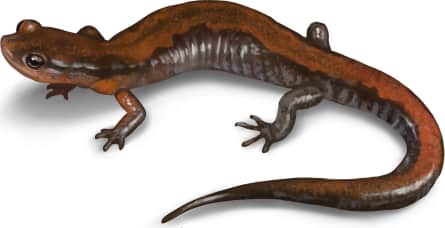
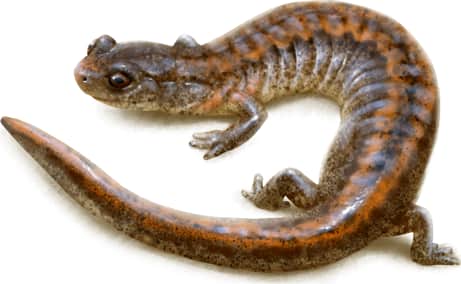
A small, slender salamander that averages 3.5-5 cm in snout to vent length. Some individuals have a zigzag-shaped dorsal stripe, for which the species is named. It has slender legs and its tail is about the same length as its body. The dorsal stripe is usually light brown to orange, and the background coloration is grey or brown with tiny white speckles. Many individuals lack the dorsal stripe and are solid grey or brown with white frosting. Its ventrum is light grey with dense white speckling.
Range
Central Indiana to central Alabama, including most of Kentucky and Tennessee, and adjacent areas of eastern and southern Illinois and northeastern Mississippi.
Habitat
This salamander prefers moist talus slopes or caves, and will also live in leaf litter on wooded hillsides, ravines, or in sinkholes.
Variations
The dorsal stripe is sometimes straight-edged instead of zigzag, or it is completely absent.
Similar species
Most similar to the southern zigzag salamander (*Plethodon ventralis*) or Webster's salamander (*Plethodon websteri*). It could also be confused with the southern ravine salamander (*Plethodon richmondi*) or eastern red-backed salamander (*Plethodon cinereus*).
Name and etymology
Genus
Plethodon
Greek for full of (plethore) teeth (odon).
Origin
Sources
- Tschudi, "1838" 1839. reprinted in Classif. Batr., Mem. Soc. Sci. Nat. Neuchatel, p. 92 ↗
Plethodon. Tschudi, "1838" 1839 - reprinted in Classif. Batr., Mem. Soc. Sci. Nat. Neuchatel, p. 92
Species epithet
dorsalis
Latin for of the back.
Origin
Sources
- Dumeril and Bibron, 1841. Erp. Gen., Vol. 8, p. 758 ↗
Rhinophrynus dorsalis. Dumeril and Bibron, 1841 - Erp. Gen., Vol. 8, p. 758
- Cope, 1889. Bull. U. S. Natl. Mus., No. 34, p. 138 ↗
Plethodon dorsalis. Cope, 1889 - Bull. U. S. Natl. Mus., No. 34, p. 138
Explore more names in the etymology index.
At a glance
Range
Central Indiana to central Alabama, including most of Kentucky and Tennessee, and adjacent areas of eastern and southern Illi…
Habitat
This salamander prefers moist talus slopes or caves, and will also live in leaf litter on wooded hillsides, ravines, or in si…
Guide
Reptiles and Amphibians of North America
Range map
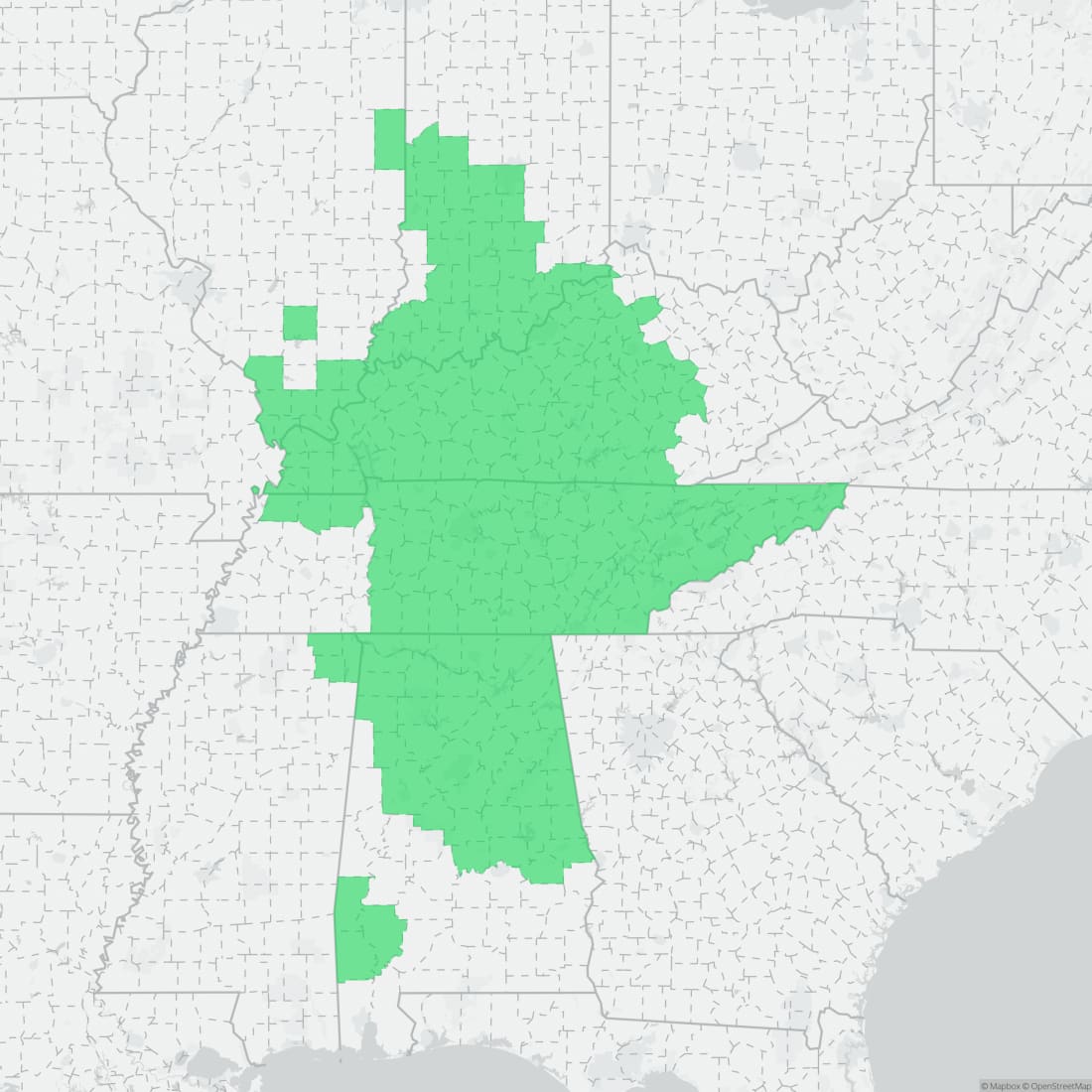
Approximate range. © Mapbox © OpenStreetMap