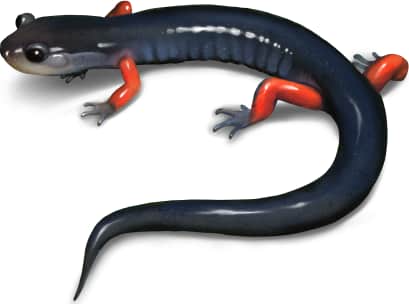
Red-legged Salamander
Plethodon shermani
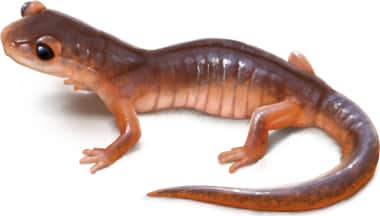
This salamander is mostly slate grey with contrasting bright orange coloration on all 4 legs. This orange coloration is sometimes solid, but often patchy. It averages 3-7…
How to identify
This salamander is mostly slate grey with contrasting bright orange coloration on all 4 legs. This orange coloration is sometimes solid, but often patchy. It averages 3-7 inches in total length and has 16 very obvious costal grooves. It has a pale gray venter, flattened head, and a thick, round tail.
Range
Small range in the southwest corner of North Carolina, spilling slightly into adjacent areas of southeastern Tennessee and northeastern Georgia.
Habitat
During the day, this salamander hides under rocks and logs. It emerges at night to forage on the forest floor. It prefers cool, humid environments at high elevations (850-1500 meters).
Variations
Pale grey ventral color sometimes extends dorsally onto the salamander's sides and cheeks. One isolated population in the Unicoi Mountains rarely displays the red coloration, but instead has white lateral spotting.
Similar species
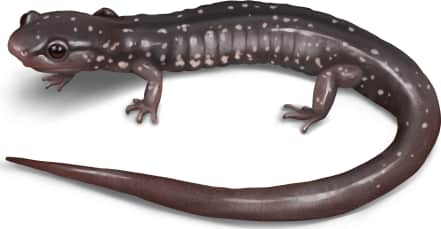
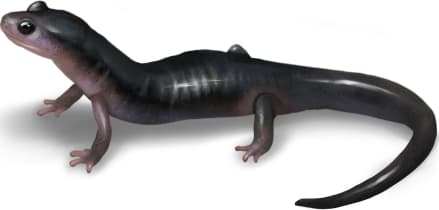
Individuals which lack red legs and have white spotting can be mistaken for the southern Appalachian salamander (*Plethodon teyahalee*). Solid grey individuals look very much like the overlapping southern gray-cheeked salamander (*Plethodon metcalfi*). The ensatina (*Ensatina eschscholtzii*) lives on the west coast, but can have similar grey coloration with orange legs.
Name and etymology
Genus
Plethodon
Greek for full of (plethore) teeth (odon).
Origin
Sources
- Tschudi, "1838" 1839. reprinted in Classif. Batr., Mem. Soc. Sci. Nat. Neuchatel, p. 92 ↗
Plethodon. Tschudi, "1838" 1839 - reprinted in Classif. Batr., Mem. Soc. Sci. Nat. Neuchatel, p. 92
Species epithet
shermani
Honoring Franklin Sherman Jr.
Origin
Honors
Sources
- Brimley 1912. Proc. Biol. Soc. Wash. 25:135
Plethodon shermani. Brimley 1912. Proc. Biol. Soc. Wash. 25:135
Explore more names in the etymology index.
At a glance
Range
Small range in the southwest corner of North Carolina, spilling slightly into adjacent areas of southeastern Tennessee and no…
Habitat
During the day, this salamander hides under rocks and logs. It emerges at night to forage on the forest floor. It prefers coo…
Guide
Reptiles and Amphibians of North America
Range map
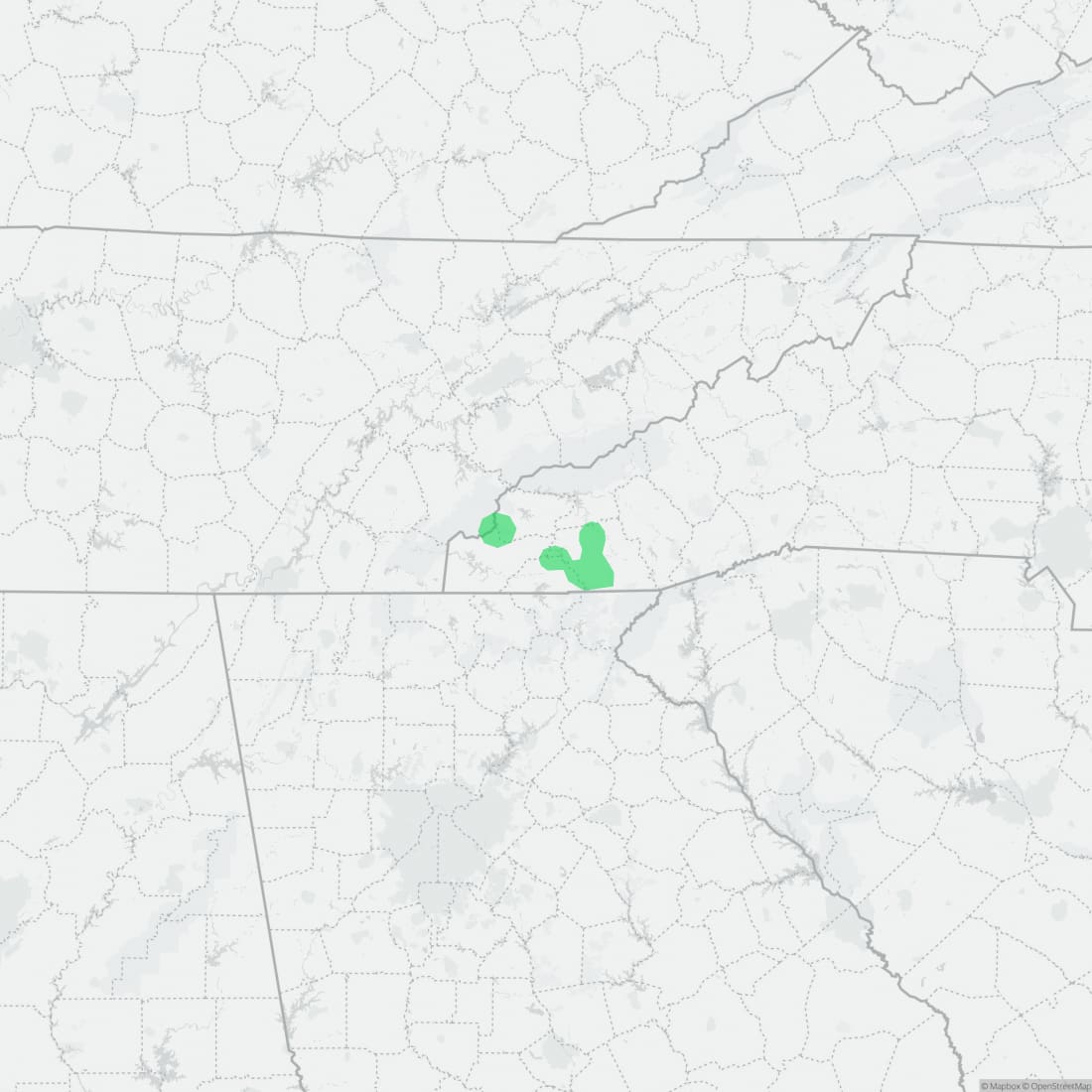
Approximate range. © Mapbox © OpenStreetMap