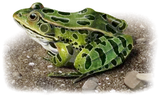
Columbia Spotted Frog
Rana luteiventris
This species is a medium-sized frog with males reaching lengths of 65 mm and females reaching 100 mm in body length. Individuals are normally light brown in color, grey o…
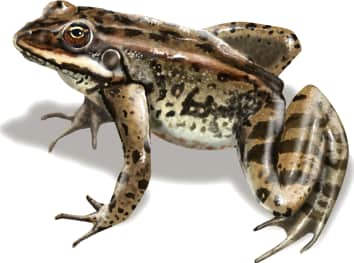
How to identify
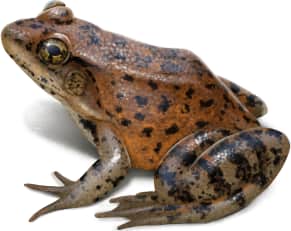
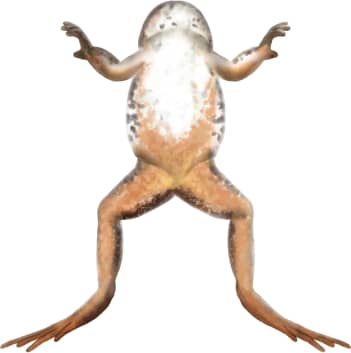
This species is a medium-sized frog with males reaching lengths of 65 mm and females reaching 100 mm in body length. Individuals are normally light brown in color, grey or olive-green with distinct light-centered dark spots on their backs. Adults have yellow, red and salmon-pink bellies, while juveniles have cream-colored or white bellies which change color as they mature into adults. This species has smooth skin with tiny bumps and their eyes face upwards to give them great visibility when submerged in water. Their hind feet have webbings all the way to the end of their toes.
Range
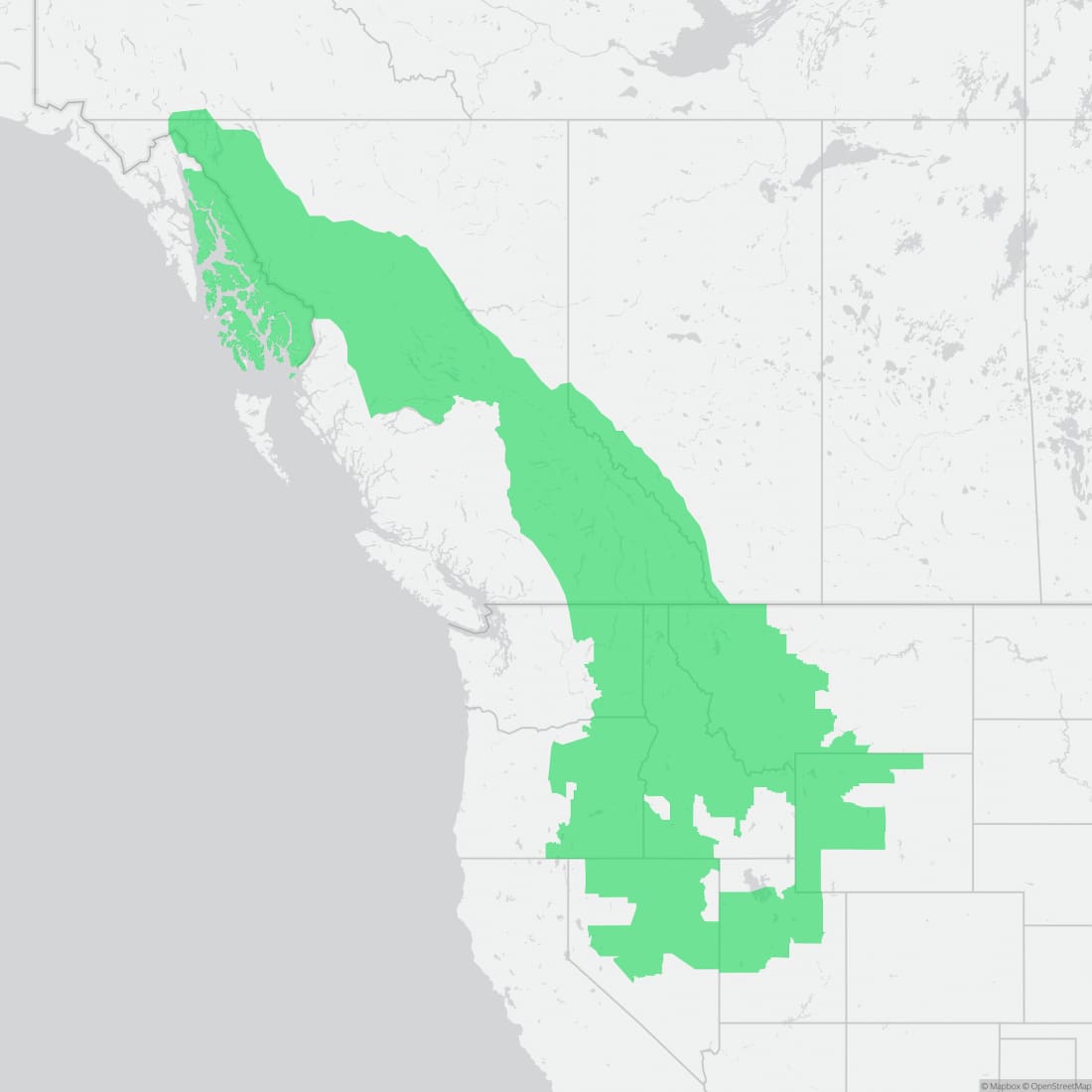
This species is found inland off the Western Coast of North America and is found as far south as Salt Lake City and as far north as British Columbia.
Habitat
This species is found in a variety of habitats including forests, inland wetlands, grasslands, shrublands. This fully-aquatic frog is usually found in large bodies of water or rivers that flow year round.
Variations
There is very little morphological variation in this species and therefore not a determining factor in identification. Very similar species do occur but have completely different geographical ranges.
Similar species
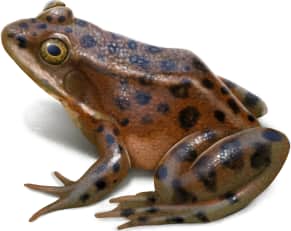
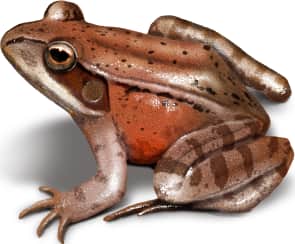
The Columbia Spotted Frog is very similar to the Oregon Spotted Frog and the Northern Red-legged Frog. The way to tell the difference is that the Northern Red-Legged Frog has semi-translucent skin on the underside of the hind legs and lacks the upward angled eyes, and their webbing on the hind feet does not extend to the tips of the toes like the Columbia Spotted Frog. The Oregon and Columbia Spotted Frogs distributions do not overlap so they and they are very similar species but can easily be identified based on the location that they are found in.
Name and etymology
Genus
Rana
Latin for frog.
Origin
Sources
- Linnaeus, 1758. Syst. Nat., 10th ed., Vol. 1, p. 210 ↗
Rana. Linnaeus, 1758 - Syst. Nat., 10th ed., Vol. 1, p. 210
Species epithet
luteiventris
Latin for golden-yellow (luteus) belly (ventris)
Origin
Sources
- Thompson, 1913. Proc. Biol. So. Wash., Vol. 26, p. 53, pl. 3, figs. 2-3
Rana luteiventris. Thompson, 1913 - Proc. Biol. So. Wash., Vol. 26, p. 53, pl. 3, figs. 2-3
Explore more names in the etymology index.
More illustrations
At a glance
Size
46 to 100 mm
Range
This species is found inland off the Western Coast of North America and is found as far south as Salt Lake City and as far no…
Habitat
This species is found in a variety of habitats including forests, inland wetlands, grasslands, shrublands. This fully-aquatic…
Range map
Approximate range. © Mapbox © OpenStreetMap