Resplendent Desert Shovel-nosed Snake
Sonora annulata
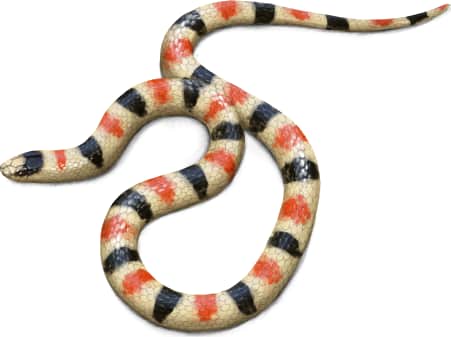
It is a small snake of about 369 mm or 15” in length. It has more than 20 black bands often with narrow red bands between, and a cream/light yellow background. Their snou…
How to identify
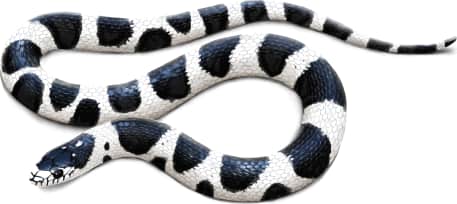
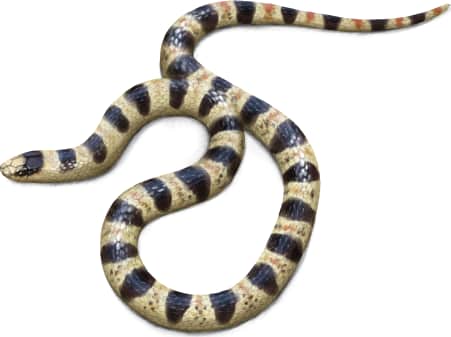
It is a small snake of about 369 mm or 15” in length. It has more than 20 black bands often with narrow red bands between, and a cream/light yellow background. Their snout is light yellow or cream. They also have a black mask which crosses the top of the head and covers the eyes. Along with their underside being cream, it has a countersunk jaw and valves in the nasal passages. Additionally, the snake has a concave belly and a relatively flat snout. With these qualities, the Western Shovel-nosed Snake is well equipped for burrowing under fine sand and loose gravel. Lastly, their pupils are round and their scales are shiny and smooth.
Range
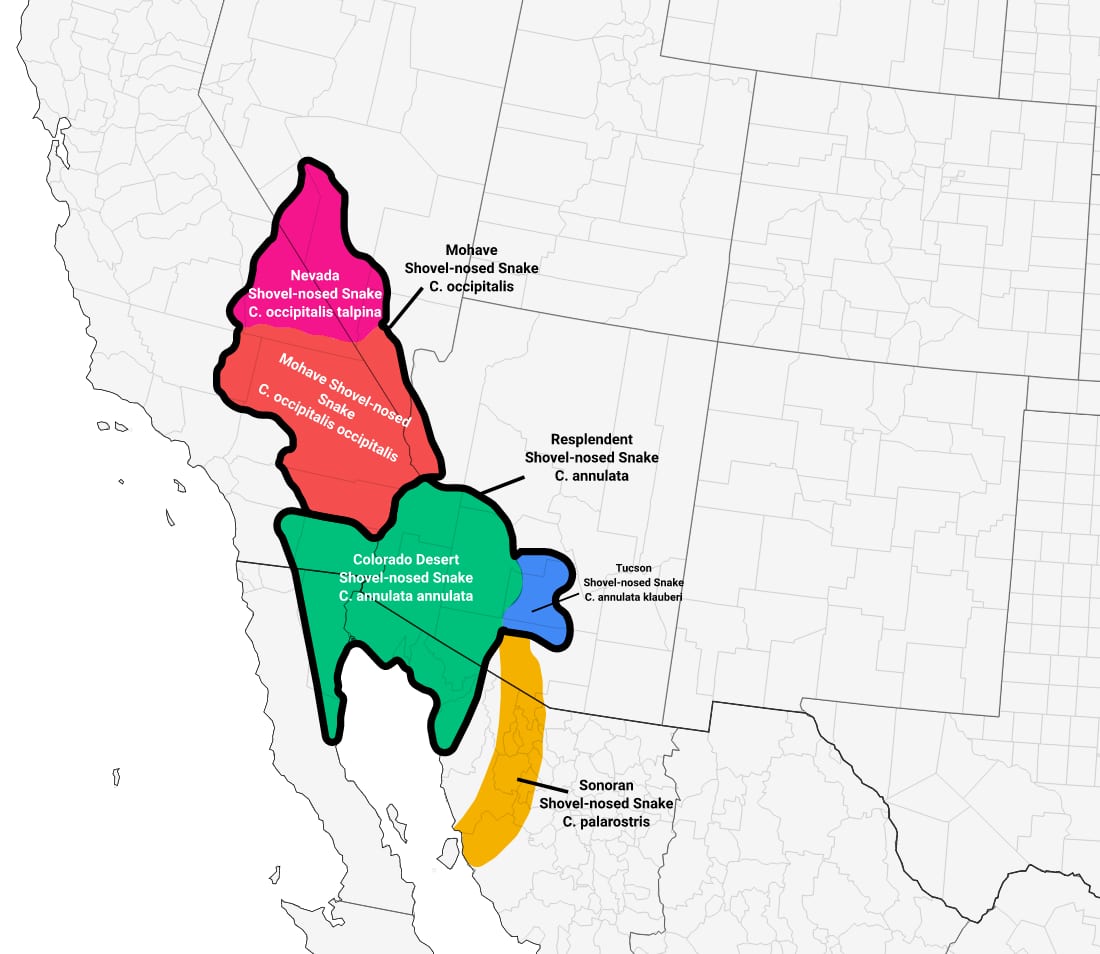
The Resplendent Desert Shovel-Nosed Snake occurs in the low deserts of Southern California, Arizona, and northern portions of Baja California and Sonora, Mexico.
Habitat
This snake is usually found close to washes in desert flats or on gently sloping bajadas. They are ground dwellers and primarily crepuscular. They are nocturnal and are in underground burrows during the daytime. They feed on insects, spiders, centipedes, reptile eggs and so on. Lastly, their mating takes place in spring. In summer, a clutch of about 9 eggs is laid.
Variations
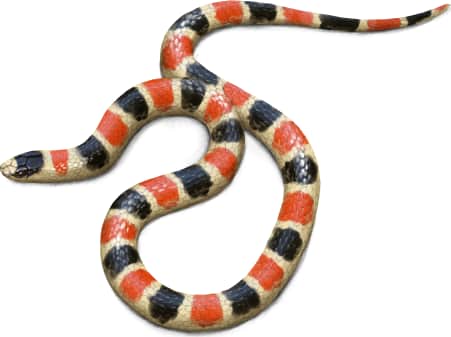
COLORADO DESERT SHOVEL-NOSED SNAKE (Sonora annulata annulata) This snake usually has relatively narrow black bands, more space between bands, and orange saddles that are not flecked with black or brown TUCSON SHOVEL-NOSED SNAKE (Sonora annulata klauberi) Their orange secondary saddles are usually heavily flecked with black or purplish-black on the sides. Although they are usually clean mid-dorsally.
Similar species
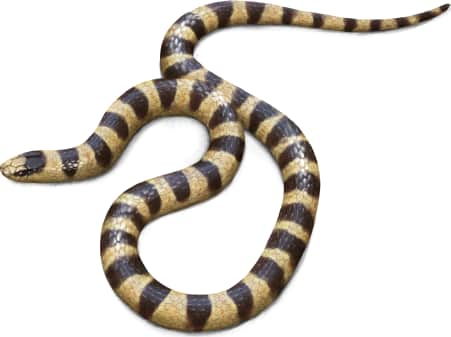
The Resplendent Desert Shovel-Nosed Snake is very similar to the Mohave Shovel-nosed Snake, as the two snakes were once considered the same species. The Mohave Shovel-nosed Snake may have some red but not the full narrow reds bands of the Resplendent Desert Shovel-Nosed Snake. The Mohave Shovel-nosed Snake is similar to the Sonoran Coralsnake also known as Micruroides euryxanthus. Shovel-nosed Snakes have saddles as opposed to the full bands of a coral snake. The light snout of The Mohave Shovel-nosed Snake may also help distinguish it from a coral snake.
Name and etymology
Genus
Sonora
Referencing the region of Sonora.
Origin
Sources
- Baird and Girard, 1853. Cat. N. Amer. Rept., Pt. 1, p. 117 ↗
Sonora. Baird and Girard, 1853 - Cat. N. Amer. Rept., Pt. 1, p. 117
Species epithet
annulata
latin for ringed.
Origin
Sources
- Kennicott, 1860. Proc. Acad. Nat. Sci. Philadelphia, Vol. 12, p. 329 ↗
Lampropeltis triangulum annulata. Kennicott, 1860 - Proc. Acad. Nat. Sci. Philadelphia, Vol. 12, p. 329
Explore more names in the etymology index.
More illustrations
Tucson shovel-nosed Snake
At a glance
Range
The Resplendent Desert Shovel-Nosed Snake occurs in the low deserts of Southern California, Arizona, and northern portions of…
Habitat
This snake is usually found close to washes in desert flats or on gently sloping bajadas. They are ground dwellers and primar…
Guide
Reptiles and Amphibians of North America
Range map
Approximate range. © Mapbox © OpenStreetMap