Western Massasauga
Sistrurus tergeminus
A western Massasauga is a somewhat stout snake that looks stunted. The illusion is created because of its size in width across the length of its body. That being said, an…
How to identify
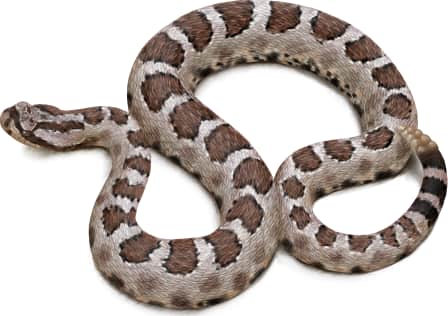
A western Massasauga is a somewhat stout snake that looks stunted. The illusion is created because of its size in width across the length of its body. That being said, an average adult can measure about 500-700millimeters from the snout to its to vent. Its base color is gray, near the vertebral column it is silver and meekly merged with red-like brown on the laterals. A brown mask that is highlighted by thin white pigmentation extends from the eyes to the back of the edge of the mouth. There are patterns on its entire body that markedly makes this snake a very beautiful species worthy of spectacle. Blotches that are shaped like lyres are one of such patterns and they reach from the back of the head and into the neck. Up to 33-40 brown chocolate blotches mark its dorsum, lining up medially in a row on its back. The tail of the western Massasauga is usually orange or yellow in juveniles, but after a year there’s a color change to a less bright gray color marked by 5-10 brown colored bands. Its belly is of a uniform light brown to gray color and can be seen to have somewhat darkened flecks. Its tail ends in form of a rattle thus generically classifying this species as a rattlesnake. This rattle has scales that look like miniature plates on the top of its head.
Range
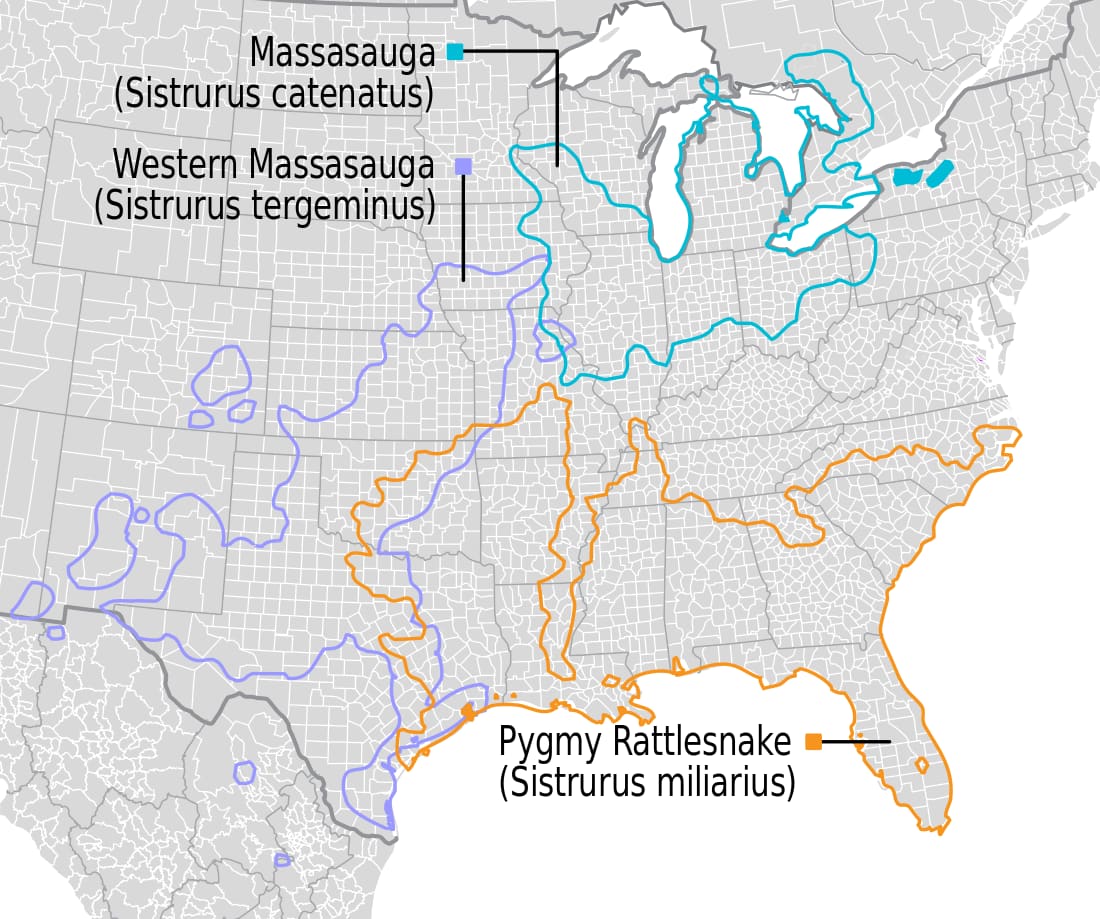
The western massasauga can be found in areas including the San Carlos Apache Reservation, Graham County in Arizona, and in Central New York in the United States of America. It can also be found in Georgian Bay in Ontario, Canada, and in Cuatro Cienegas in Coahuila in Mexico.
Habitat
The Western Massasauga’s habitat includes but is not restricted to wet meadows, marshes, woodlands, short grass prairies, desert grasslands and oak scrublands. It is a nocturnal animal. Reproduction habit studies says it starts breeding from March through October. Mating occurs in between spring to fall season while births period can range from late April to August, sometimes through late September depending on its location. Being a nocturnal animal, the western Massasauga can be seen during summer slithering around in hours after dusk. However, it can as exceptions on various occasions seen for several hours after sunrise, and on overcast days in late afternoons. Their movements and on-ground activity increase with the regression of springs and inception of monsoon rains. This species is a carnivorous predator with a wide variety of prey which range from large centipedes, lizards, various small mammals and snakes. The Plain black-headed snake is on the diet of this large rattlesnake.
Variations
Sistrurus catenatus tergeminus or Western massasauga Sistrurus catenatus edwardsii or Desert massasauga Sistrurus catenatus catenatus or Eastern massasauga
Similar species
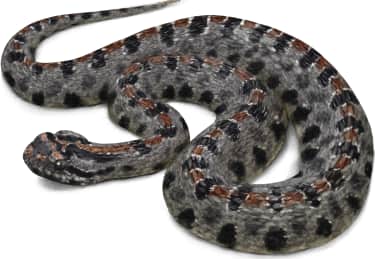
Western pygmy rattlesnake (Sistrurus millianus streckeri) has a total length (tail is included) of 400- 630milimeters and average reports state a 530millimeter frequent occurrence. This species has an irregular pattern on its body which are wide shaped mid-dorsal blotches. It also has the lowest number of ventral scales for its entire species. Barbour’s pygmy rattlesnake (Sistrurus millianus barbouri) can reach 355- 760millimeters if you include the length of its rattle tail with a reported average of 535millimeters for both sexes. It usually has twenty-three rows of dorsal rows on the dorsal part of the body. It has dorsal spots and a whitish belly that is heavily flecked or mottled with dark or dark brown patterns.
Name and etymology
Genus
Sistrurus
Meaning rattle (Latin - sistrum) tail (Greek - oura).
Origin
Sources
- Garman, 1883. Mem. Mus. Comp. Zool. Harvard, Vol. 8, No. 3, p. 110
Sistrurus. Garman, 1883 - Mem. Mus. Comp. Zool. Harvard, Vol. 8, No. 3, p. 110
Species epithet
tergeminus
Latin for triple, referencing 3 rows of spots.
Origin
Sources
- (Say, 1823).
Thamnophis proximus. (Say, 1823) -
Explore more names in the etymology index.
At a glance
Range
The western massasauga can be found in areas including the San Carlos Apache Reservation, Graham County in Arizona, and in C…
Habitat
The Western Massasauga’s habitat includes but is not restricted to wet meadows, marshes, woodlands, short grass prairies, des…
Guide
Reptiles and Amphibians of North America
Range map
Approximate range. © Mapbox © OpenStreetMap