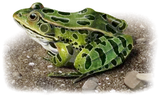
Great Basin Spadefoot
Spea intermontana
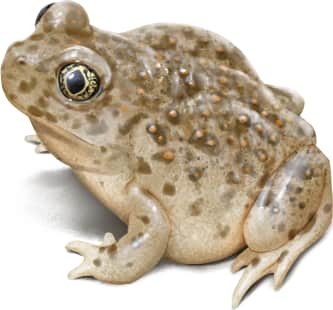
A plump, round toad with a short snout and large bulging eyes with vertical pupils. Its skin is mildly bumpy and it averages 4-6 cm in body length. Its background colorat…
How to identify
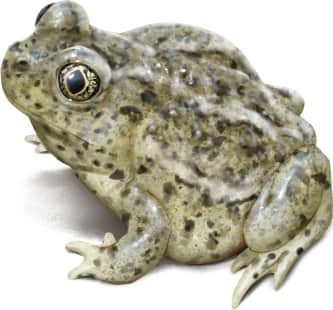
A plump, round toad with a short snout and large bulging eyes with vertical pupils. Its skin is mildly bumpy and it averages 4-6 cm in body length. Its background coloration is mid-toned adorned with dark spots and splotches, as well as wavy, undefined light stripes down its back that create an hourglass shape. It has a hard black protrusion on the bottom of each hind foot to aide in digging. Ventrum is mostly pale and unmarked with some dark coloration on the throat and groin.
Range
Ranges from south central British Columbia down through eastern Washington and Oregon, southern Idaho, southwest Wyoming, most of Nevada and Utah, and some adjacent areas in California, Arizona, and Colorado.
Habitat
Found in a wide variety of habitats within its range, including forests, shrubland, grasslands, sagebrush flats, deserts, and agricultural areas. It spends most of the year burrowed underground and emerges after heavy spring rains to breed in slow-moving streams, springs, and manmade reservoirs.
Variations
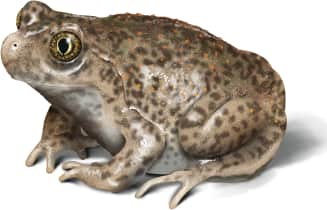
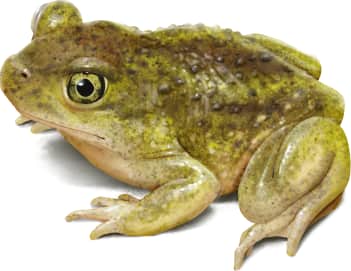
Color palette can be shades of tan, brown, olive, or grey and black.
Similar species
Most akin to the plains spadefoot (*Spea bombifrons*), Hurter's spadefoot (*Scaphiopus hurterii*), or western spadefoot (*Spea hammondii*).
Name and etymology
Genus
Spea
Greek for cave or cavern.
Origin
Sources
- Cope, 1866. Journ. Acad. Nat. Sci. Philadelphia, Vol. 6, 2nd Series, p. 81 ↗
Spea. Cope, 1866 - Journ. Acad. Nat. Sci. Philadelphia, Vol. 6, 2nd Series, p. 81
Species epithet
intermontana
Latin for in between (inter) the mountains (montis).
Origin
Sources
- (Cope, 1883). Proc. Acad. Nat. Sci. Philadelphia, Vol. 35, p. 15 ↗
Spea intermontana. (Cope, 1883) - Proc. Acad. Nat. Sci. Philadelphia, Vol. 35, p. 15
Explore more names in the etymology index.
At a glance
Size
32 to 67 mm
Range
Ranges from south central British Columbia down through eastern Washington and Oregon, southern Idaho, southwest Wyoming, mos…
Habitat
Found in a wide variety of habitats within its range, including forests, shrubland, grasslands, sagebrush flats, deserts, and…
Range map
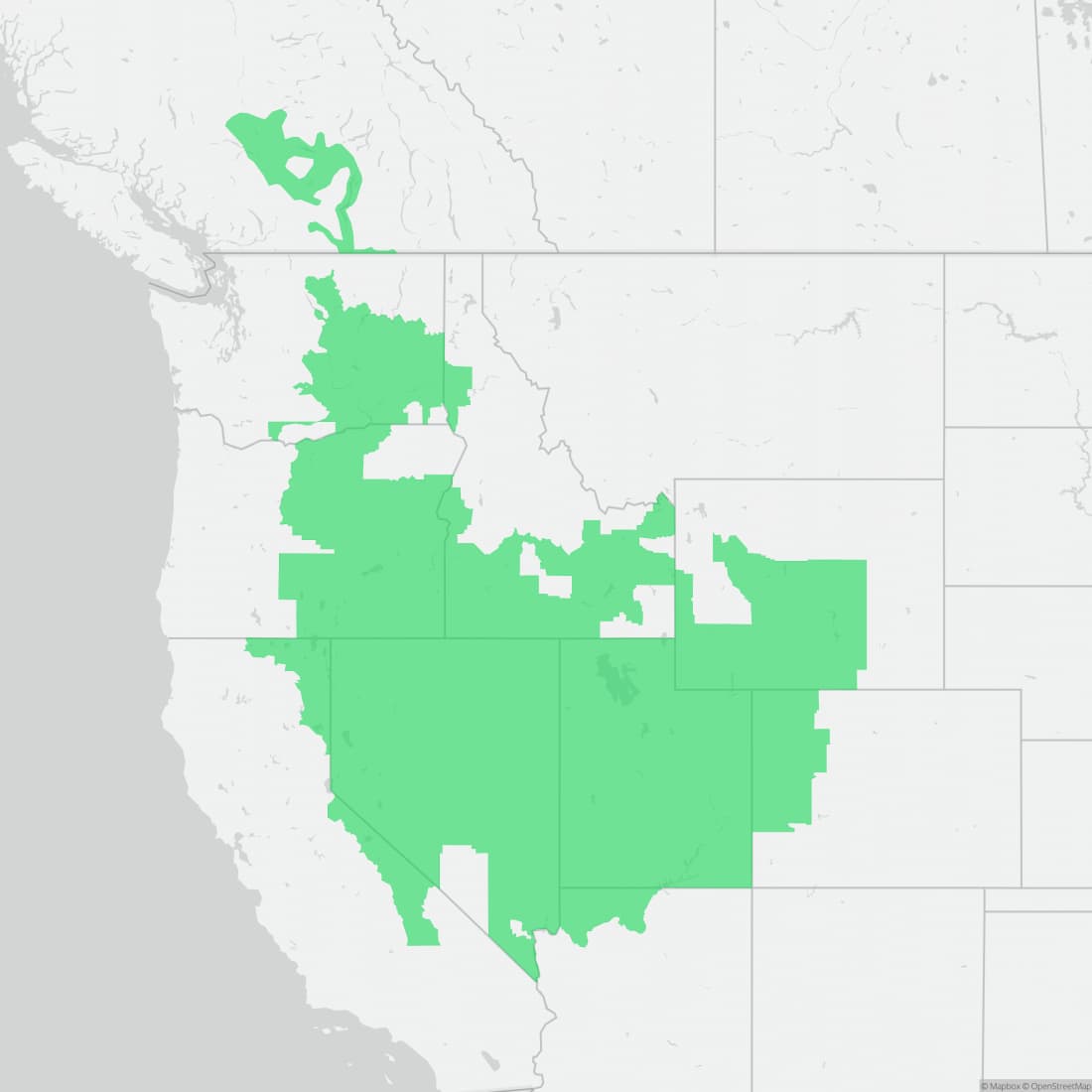
Approximate range. © Mapbox © OpenStreetMap