Northern Gray-cheeked Salamander
Plethodon montanus
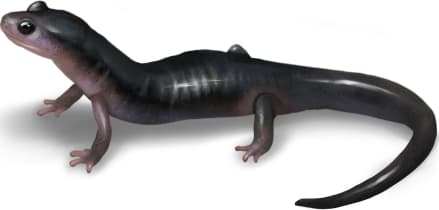
This plain grey salamander averages 3.5-5 inches in total length and has very obvious costal grooves. It has large bulging eyes on its wide, flat head. It has relatively…
How to identify
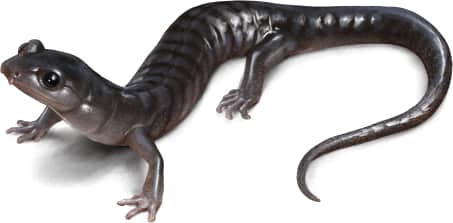
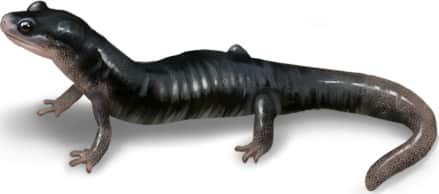
This plain grey salamander averages 3.5-5 inches in total length and has very obvious costal grooves. It has large bulging eyes on its wide, flat head. It has relatively long, well-developed legs, and long, non-webbed toes. Its throat is pale whitish or pinkish, and its tail is about the same length as its body.
Range
Patchy range in the Appalachian Mountains of western Virginia, western North Carolina, and extreme eastern Tennessee.
Habitat
Found in mesic montane forests above 2500 feet, often hiding under mossy rocks, rotten logs, and leaf litter.
Variations
Some are lighter slate grey while others are dark grey.
Similar species
Practically identical to the southern gray-cheeked salamander (*Plethodon metcalfi*), and very similar to the Blue Ridge gray-cheeked salamander (*Plethodon amplus*).
Name and etymology
Genus
Plethodon
Greek for full of (plethore) teeth (odon).
Origin
Sources
- Tschudi, "1838" 1839. reprinted in Classif. Batr., Mem. Soc. Sci. Nat. Neuchatel, p. 92 ↗
Plethodon. Tschudi, "1838" 1839 - reprinted in Classif. Batr., Mem. Soc. Sci. Nat. Neuchatel, p. 92
Species epithet
montanus
Latin for belonging to the mountain.
Origin
Sources
- Highton and Peabody, 2000
Plethodon montanus. Highton and Peabody, 2000
Explore more names in the etymology index.
At a glance
Range
Patchy range in the Appalachian Mountains of western Virginia, western North Carolina, and extreme eastern Tennessee.
Habitat
Found in mesic montane forests above 2500 feet, often hiding under mossy rocks, rotten logs, and leaf litter.
Guide
Reptiles and Amphibians of North America