Orange-throated Whiptail
Aspidoscelis hyperythrus
This lizard averages 2-3 inches in snout to vent length. Like all whiptails, it has a pointed snout, plate-like scales on its head, granular body scales, and sharply keel…
How to identify
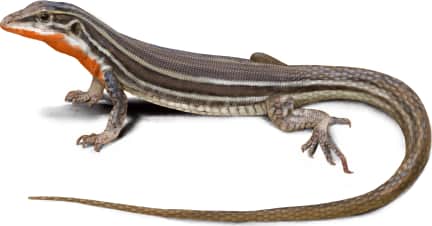
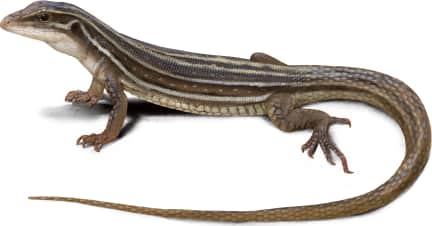
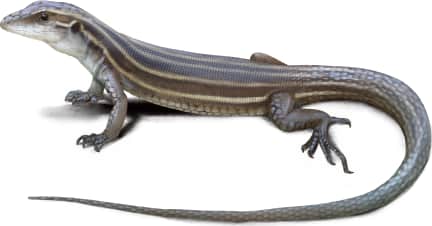
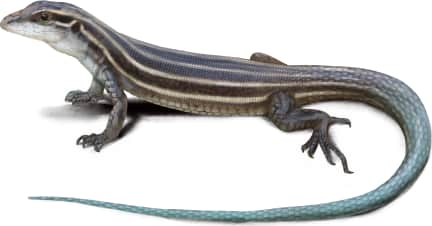
This lizard averages 2-3 inches in snout to vent length. Like all whiptails, it has a pointed snout, plate-like scales on its head, granular body scales, and sharply keeled scales on its long tail. It also has very long toes on its hind feet. Its back is patterned with 5-6 light longitudinal stripes on a dark background. These stripes begin just behind the eyes, and fade part way down the tail. Its hind legs have a grey mottled pattern. Its ventrum is typically yellowish or cream colored. Males and some females have a bright orange throat.
Range
Ranges throughout the Baja Peninsula and the southwestern corner of California.
Habitat
This species likes semi-arid habitat with lots of scrub and loose, gravely substrate. It often digs through ground debris while foraging. It can be found in coastal chaparral, dry washes, or rocky hillsides.
Variations
Juveniles have a bright blue tail and bluish hind legs. The dark dorsal coloration can be black or reddish brown, and the light lines are cream to yellow. The orange throat coloration on breeding males may extend down the ventrum and ventral tail. Gravid females may also develop orange coloration on their jawline.
Similar species
Similar in appearance to other southwestern whiptails that range further east, including the Sonoran spotted whiptail (*Aspidoscelis sonorae*), desert grassland whiptail (*Aspidoscelis uniparens*), and plateau striped whiptail (*Aspidoscelis velox*).
Name and etymology
Genus
Aspidoscelis
Greek for shield (aspido) leg (skelos).
Origin
Sources
- Wagler, 1830. Nat. Syst. Amph., p. 154
Cnemidophorus. Wagler, 1830 - Nat. Syst. Amph., p. 154
Species epithet
hyperythrus
Greek for above (hyper) red (erythros).
Origin
Sources
- Cope, 1863. Proc. Acad. Nat. Sci. Philadelphia, Vol. 15, p. 103 ↗
Cnemidophorus hyperythrus. Cope, 1863 - Proc. Acad. Nat. Sci. Philadelphia, Vol. 15, p. 103
Explore more names in the etymology index.
At a glance
Range
Ranges throughout the Baja Peninsula and the southwestern corner of California.
Habitat
This species likes semi-arid habitat with lots of scrub and loose, gravely substrate. It often digs through ground debris whi…
Guide
Reptiles and Amphibians of North America
Range map
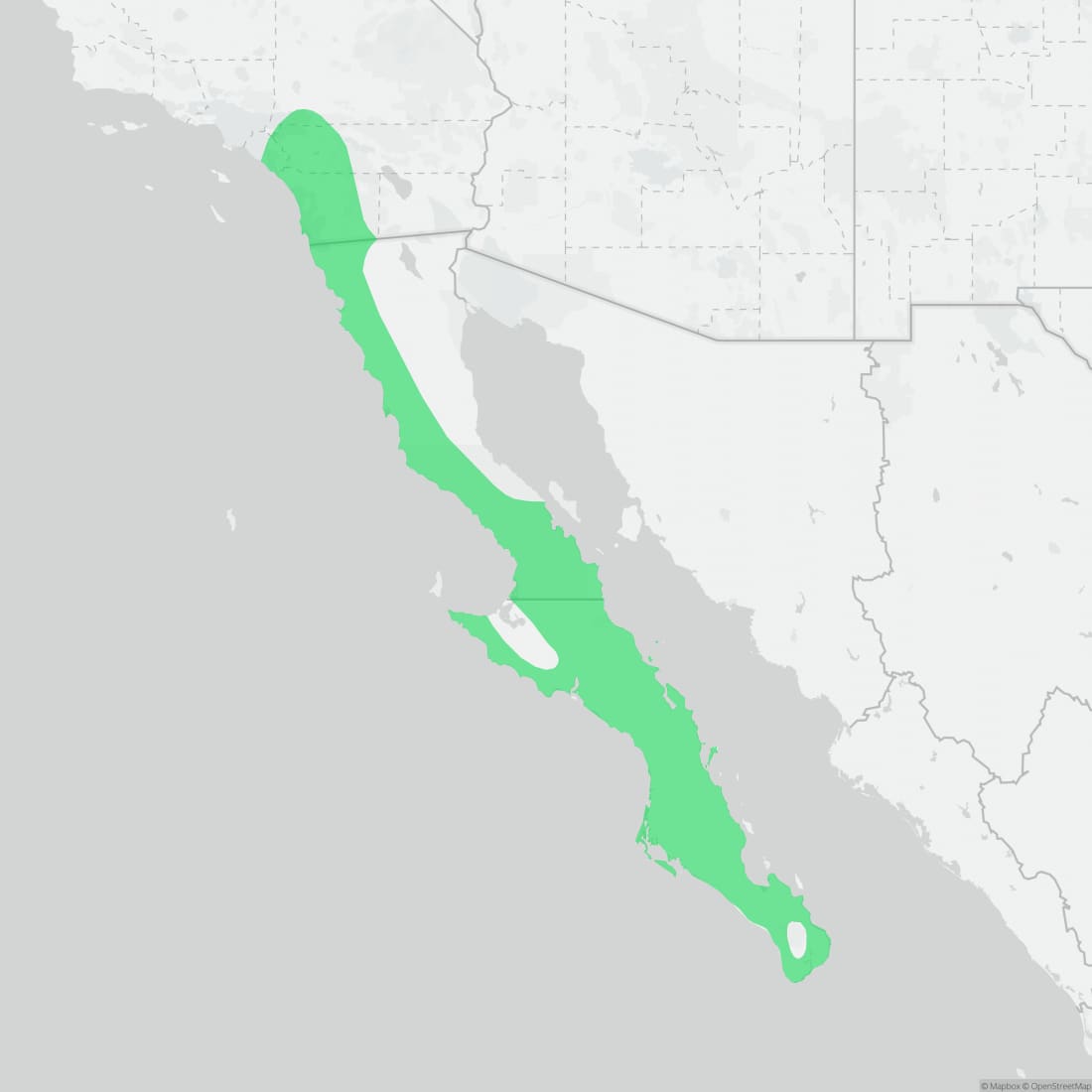
Approximate range. © Mapbox © OpenStreetMap