Seepage Salamander
Desmognathus aeneus
The length of the seepage salamander or Desmognathus aeneus ranges from 1.75-2.25 inches. Its tail is rounded and terete. This species also possesses a pale dorsal strip…
How to identify
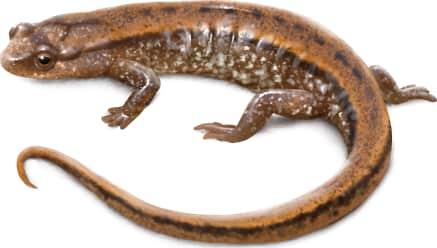
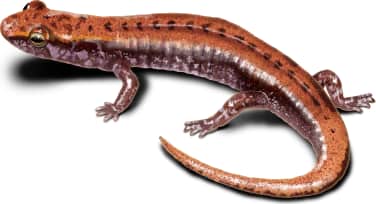
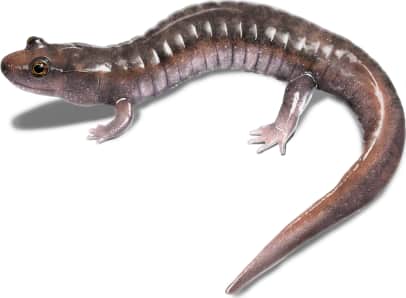
The length of the seepage salamander or Desmognathus aeneus ranges from 1.75-2.25 inches. Its tail is rounded and terete. This species also possesses a pale dorsal stripe that ranges from yellow to tan or reddish brown. The strip may be flecked with a darker pigment. There is a Y-shaped mark on the head and a mid-dorsal line. Another feature of the seepage salamander Is that it is lungless and respires through its skin.
Range
This species is endemic to the United States and is found in states like Tennessee, Georgia, North Carolina and Alabama.
Habitat
The habitats of the seepage salamander includes freshwater springs, temperate forests and intermittent rivers. It is a nocturnal creature and feeds on mites, crustaceans, nematodes, myriapods, springtails and snails. Oviposition takes place between April and May with eggs ready for deposition by females. Eggs are laid in clutches of 11-14 under cover objects, near streams and moss. After fertilization, hatching takes place within 68-75 days with juveniles resembling adults.
Similar species
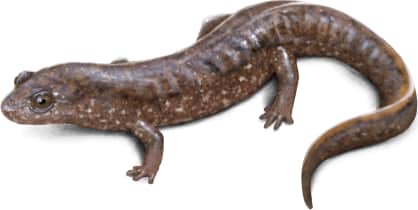
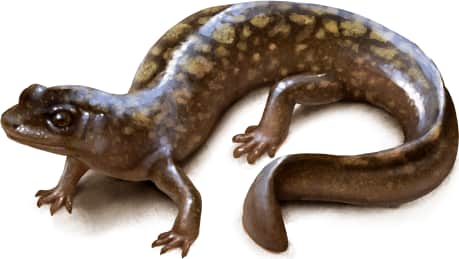
The Southern dusky salamander or Desmognathus auriculatus have red or white spotting between limbs and rear legs which are larger than its front legs. The Shovelnose salamander or Desmognathus marmoratus has a more square-ended snout compared with other salamanders. The color of the snout is dusky brown, black with two longitudinal rows of small patches smaller pale speckles. The pygmy salamander or Desmognathus wrighti has a classic pigmentation marking on its dorsal side that is shaped in “V” shape. The light stripe from the eye of the pygmy salamander to the jaw designates this species as a desmognathan. This species has six vomerine teeth on each side of its mouth.
Name and etymology
Genus
Desmognathus
Greek for jaw (gnathos) ligament (desmos).
Origin
Sources
- Baird, 1850. Journ. Acad. Nat. Sci. Philadelphia, Ser. 2, Vol. 1, p. 282 and p. 285 ↗
Desmognathus. Baird, 1850 - Journ. Acad. Nat. Sci. Philadelphia, Ser. 2, Vol. 1, p. 282 and p. 285
Species epithet
aeneus
Latin for bronze or copper.
Origin
Sources
- Brown and Bishop, 1947. Copeia, p. 163 ↗
Desmognathus aeneus. Brown and Bishop, 1947 - Copeia, p. 163
Explore more names in the etymology index.
At a glance
Range
This species is endemic to the United States and is found in states like Tennessee, Georgia, North Carolina and Alabama.
Habitat
The habitats of the seepage salamander includes freshwater springs, temperate forests and intermittent rivers. It is a noctu…
Guide
Reptiles and Amphibians of North America
Range map
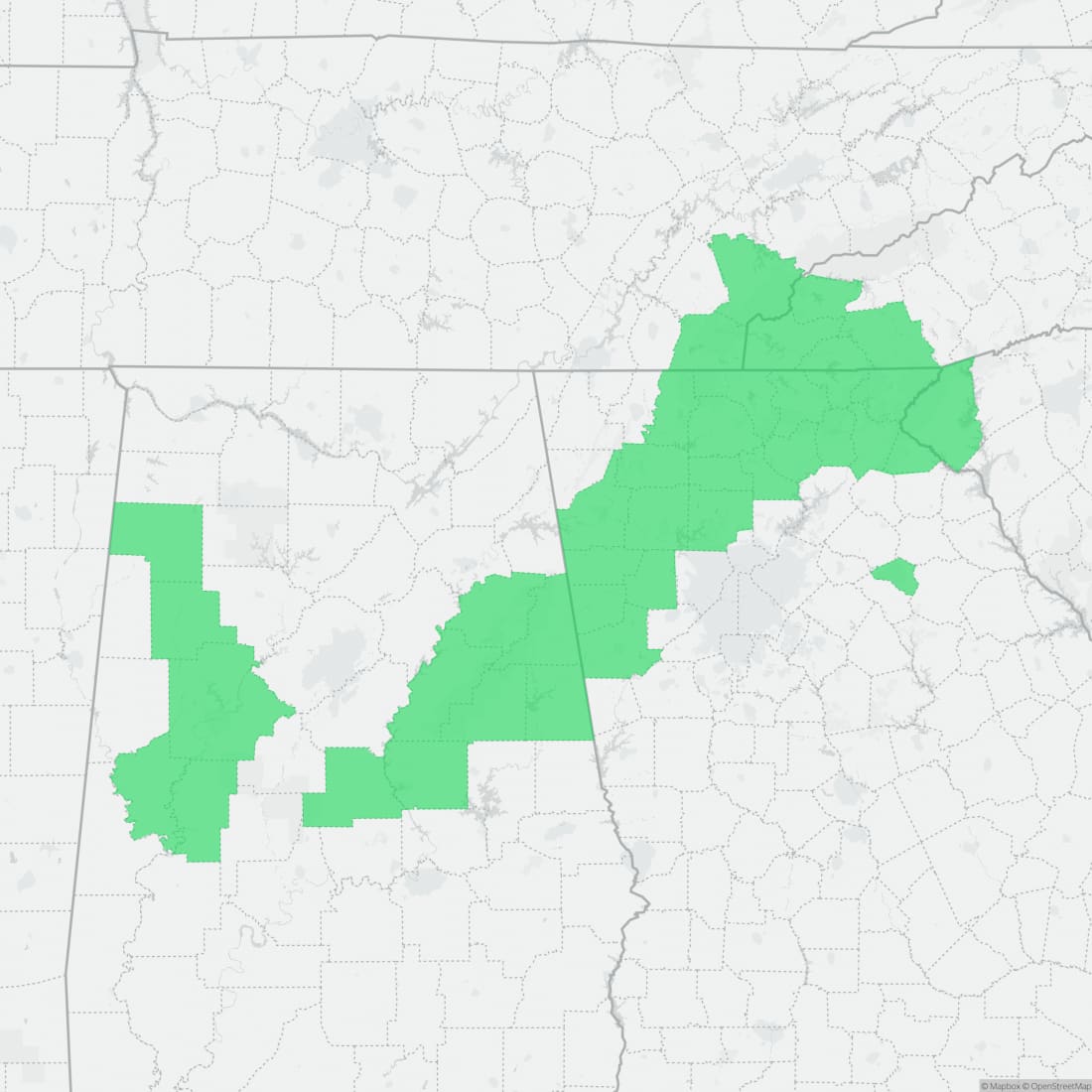
Approximate range. © Mapbox © OpenStreetMap