California Giant Salamander
Dicamptodon ensatus
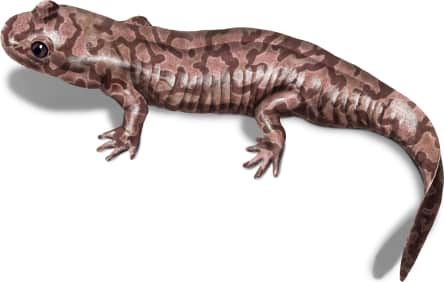
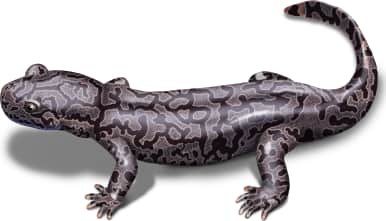
This plump, stocky salamander has a striking marbled pattern all over its body. Its background color is deep tan to rusty brown, with dark brown patterning. It can grow t…
How to identify
This plump, stocky salamander has a striking marbled pattern all over its body. Its background color is deep tan to rusty brown, with dark brown patterning. It can grow to 6-12 inches in total length, and has a very wide head and body. It has 4 toes on each front foot and 5 on each back foot, as well as a gular fold across the throat.
Range
Endemic to California, along the Pacific coast. There are 2 distinct populations; one north and one south of San Francisco.
Habitat
Damp riparian forest regions along the coast. Terrestrial adults live amongst the debris on the forest floor or in tunnels underground. Can be found at elevations up to 6,500 feet. Aquatic adults live in cool, rocky freshwater streams or lakes and ponds.
Variations
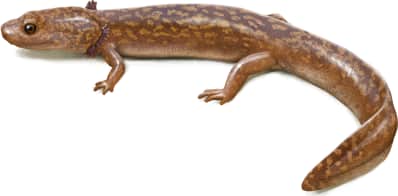
Brown coloration varies slightly from lighter to darker shades. Some juveniles (larvae) can grow to adulthood and become sexually mature while retaining their external gills. These neotenes are completely brown and remain aquatic as adults.
Similar species
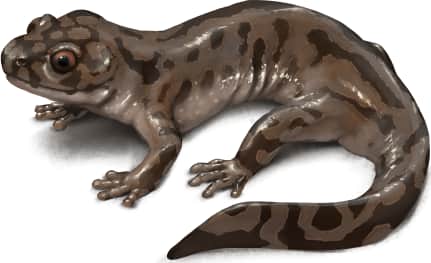
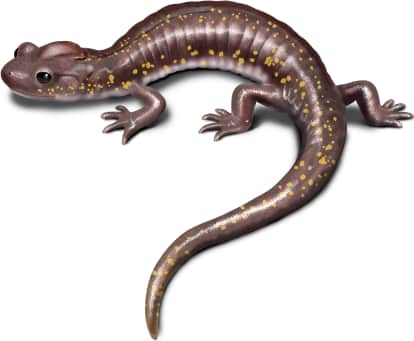
Related to and resembles the coastal giant salamander (*Dicamptodon tenebrosus*), which is found further north in California and through Oregon and Washington, and has a more mottled versus marbled pattern. Also the Idaho giant salamander (*Dicamptodon aterrimus*) found only in northern Idaho, and Cope's giant salamander (*Dicamptodon copei*) found only in Oregon and Washington which rarely morphs into terrestrial adult form. The arboreal salamander (*Aneides lugubris*) shares its range with the California giant salamander, but has solid brown coloration with tiny yellow spots.
Name and etymology
Genus
Dicamptodon
Greek for two (di) curved (kamptos) teeth (odon).
Origin
Sources
- Strauch, 1870. Mem. Acad. Sci. St. Petersburg, Ser. 7, Vol. 16, No. 4, p. 68
Dicamptodon. Strauch, 1870 - Mem. Acad. Sci. St. Petersburg, Ser. 7, Vol. 16, No. 4, p. 68
Species epithet
ensatus
Latin for sword-shaped.
Origin
Sources
- (Eschscholtz, 1833). Zool. Atlas, Pt. 5, p. 6, pl. 22
Dicamptodon ensatus. (Eschscholtz, 1833) - Zool. Atlas, Pt. 5, p. 6, pl. 22
Explore more names in the etymology index.
At a glance
Range
Endemic to California, along the Pacific coast. There are 2 distinct populations; one north and one south of San Francisco.
Habitat
Damp riparian forest regions along the coast. Terrestrial adults live amongst the debris on the forest floor or in tunnels un…
Guide
Reptiles and Amphibians of North America
Range map
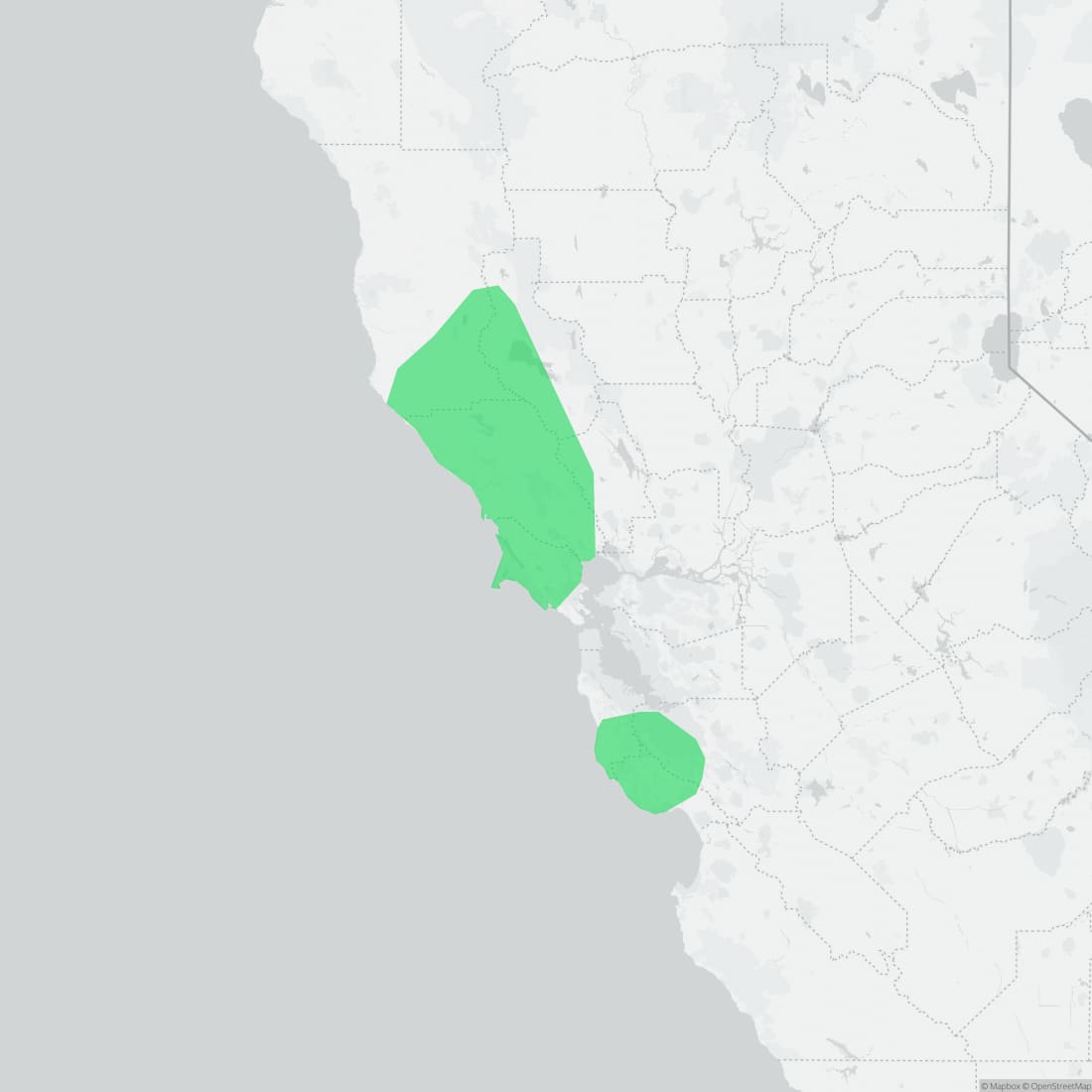
Approximate range. © Mapbox © OpenStreetMap