Carolina Sandhills Salamander
Eurycea arenicola
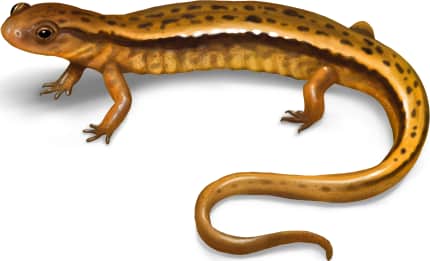
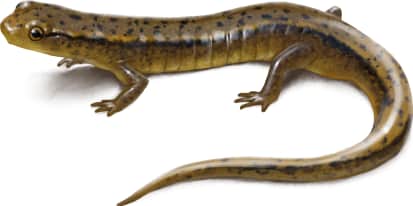
Eurycea arenicola is a small and slender salamander that belongs to the E. bislineata complex. It has a long tail that makes up almost half of its total length, which ran…
How to identify
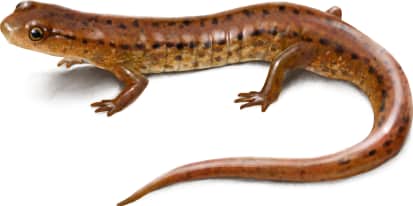
Eurycea arenicola is a small and slender salamander that belongs to the E. bislineata complex. It has a long tail that makes up almost half of its total length, which ranges from 56 to 89 mm. It has a short and rounded snout with nostrils close to the tip. Males have nasal cirri and a mental gland on the chin. Its color varies from olive yellow to red, with a row of black spots along the sides of its body and tail.
Range
The Carolina Sandhills salamander (Eurycea arenicola) is endemic to the Sandhills region of North Carolina. It is currently known from seven counties in the central and southern parts of the state.
Habitat
E. arenicola is semi-terrestrial and reproduces in aquatic habitats such as springs and blackwater streams. It has a biphasic life cycle, with eggs and larvae being aquatic and adults living on land. The breeding season, courtship behavior, clutch size, and larval duration are poorly known, but some evidence suggests that females lay eggs in winter and guard their nests. The larvae feed on small invertebrates and remain in the water for at least one year before metamorphosing into adults.
Similar species
The Carolina Sandhills salamander belongs to the "two-lined salamander" complex, a group of closely related Eurycea species that share morphological and genetic traits. One of the features that distinguishes E. arenicola from other salamander in the complex is the presences of cirri in adult males and the lack of stripes in all adults.
Name and etymology
Genus
Eurycea
Probably honoring Eurydice the wife of Orpheus in Greek mythology. Although Rafinesque, who named the genus, only wrote "mythological"
Origin
Honors
Sources
- Rafinesque, 1822. Kentucky Gazette, Lexington, N. S., Vol. 1, No. 9, Feb. 28, p. 3, column 6
Eurycea. Rafinesque, 1822 - Kentucky Gazette, Lexington, N. S., Vol. 1, No. 9, Feb. 28, p. 3, column 6
Species epithet
arenicola
Latin for sandy place (arena) dweller (cola) in reference to the species being restricted to the Sandhills of North Carolina.
Origin
Sources
- Wikipedia: Eurycea arenicola ↗
“Eurycea arenicola.” Wikipedia. https://en.wikipedia.org/wiki/Carolina_Sandhills_salamander
Explore more names in the etymology index.
At a glance
Range
The Carolina Sandhills salamander (Eurycea arenicola) is endemic to the Sandhills region of North Carolina. It is currently k…
Habitat
E. arenicola is semi-terrestrial and reproduces in aquatic habitats such as springs and blackwater streams. It has a biphasic…
Guide
Reptiles and Amphibians of North America