Blue Ridge Two-lined Salamander
Eurycea wilderae
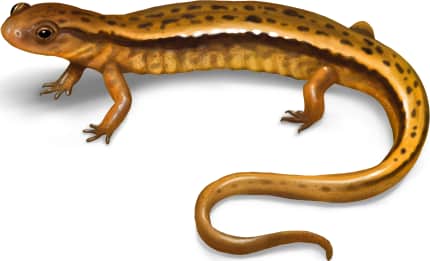
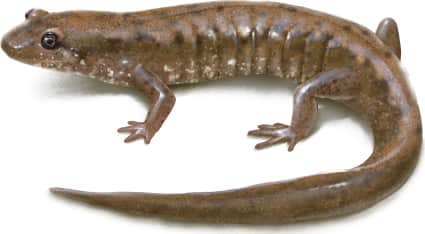
Slender with a length of 2.75 – 4.21 in, the Blue Ridge two-lined salamander has a tail that takes up to 60% of its total body length. Their skin coloration is yellow-ora…
How to identify
Slender with a length of 2.75 – 4.21 in, the Blue Ridge two-lined salamander has a tail that takes up to 60% of its total body length. Their skin coloration is yellow-orange with two dark stripes that run from each eye to the end of the tail. Between the pair of stripes, there are black spots that bedeck the space from nose to tail with these irregular black spots on the sides as well. E. wilderae have nasolabial grooves under the nostrils because they are a lungless type of salamander. Coastal grooves number vary by elevation; specimens at below 1200 meters have 14 while the others above have 15 or 16. The nature of the cirri and the size of the hedonic glands help determine sex. The larvae are yellow and have a dorsolateral stripe.
Range
It is endemic to North American Nearctic region predominantly. The Blue Ridge Two-Line salamander’s range includes southern Appalachian Mountains; the Blue Ridge Mountains, Cumberland Mountains, and the Cumberland Plateau. In the United States, they can be found in North Carolina, South Carolina, Tennessee, Georgia, and Virginia.
Habitat
The E. wilderae can be found in terrestrial habitats (forests) or aquatic habitats (streams) based on what season or what time of the breeding cycle it is. When on land, you can find them in damp locations like underneath logs or rocks. They return the stream to mate in winter and females would lay eggs in water on the underside of rocks and logs. The eggs are laid from the beginning of the year to the middle of summer with varying clutch sizes; some lay 28 – 56 but there are reports of clutches as large as 87 eggs. E. wilderae feed on many types of aquatic invertebrates such as chironomids, nematodes, and copepods and on land they eat insects.
Similar species
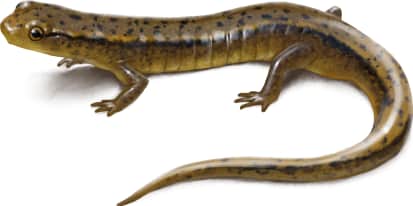
The Northern Two-lined Salamander or Eurycea bislineata. The E. wilderae has a brighter yellow to orange color compared to the browner colored members of the Eurycea family with long striped tails. Northern Dusky Salamander or Desmognathus fuscus while having a roughly similar size and somewhat similar colors, are fairly distinguishable from the E. wilderae. The biggest difference lies in the tail; they have a tail that is less than half their body length which is quite different from the E. wilderae’s long tail. Their tail is also lighter in color compared to its body.
Name and etymology
Genus
Eurycea
Probably honoring Eurydice the wife of Orpheus in Greek mythology. Although Rafinesque, who named the genus, only wrote "mythological"
Origin
Honors
Sources
- Rafinesque, 1822. Kentucky Gazette, Lexington, N. S., Vol. 1, No. 9, Feb. 28, p. 3, column 6
Eurycea. Rafinesque, 1822 - Kentucky Gazette, Lexington, N. S., Vol. 1, No. 9, Feb. 28, p. 3, column 6
Species epithet
wilderae
Honoring herpetologist Inez Whipple Wilder
Origin
Sources
- Dunn, 1920. Proc. Biol. Soc. Washington, Vol. 33, p. 134 ↗
Eurycea wilderae. Dunn, 1920 - Proc. Biol. Soc. Washington, Vol. 33, p. 134
Explore more names in the etymology index.
At a glance
Size
7 to 10.7 cm
Range
It is endemic to North American Nearctic region predominantly. The Blue Ridge Two-Line salamander’s range includes southern A…
Habitat
The E. wilderae can be found in terrestrial habitats (forests) or aquatic habitats (streams) based on what season or what tim…
Range map
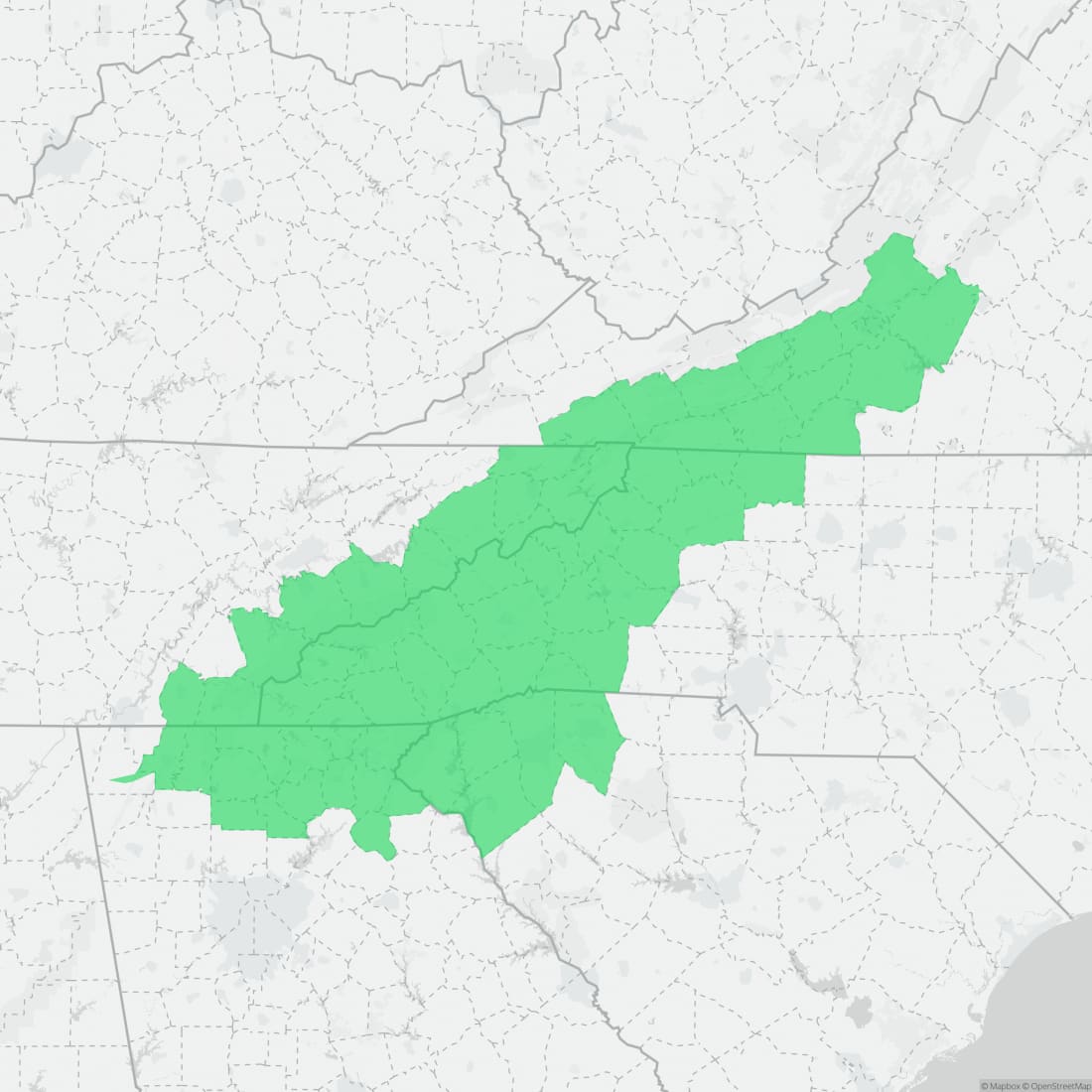
Approximate range. © Mapbox © OpenStreetMap