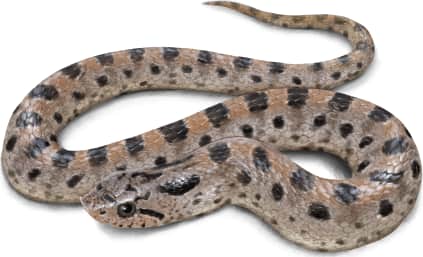
Southern Hognose Snake
Heterodon simus
Can be identified by easily distinguishable upturned snout which resembles that of a hog. Dorsum is tan, grey, or reddish and exhibits large dark brown spots down back an…
How to identify
Can be identified by easily distinguishable upturned snout which resembles that of a hog. Dorsum is tan, grey, or reddish and exhibits large dark brown spots down back and smaller spots down either side. Venter is light gray. Males and females breed between April and August. Females typically lay clutches of between 6 and 10 eggs and are larger than their male counterparts. Juveniles exhibit a gray dorsum with dark spots.
Range
Southeastern United States southward from eastern North Carolina to Florida; westward to southern Mississippi. Populations in Mississippi and Alabama are rare and potentially extirpated.
Habitat
Can be found in dry, open areas like sand ridges, pine flatwoods, sand dunes, woodlands, oak hammocks, and old fields. Especially prefer dry, sandy soil. Spends a great deal of its time burrowed underground. Diet usually includes toads and frogs; will also ingest lizards and small mammals. Uses its snout to dig for food.
Variations
When threatened, will display a number of defensive behaviors including hissing, neck spreading, and playing dead.
Similar species
Name and etymology
Genus
Heterodon
Greek for different (heteros) tooth (odotos).
Origin
Sources
- Latreille, 1801.
Heterodon. Latreille, 1801 -
Species epithet
simus
Latin for snub nosed, refereing upturned rostral scale.
Origin
Sources
- (Linnaeus, 1766). Syst. Nat., 12th ed., Vol. 1, p. 375 ↗
Virginia striatula. (Linnaeus, 1766) - Syst. Nat., 12th ed., Vol. 1, p. 375
Explore more names in the etymology index.
More illustrations
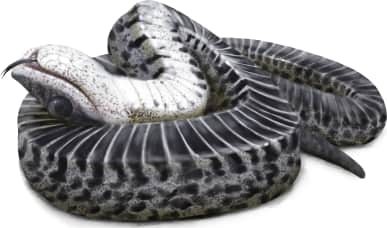
Hognose playing dead
At a glance
Size
33 to 61 cm
Range
Southeastern United States southward from eastern North Carolina to Florida; westward to southern Mississippi. Populations in…
Habitat
Can be found in dry, open areas like sand ridges, pine flatwoods, sand dunes, woodlands, oak hammocks, and old fields. Especi…
Range map
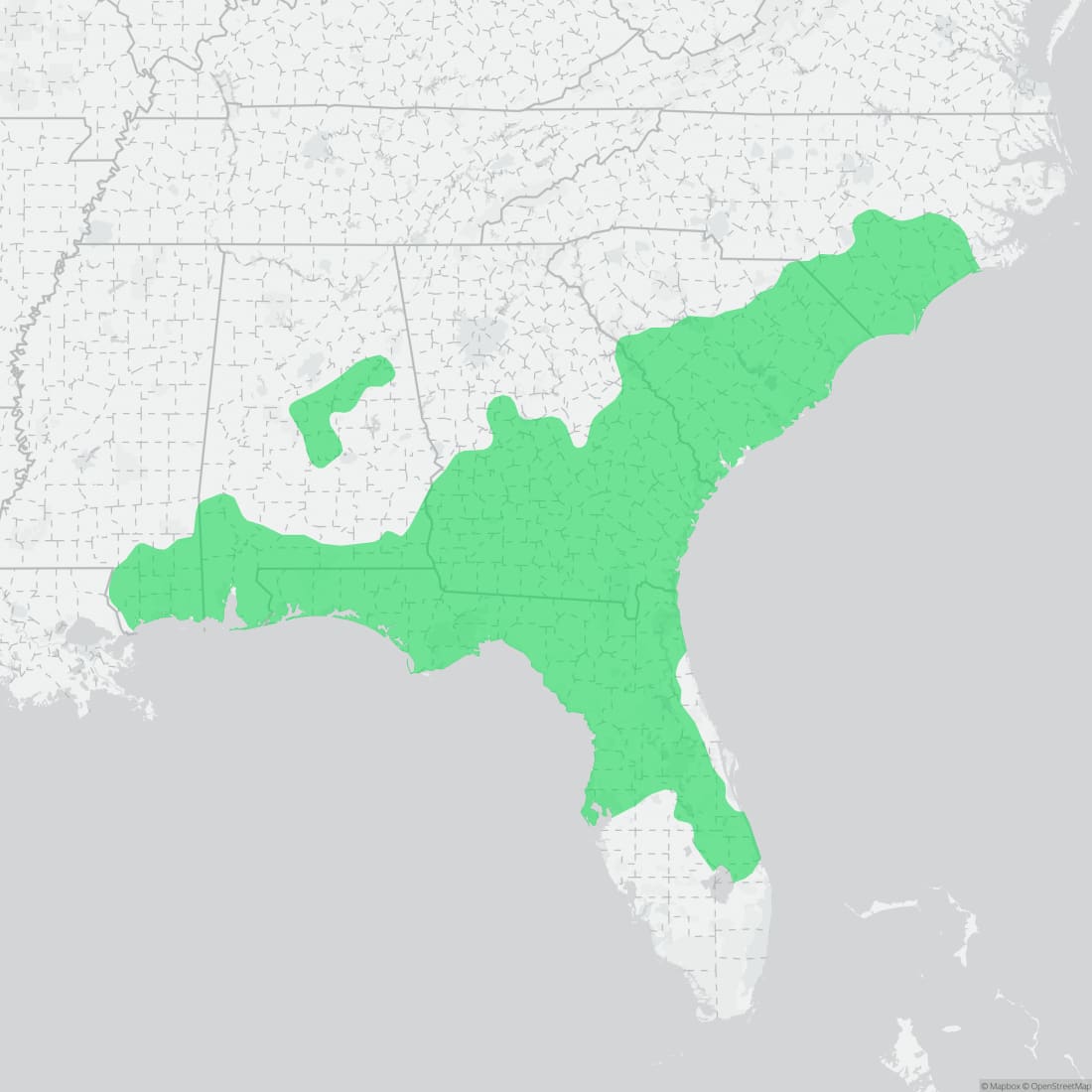
Approximate range. © Mapbox © OpenStreetMap