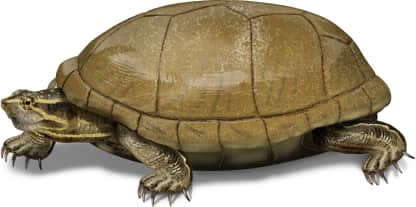
Eastern Mud Turtle
Kinosternon subrubrum
A small turtle with a smooth, rounded, patternless carapace, a pointed snout with a hooked upper mandible, and a double-hinged plastron. It averages 3-4 inches in length,…
How to identify
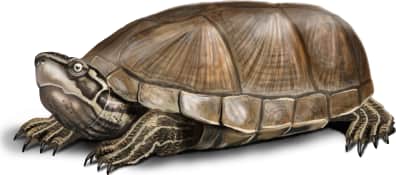
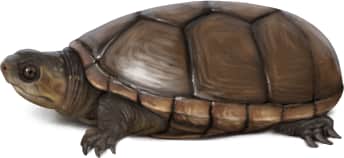
A small turtle with a smooth, rounded, patternless carapace, a pointed snout with a hooked upper mandible, and a double-hinged plastron. It averages 3-4 inches in length, and its carapace is more drastically sloped at the front of its body, giving it a pear shape when viewed from the side. It can have streaking or mottling on its throat and neck, but the rest of its skin is dark grey and unmarked. Its plastron is yellow with brown striations, and its feet are webbed. It has a large head in comparison to its body size.
Range
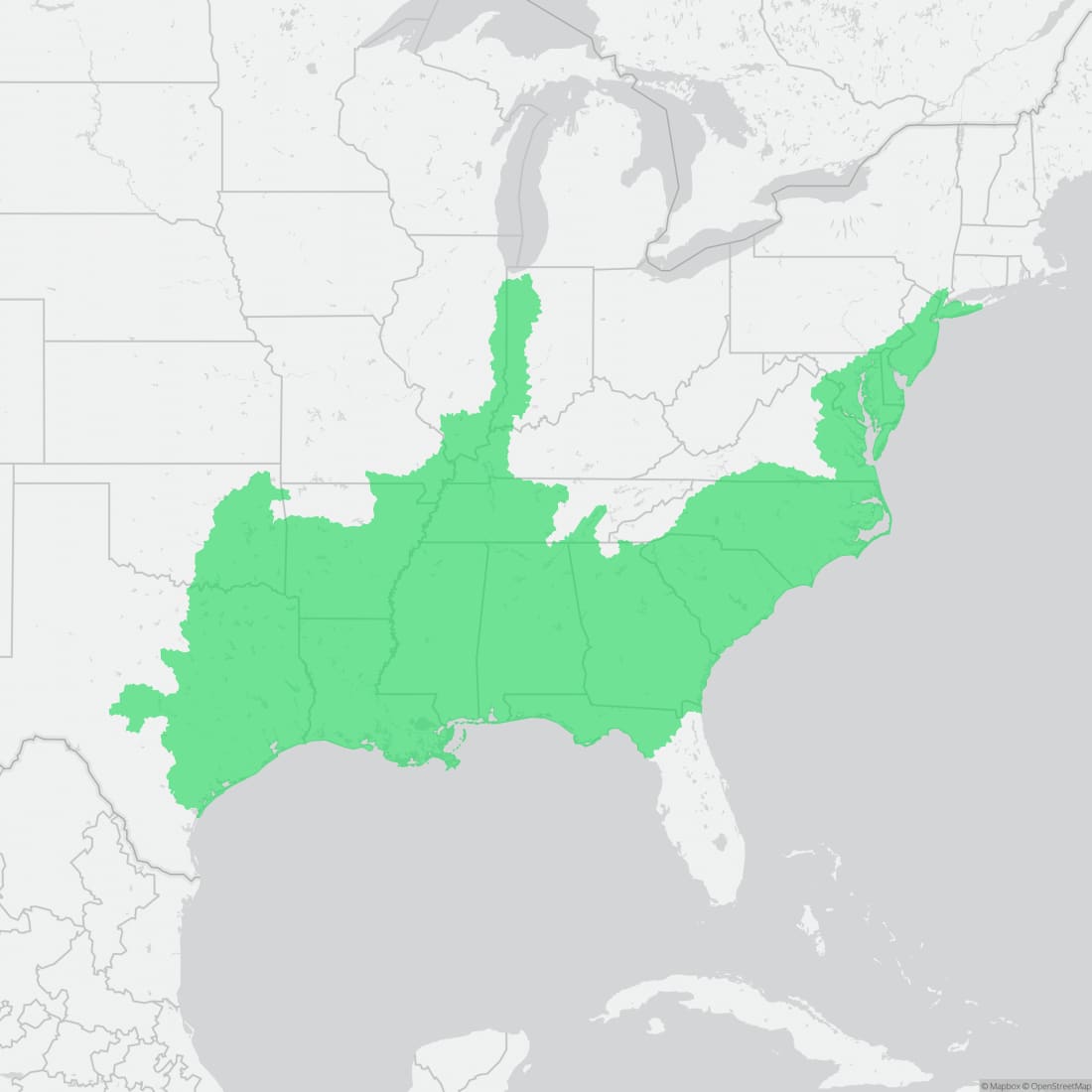
Ranges along the east coast from Long Island to south Florida, and throughout the southeastern states from Florida to central Texas, with an extension of range stretching north to southwestern Indiana.
Habitat
Found in and around rivers, lakes, ponds, and swamps with heavy vegetation. They prefer sandy or muddy areas around spring-fed water sources.
Variations
Carapace color ranges from yellowish brown to black. The plastron can be mostly brown with little yellow coloration.
Similar species
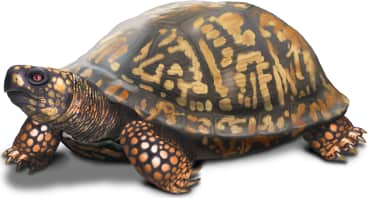
Most likely to be confused with the yellow mud turtle (*Kinosternon flavescens*), common musk turtle (*Sternotherus odoratus*), or eastern box turtle (*Terrapene carolina*).
Name and etymology
Genus
Kinosternon
Greek for moving (kineo) breast (sternon), referencing ability to move lower shell.
Origin
Sources
- Spix, 1824. Testud. Brasil, p. 17
Kinosternon. Spix, 1824 - Testud. Brasil, p. 17
Species epithet
subrubrum
red (rubrum) below (sub), referencing the plastron of hatchlings.
Origin
Sources
- (Lacepede,. Hist. Nat. Quadr. Ovip. Serp., Vol. 1, p. 132 and p. 618
Kinosternon subrubrum. (Lacepede, - Hist. Nat. Quadr. Ovip. Serp., Vol. 1, p. 132 and p. 618
Explore more names in the etymology index.
More illustrations
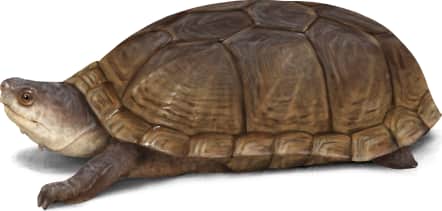
Southeastern Mud Turtle
At a glance
Range
Ranges along the east coast from Long Island to south Florida, and throughout the southeastern states from Florida to central…
Habitat
Found in and around rivers, lakes, ponds, and swamps with heavy vegetation. They prefer sandy or muddy areas around spring-fe…
Guide
Reptiles and Amphibians of North America
Range map
Approximate range. © Mapbox © OpenStreetMap