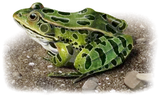
Common Box Turtle
Terrapene carolina
A terrestrial turtle with a high-domed carapace and a plastron with a single hinge that allows the turtle to close its body within the shell entirely. It is a relatively…
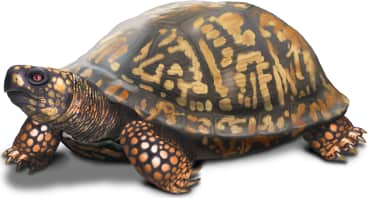
How to identify
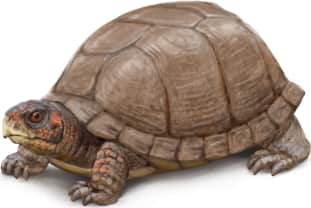
A terrestrial turtle with a high-domed carapace and a plastron with a single hinge that allows the turtle to close its body within the shell entirely. It is a relatively small turtle that typically reaches 4.5-6 inches in length. This species has a distinctive hooked upper mandible, and non-webbed tortoise-like feet for walking on land. Its shell is smooth, but individual scutes have very slight peaks in the center. The edge of the shell is not serrated. The coloration and patterning of this species is highly variable, but they are generally brown with yellow, orange, or red markings on their skin and shell.
Range
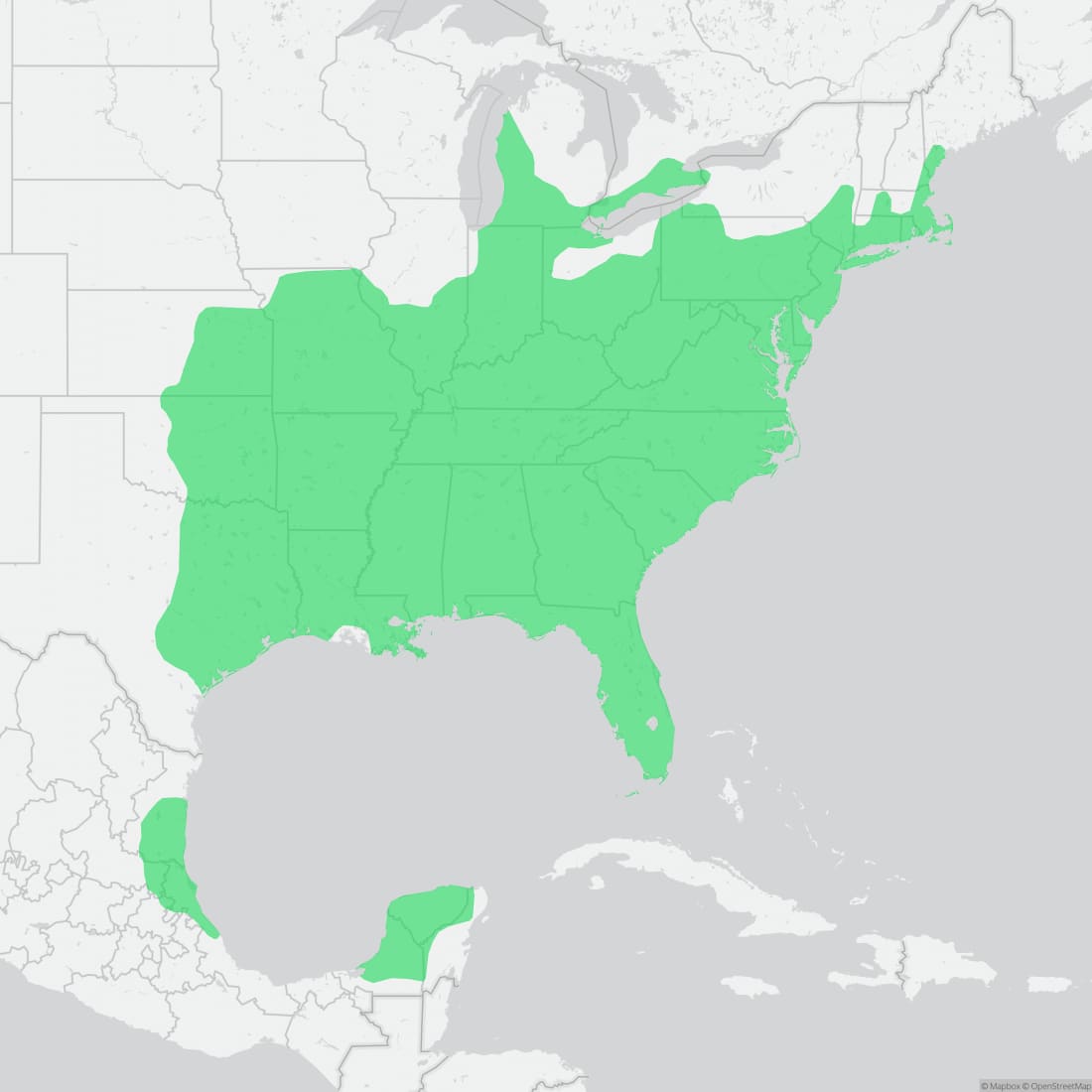
Large range covering most of the eastern half of the United States
Habitat
Eastern box turtles will inhabit open woodlands, marshy meadows, scrublands, grasslands, swampy areas, and suburban areas. They are often found near roads or they get hurt trying to cross roads. They like to take shelter in leaf litter, under logs, and in abandoned burrows. In the northern part of their range, they hibernate underground through winter.
Variations
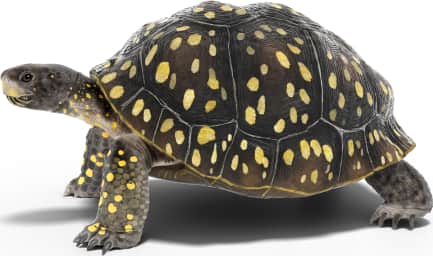
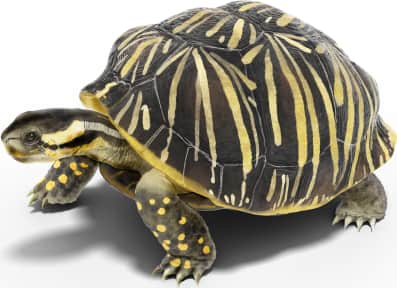
Males have red eyes, while females have yellow-brown eyes. Females also have longer, straighter claws on their hind feet, and their tails are shorter and thinner. Males have a concave plastron, while females have a flat plastron. Carapace can be all brown with no markings, or have yellow, orange, or red stripes, striations, marbling, spots, or blotches. The color of the markings will also match their skin & scale coloration. Their skin and scales can be a solid color, or have random unique markings on the face and legs.
Similar species
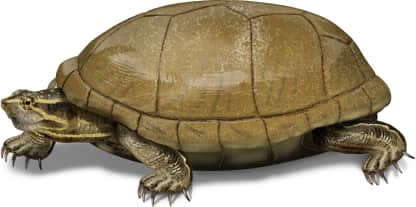
Most likely to be confused with the ornate box turtle (*Terrapene ornata*), but could also be misidentified as an eastern mud turtle (*Kinosternon subrubrum*) or painted wood turtle (*Rhinoclemmys pulcherrima*).
Name and etymology
Genus
Terrapene
Derived from the Algonquian word for turtle.
Origin
Sources
- Merrem, 1820. Tent. Syst. Amph., p. 27
Terrapene. Merrem, 1820 - Tent. Syst. Amph., p. 27
Species epithet
carolina
Belonging to Carolina, where the species was first discovered.
Origin
Sources
- (Linnaeus, 1758). Syst. Nat., 10th ed., Vol. 1, p. 198 ↗
Terrapene carolina. (Linnaeus, 1758) - Syst. Nat., 10th ed., Vol. 1, p. 198
Explore more names in the etymology index.
More illustrations
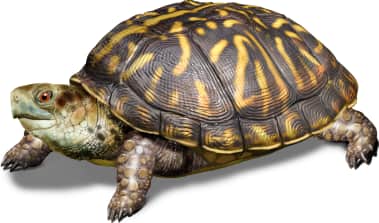
Gulf Coast Box Turtle
Florida box turtle
At a glance
Size
11 to 18 cm
Range
Large range covering most of the eastern half of the United States
Habitat
Eastern box turtles will inhabit open woodlands, marshy meadows, scrublands, grasslands, swampy areas, and suburban areas. Th…
Range map
Approximate range. © Mapbox © OpenStreetMap