Coastal Rosy Boa
Lichanura orcutti
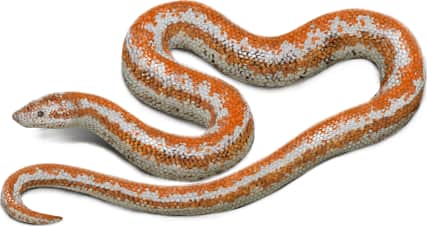
This thick-bodied snake has smooth scales, a short, blunt tail, and a narrow, elongated head. Color and pattern is variable, but this snake generally has a pale tan backg…
How to identify
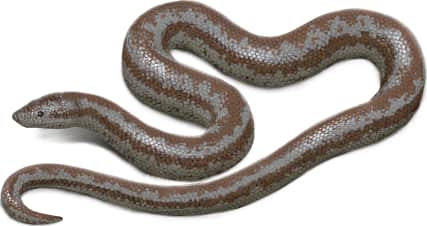
This thick-bodied snake has smooth scales, a short, blunt tail, and a narrow, elongated head. Color and pattern is variable, but this snake generally has a pale tan background with 3 longitudinal stripes that are typically burnt orange. These stripes can be straight-edged and well-defined, or they can be jagged-edged, broken, or blotchy. Its ventrum is usually pale grey with dark speckles. Average adult body length is 17-44 inches.
Range
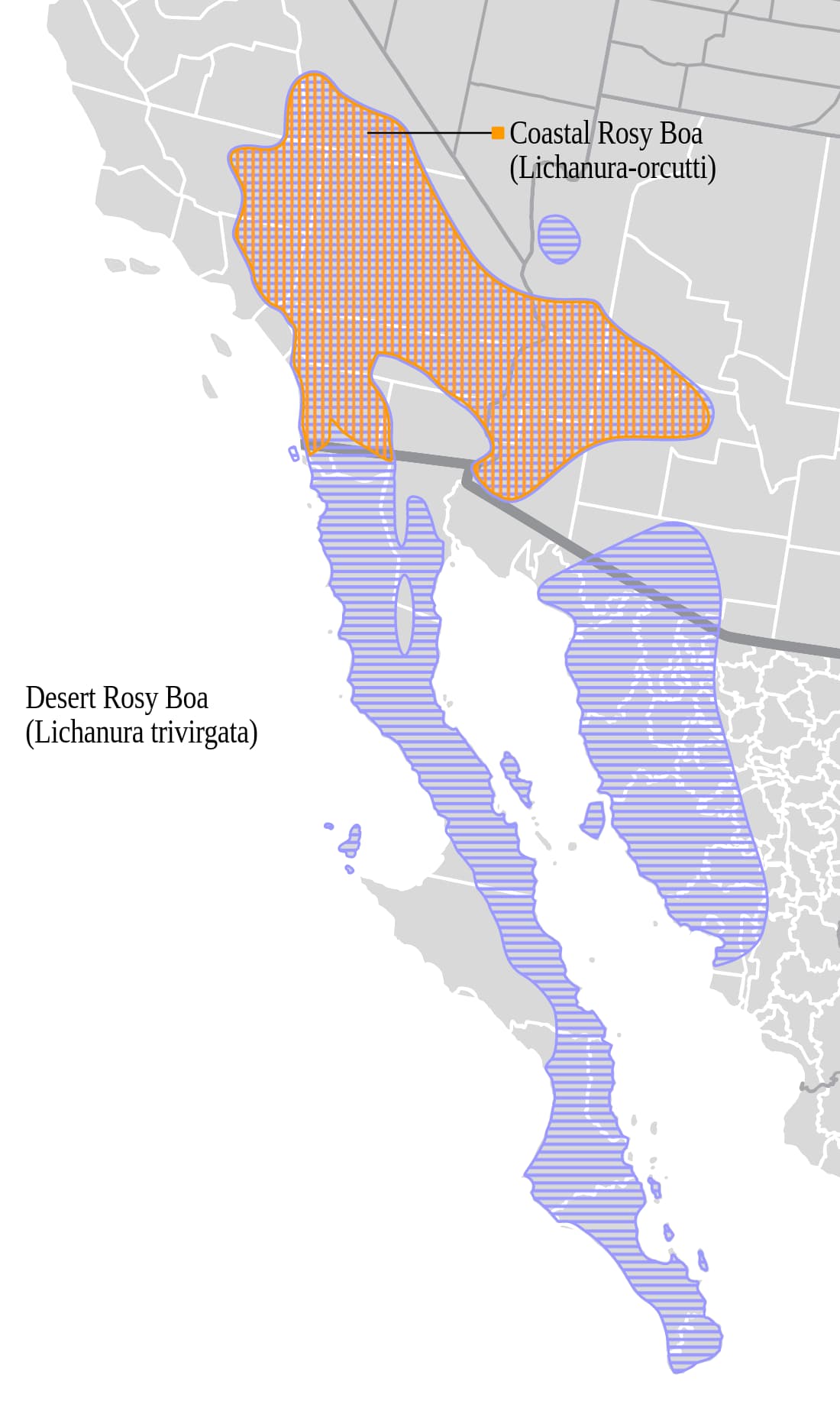
Ranges throughout southern California, western Arizona, and slightly across the border into adjacent northwestern Mexico.
Habitat
This species is most often found in dry, rocky environments. It is common in riparian habitats, but also found in canyons, rocky deserts, and semi-arid shrublands.
Variations
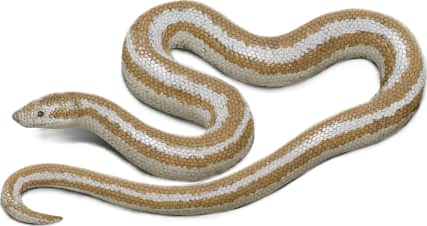
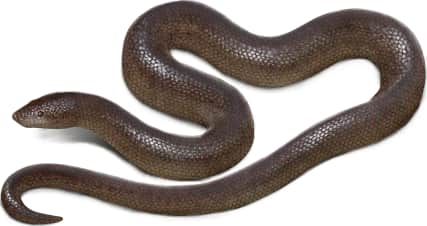
Pattern color ranges from burnt orange, to rosy pink, to shades of brown. Some individuals are a solid dark tan to brown color, with no pattern. Individuals with well-defined, straight-edged stripes are often found in drier habitats.
Similar species
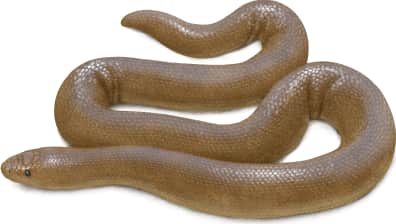
Very similar to the desert rosy boa (*Lichanura trivirgata*), but could also be confused with the southern rubber boa (*Charina umbratica*) or northern rubber boa (*Charina bottae*).
Name and etymology
Genus
Lichanura
Greek for forefinger (lichanos) tail (oura).
Origin
Sources
- Cope, 1861. Proc. Acad. Nat. Sci. Philadelphia, Vol. 13, p. 304 ↗
Lichanura. Cope, 1861 - Proc. Acad. Nat. Sci. Philadelphia, Vol. 13, p. 304
Species epithet
orcutti
Honoring Charles R. Orcutt.
Origin
Honors
Sources
- Stejneger, 1893. N. Amer. Fauna, No. 7, p. 181, pl. 1, figs. 4a-c ↗
Sceloporus orcutti. Stejneger, 1893 - N. Amer. Fauna, No. 7, p. 181, pl. 1, figs. 4a-c
Explore more names in the etymology index.
More illustrations
At a glance
Size
43 to 112 cm
Range
Ranges throughout southern California, western Arizona, and slightly across the border into adjacent northwestern Mexico.
Habitat
This species is most often found in dry, rocky environments. It is common in riparian habitats, but also found in canyons, ro…
Range map
Approximate range. © Mapbox © OpenStreetMap