Red Salamander
Pseudotriton ruber
A somewhat large, heavy-bodied salamander averaging 11-18 cm in total length. It has thick, sturdy legs and a wide, flattened head with a very rounded snout. Its tail is…
How to identify
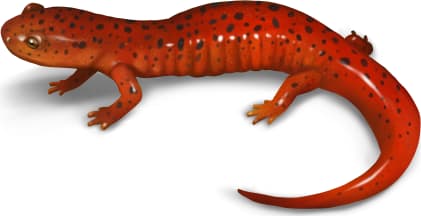
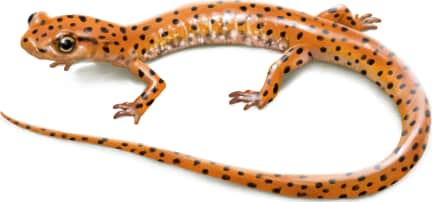
A somewhat large, heavy-bodied salamander averaging 11-18 cm in total length. It has thick, sturdy legs and a wide, flattened head with a very rounded snout. Its tail is no longer than its body, very thick at the base, and then becomes laterally compressed. Juveniles typically start out brown with subtle black dorsal spots. Adults develop a vibrant orange to red coloration with many distinct black spots on their dorsal surfaces. Its ventrum is slightly paler than the dorsum, and has very muted or no spotting. Its golden eyes are relatively small and set far apart.
Range
Wide ranging through the eastern United States, from central New York through the Florida panhandle, and west through eastern Ohio, and most of Kentucky, Tennessee, and Mississippi. South of Delaware, it is absent from the coastal areas along the Atlantic.
Habitat
This species is semi-aquatic and spends more time in wet environments in the hot summer months. It prefers slow-moving woodland springs and seepage areas. In the cooler months, it is more terrestrial and spends time in burrows, or under logs, rocks, or sphagnum moss in woodlands, swamps, fields, or meadows.
Variations
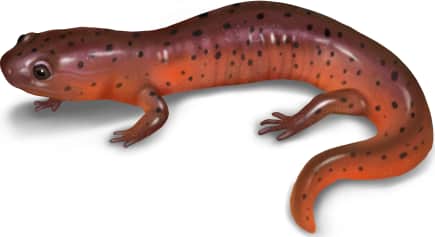
Older adults become darker with age, becoming brownish red. Spotting can be minimal or very dense.
Similar species
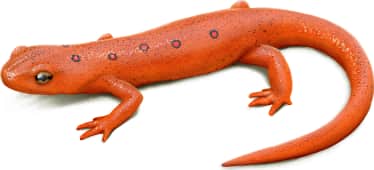
Most akin to the mud salamander (*Pseudotriton montanus*) which shares much of its range, but generally has fewer spots. It is thought to mimic the coloration of the toxic eastern newt (*Notophthalmus viridescens*). It also resembles the cave salamander (*Eurycea lucifuga*) which is much more slender with a long rounded tail.
Name and etymology
Genus
Pseudotriton
Greek for false (pseudes) Triton, referencing similarity to the European genus Triturus.
Origin
Sources
- Tschudi, "1838" 1839. reprinted in Classif. Batr., Mem. Soc. Sci. Nat. Neuchatel, p. 60 ↗
Pseudotriton. Tschudi, "1838" 1839 - reprinted in Classif. Batr., Mem. Soc. Sci. Nat. Neuchatel, p. 60
Species epithet
ruber
Latin for red.
Origin
Sources
- Cope, 1892. Proc. U.S. Natl. Mus., Vol. 14, p. 690 ↗
Crotalus ruber. Cope, 1892 - Proc. U.S. Natl. Mus., Vol. 14, p. 690
- (Latreille, 1801).
Pseudotriton ruber. (Latreille, 1801) -
Explore more names in the etymology index.
More illustrations
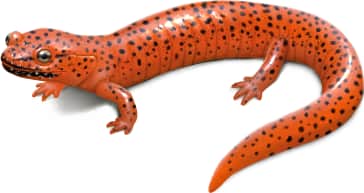
Black-chinned Red Salamander
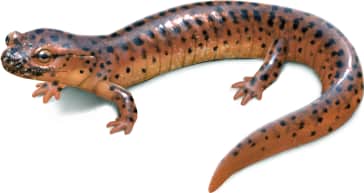
Southern Red Salamander
At a glance
Size
11 to 18 cm
Range
Wide ranging through the eastern United States, from central New York through the Florida panhandle, and west through eastern…
Habitat
This species is semi-aquatic and spends more time in wet environments in the hot summer months. It prefers slow-moving woodla…
Range map
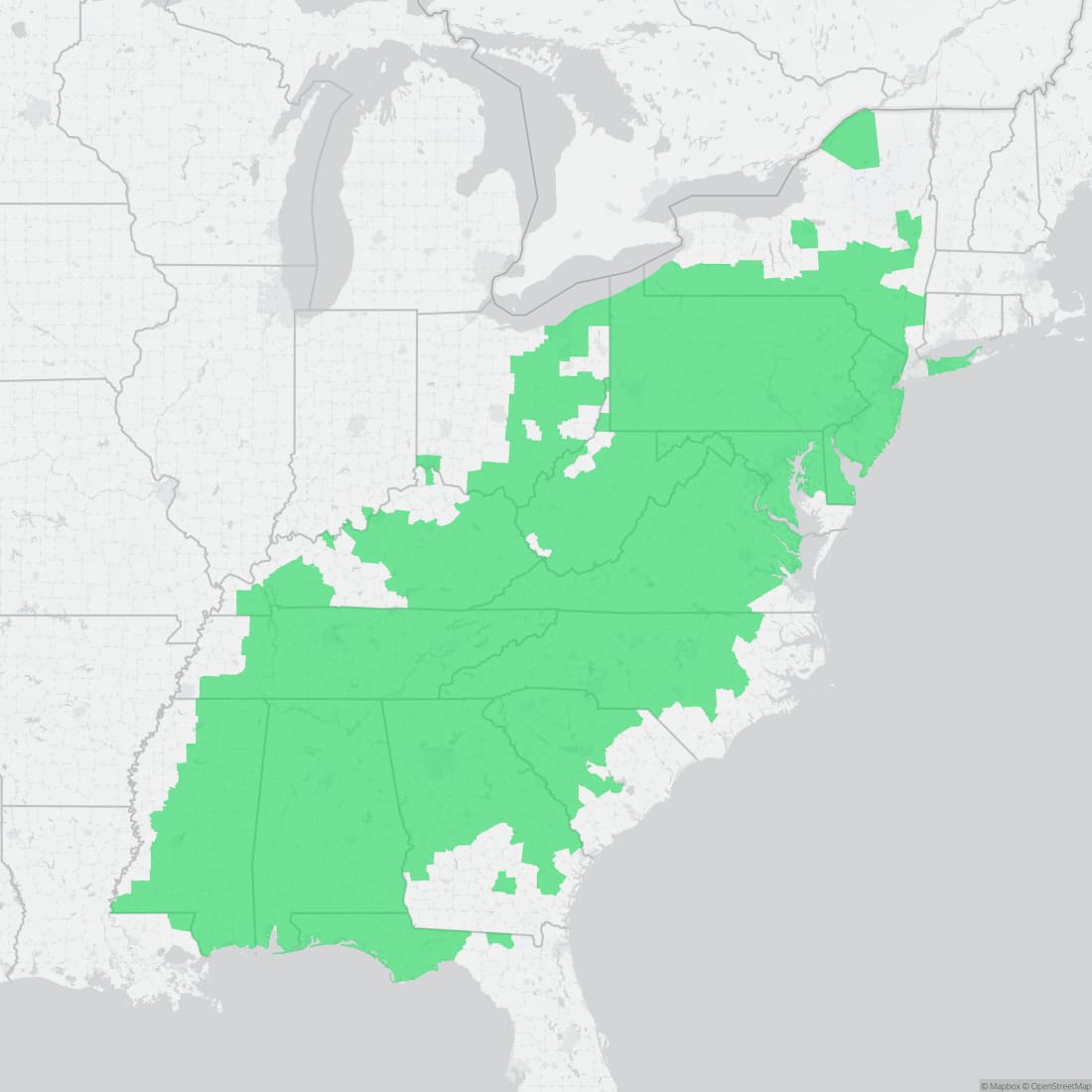
Approximate range. © Mapbox © OpenStreetMap