
Mud Salamander
Pseudotriton montanus
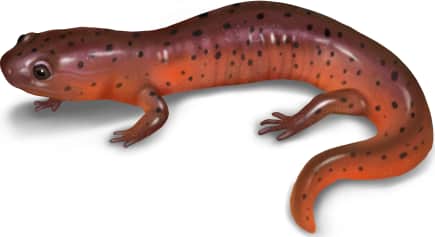
A very stocky salamander with a wide face and a very short snout. It has short, stubby legs and 16-17 costal grooves. It averages 8-16 cm in total length and has gold col…
How to identify
A very stocky salamander with a wide face and a very short snout. It has short, stubby legs and 16-17 costal grooves. It averages 8-16 cm in total length and has gold colored irises. Depending on subspecies and locality, they are either orange or red with black spots, or drab grey-brown with speckles or spots.
Range
Wide-ranging in the eastern United States, from southern Pennsylvania and New Jersey down the Atlantic coast to central Florida, west along the Gulf coast to southeastern Louisiana, and stretching inland throughout eastern Tennessee, most of Kentucky, and southern Ohio.
Habitat
Like most salamanders, this species is often found hiding under rocks, logs, or leaf litter. It prefers moist habitats around streams, swamps, bogs, or water seepage areas at lower elevations.
Variations
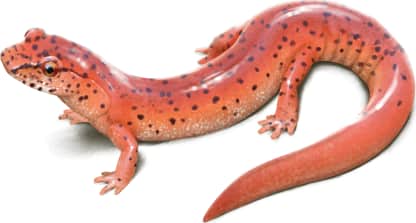
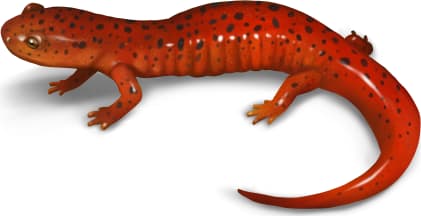
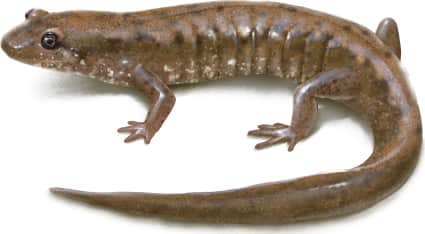
There are 4 subspecies and they vary in coloration by age and locality. Inland salamanders are bright orange with random black spots, while coastal populations are more brown and drab with faint speckling or black spots. Juveniles are lighter in overall coloration, and adults become darker with age. Ventrum is unmarked on juveniles, but develops spots with age.
Similar species
Orange spotted individuals are most similar to the red salamander (*Pseudotriton ruber*) and spring salamander (*Gyrinophilus porphyriticus*). Darker individuals resemble the northern dusky salamander (*Desmognathus fuscus*)
Name and etymology
Genus
Pseudotriton
Greek for false (pseudes) Triton, referencing similarity to the European genus Triturus.
Origin
Sources
- Tschudi, "1838" 1839. reprinted in Classif. Batr., Mem. Soc. Sci. Nat. Neuchatel, p. 60 ↗
Pseudotriton. Tschudi, "1838" 1839 - reprinted in Classif. Batr., Mem. Soc. Sci. Nat. Neuchatel, p. 60
Species epithet
montanus
Latin for belonging to mountains.
Origin
Sources
- Baird, 1849. Journ. Acad. Nat. Sci. Philadelphia, Ser. 2, Vol. 1, p. 293 ↗
Pseudotriton montanus. Baird, 1849 - Journ. Acad. Nat. Sci. Philadelphia, Ser. 2, Vol. 1, p. 293
Explore more names in the etymology index.
At a glance
Size
7.5 to 16 cm
Range
Wide-ranging in the eastern United States, from southern Pennsylvania and New Jersey down the Atlantic coast to central Flori…
Habitat
Like most salamanders, this species is often found hiding under rocks, logs, or leaf litter. It prefers moist habitats around…
Range map
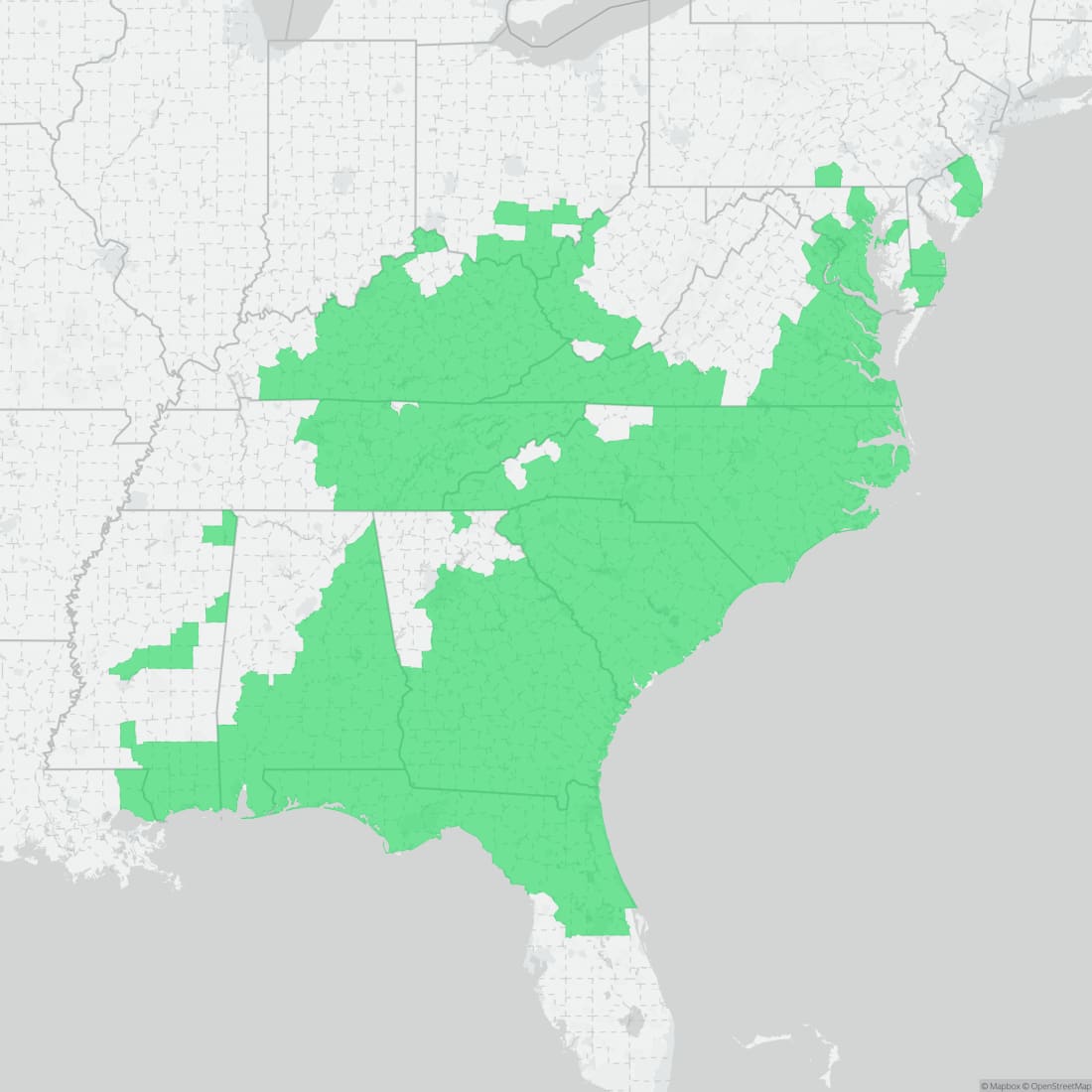
Approximate range. © Mapbox © OpenStreetMap