Clark's Spiny Lizard
Sceloporus clarkii
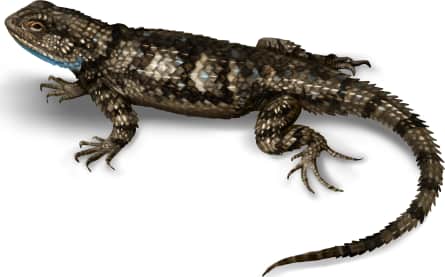
Stocky lizard with keeled, overlapping scales all over. Mostly grey-brown with flecks of turquoise scattered over its dorsum. It has an incomplete black collar around the…
How to identify
Stocky lizard with keeled, overlapping scales all over. Mostly grey-brown with flecks of turquoise scattered over its dorsum. It has an incomplete black collar around the underside of its neck, and black bands on the front legs. Males have vibrant blue accents on the throat, underside of tail, and on each side of their ventral abdomen with a central stripe of black or tan between. Brow ridges above each eye are prominent. Its long toes have yellow bands of color. It grows up to 5.6 inches from snout to vent.
Range
Central and southeastern Arizona and southwestern New Mexico. Range also extends south along the western coast of Mexico.
Habitat
Found in a wide variety of habitats within its range, including scrublands, grasslands, woodlands, chaparral, and mountain slopes. It's an excellent climber and often found scaling tree trunks or rock faces.
Variations
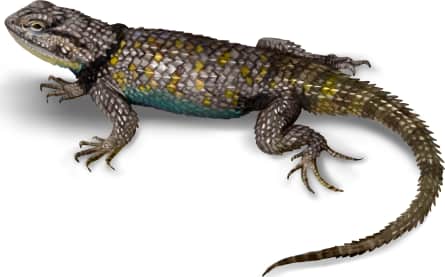
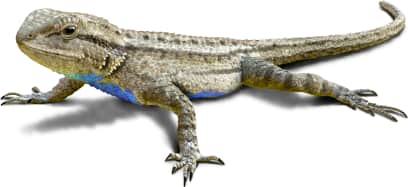
Amount of blue accent coloration varies, and is sometimes outlined in black. Some are primarily shades of tan and brown, rather than grey. Females often have darker crossbar patterning on their bodies.
Similar species
Most similar in appearance to the desert spiny lizard (*Sceloporus magister*), which lacks the black bars on its forelimbs. Also looks a lot like the western fence lizard (*Sceloporus occidentalis*) and the eastern spiny lizard (*Sceloporus spinosus*).
Name and etymology
Genus
Sceloporus
Greek for leg (skelos) pores (porus), referencing femoral pores on back legs.
Origin
Sources
- Wiegmann, 1828. Isis von Oken, Vol. 21, p. 369 ↗
Sceloporus. Wiegmann, 1828 - Isis von Oken, Vol. 21, p. 369
Species epithet
clarkii
Honoring John H. Clark
Origin
Honors
Sources
- Baird and Girard, 1852. Proc. Acad. Nat. Sci. Philadelphia, Vol. 6, p. 127 ↗
Sceloporus clarkii. Baird and Girard, 1852 - Proc. Acad. Nat. Sci. Philadelphia, Vol. 6, p. 127
- (Baird and Girard, 1853). Cat. N. Amer. Rept., Pt. 1, p. 48 ↗
Nerodia clarkii. (Baird and Girard, 1853) - Cat. N. Amer. Rept., Pt. 1, p. 48
Explore more names in the etymology index.
At a glance
Range
Central and southeastern Arizona and southwestern New Mexico. Range also extends south along the western coast of Mexico.
Habitat
Found in a wide variety of habitats within its range, including scrublands, grasslands, woodlands, chaparral, and mountain sl…
Guide
Reptiles and Amphibians of North America
Range map
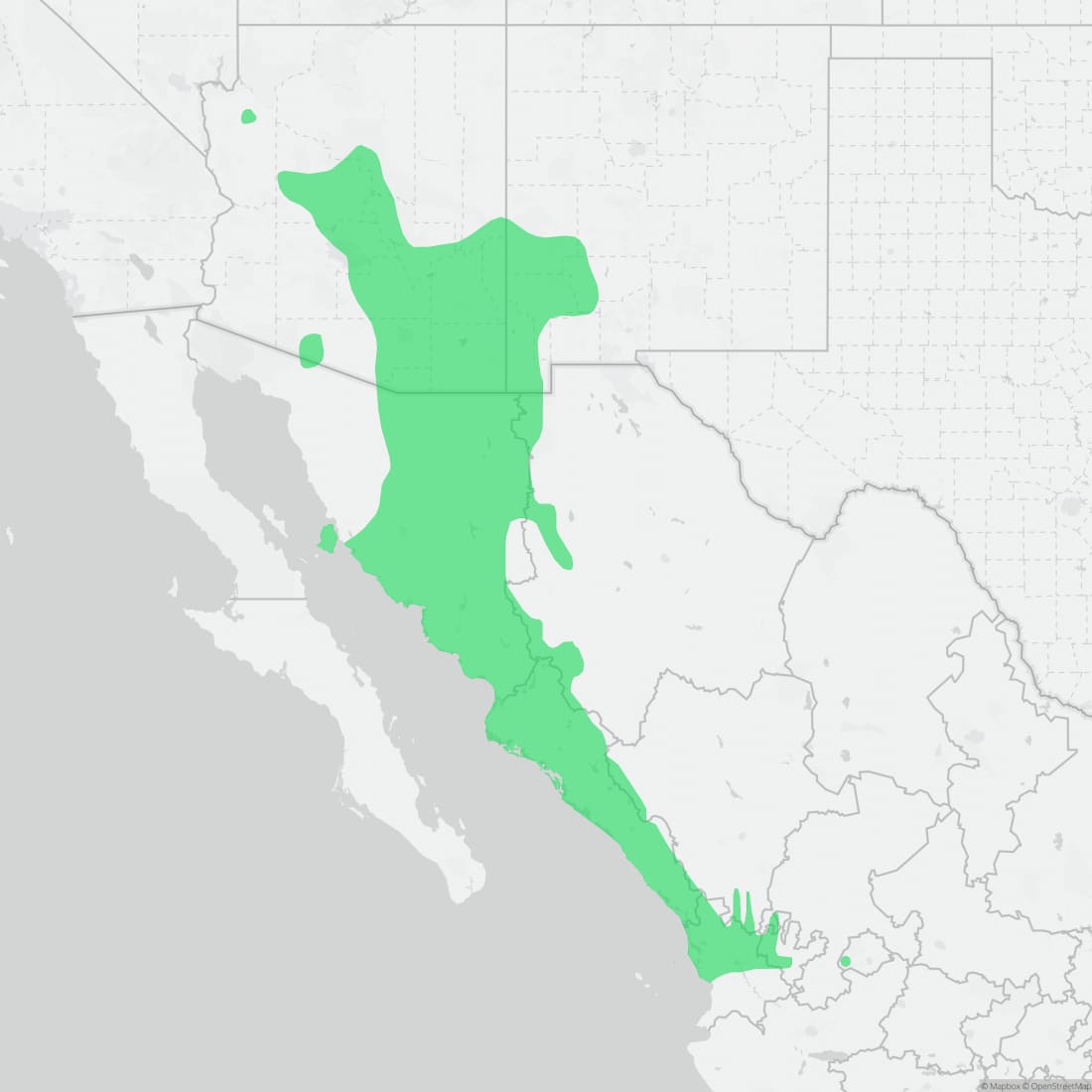
Approximate range. © Mapbox © OpenStreetMap