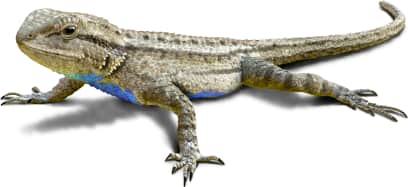
Western Fence Lizard
Sceloporus occidentalis
Known for having large, overlapping, and pointed scales on back and limbs. Color can vary but is usually black, brown or gray with wavy dark and light bands across back.…
How to identify
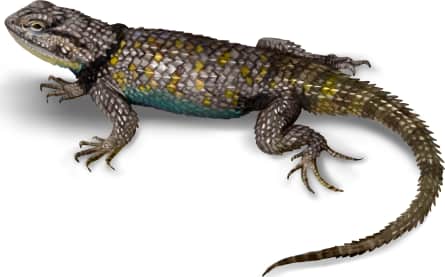
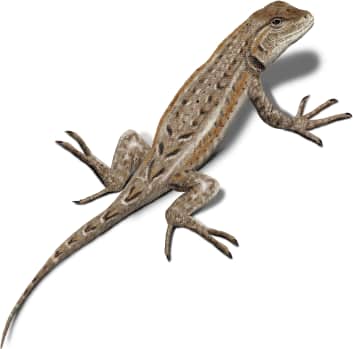
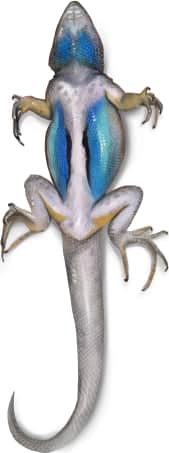
Known for having large, overlapping, and pointed scales on back and limbs. Color can vary but is usually black, brown or gray with wavy dark and light bands across back. Thigh rear is yellow or orange and exhibits mostly keeled scales. Snout-vent length up to 3.9 inches (9.9 cm). Tail can completely detach when being threatened and allow lizard to escape. When breeding, males exhibit a blue patch on the throat, a blue black-edged patch on either side of the belly, two enlarged scales behind vent, and two swollen copulatory organs below tail base. Mating occurs in spring, and eggs are laid from April to July. Clutch size ranges from 3 to 17 depending on female's size, elevation, and latitude.
Range
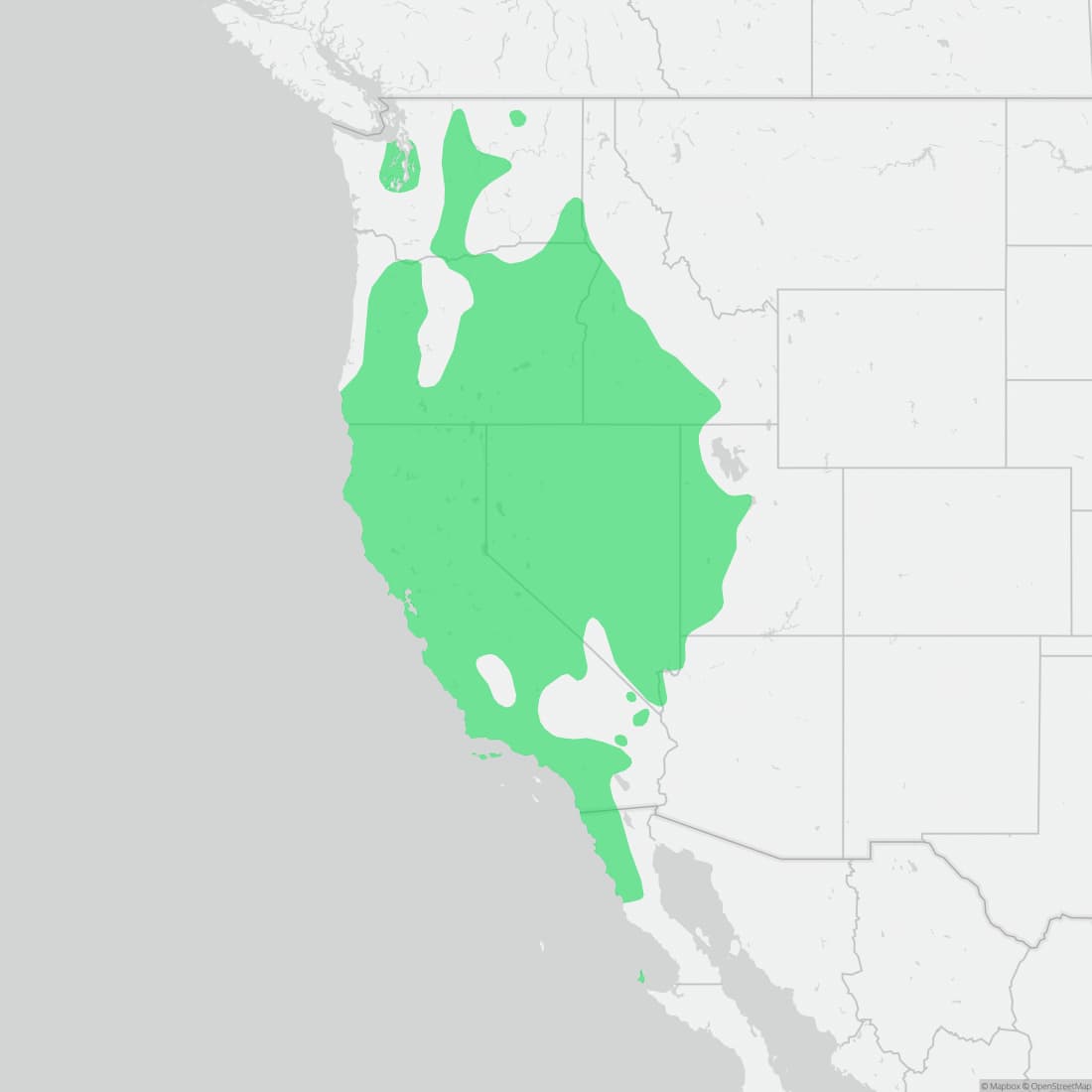
As far north as Washington and southeastern Idaho; south through Oregon, Nevada, western Utah, and Baja, California.
Habitat
Found on the ground or low perches in grassland, woodland, sagebrush, rocky canyons, open coniferous forests, and talus slopes. Does not inhabit severe deserts, but can be found near the deserts on mountain slopes. Commonly seen in suburban dwellings on basking sites like fences, woodpiles, and walls. Typically feed on insects including flies, beetles, ants, spiders, and caterpillars. During the winter, they are generally inactive.
Variations
Contains many subspecies including the Island Fence Lizard, or *Sceloporus occidentalis becki*, found only off the southern California coast in the Channel Islands, and the Great Basin Fence Lizard, or *Sceloporus occidentalis longipes*, which usually are black in color.
Similar species
Northern Sagebrush Lizard - Sceloporus graciosus graciosus Western Sagebrush Lizard - Sceloporus graciosus gracilis Southern Sagebrush Lizard - Sceloporus graciosus vandenburgianus
Name and etymology
Genus
Sceloporus
Greek for leg (skelos) pores (porus), referencing femoral pores on back legs.
Origin
Sources
- Wiegmann, 1828. Isis von Oken, Vol. 21, p. 369 ↗
Sceloporus. Wiegmann, 1828 - Isis von Oken, Vol. 21, p. 369
Species epithet
occidentalis
Latin for western
Origin
Sources
- Baird and Girard, 1852. Proc. Acad. Nat. Sci. Philadelphia, Vol. 6, p. 175 ↗
Sceloporus occidentalis. Baird and Girard, 1852 - Proc. Acad. Nat. Sci. Philadelphia, Vol. 6, p. 175
Explore more names in the etymology index.
More illustrations
At a glance
Range
As far north as Washington and southeastern Idaho; south through Oregon, Nevada, western Utah, and Baja, California.
Habitat
Found on the ground or low perches in grassland, woodland, sagebrush, rocky canyons, open coniferous forests, and talus slope…
Guide
Reptiles and Amphibians of North America
Range map
Approximate range. © Mapbox © OpenStreetMap