Mexican Spadefoot
Spea multiplicata
A small, stout-bodied toad that reaches 1.5-2.5 inches in length. It has a relatively large head with big, bulging eyes and vertical pupils. It has small bumps all over i…
How to identify
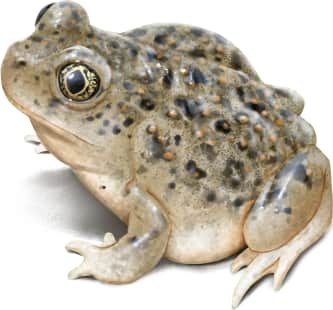
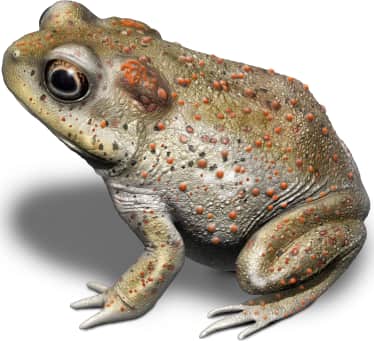
A small, stout-bodied toad that reaches 1.5-2.5 inches in length. It has a relatively large head with big, bulging eyes and vertical pupils. It has small bumps all over its skin, and is named for the hard, black, spade-like projections on its hind feet used for digging. Its background coloration is light tan, grey, or greenish with small dark spots all over its dorsum, often aligned with the skin bumps. Some spots are distinct while others are faded. It has a plump belly and a bi-lobed gular sac. Its ventrum is pale and unmarked.
Range
Large range throughout the southwest, including most of Arizona, southeastern Utah, southern Colorado, western Oklahoma, western Texas, and all of New Mexico. It stretches south through central Mexico.
Habitat
Spends most of its life buried underground, emerging nocturnally after summer monsoon rains to feed and breed in temporary rain pools.
Variations
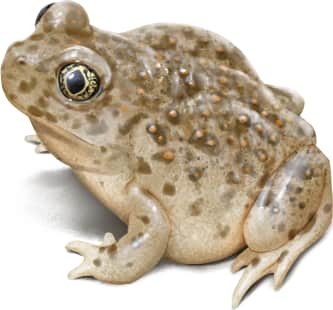
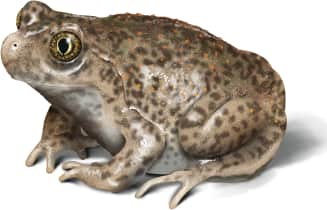
Dark spot coloration ranges from brown to green, and some are highlighted with orange. Some individuals have large blotchy patterns on their backs, while others are very dark with subtle patterning.
Similar species
It used to be considered a subspecies of the western spadefoot (*Spea hammondii*), and it's similar to the plains spadefoot (*Spea bombifrons*), with which it will sometimes hybridize. It could also be confused with the red-spotted toad (*Anaxyrus punctatus*).
Name and etymology
Genus
Spea
Greek for cave or cavern.
Origin
Sources
- Cope, 1866. Journ. Acad. Nat. Sci. Philadelphia, Vol. 6, 2nd Series, p. 81 ↗
Spea. Cope, 1866 - Journ. Acad. Nat. Sci. Philadelphia, Vol. 6, 2nd Series, p. 81
Species epithet
multiplicata
Latin for many (multi) folds (plicatus).
Origin
Sources
- (Cope, 1863). Proc. Acad. Nat. Sci. Philadelphia, Vol. 15, p. 52 ↗
Spea multiplicata. (Cope, 1863) - Proc. Acad. Nat. Sci. Philadelphia, Vol. 15, p. 52
Explore more names in the etymology index.
At a glance
Range
Large range throughout the southwest, including most of Arizona, southeastern Utah, southern Colorado, western Oklahoma, west…
Habitat
Spends most of its life buried underground, emerging nocturnally after summer monsoon rains to feed and breed in temporary ra…
Guide
Reptiles and Amphibians of North America
Range map
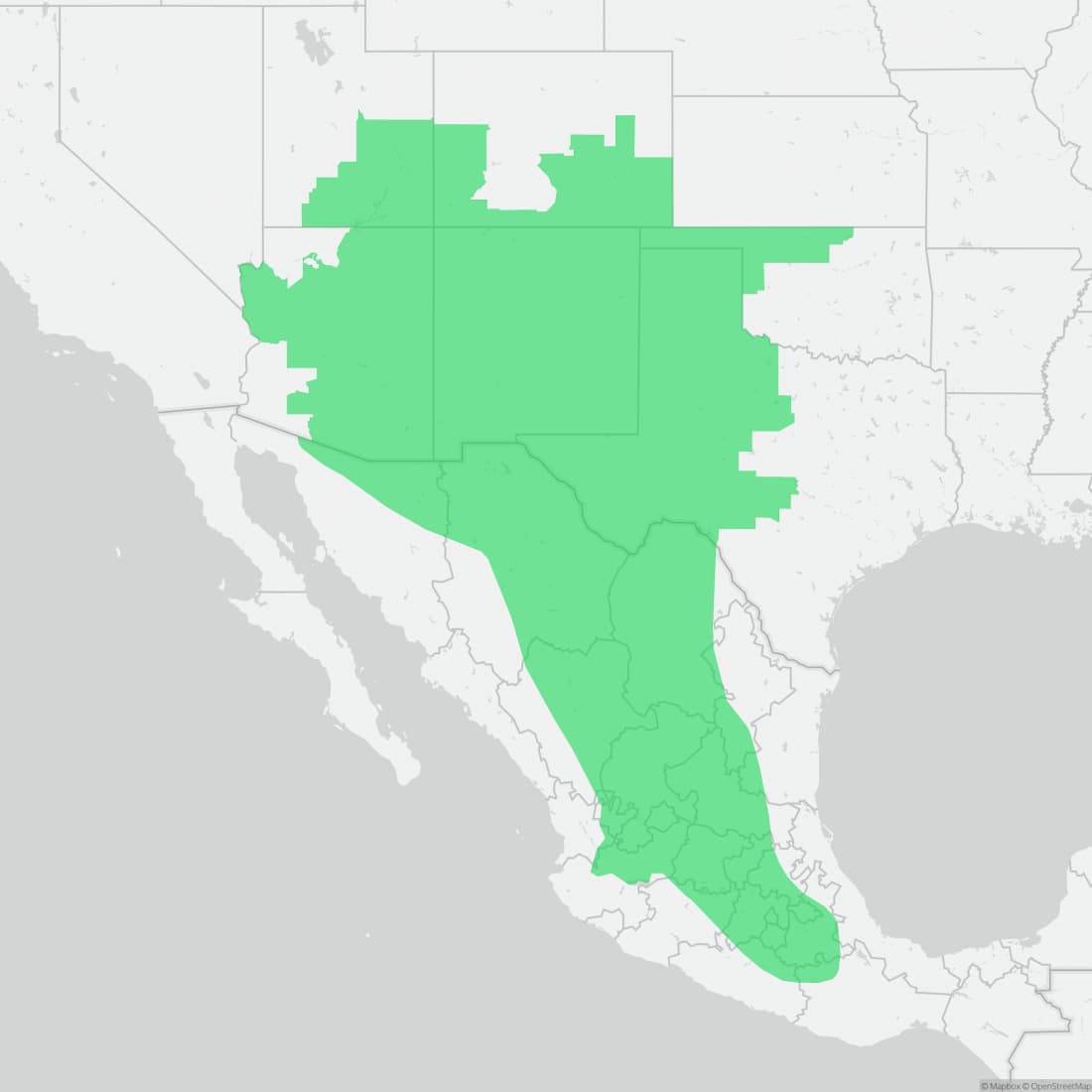
Approximate range. © Mapbox © OpenStreetMap