Red-bellied Newt
Taricha rivularis
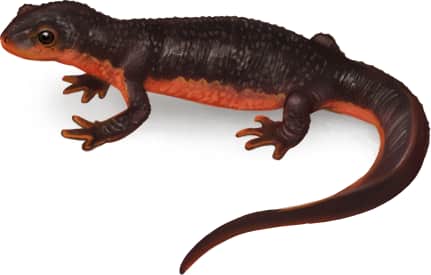
This mostly terrestrial newt is named for the bright orange to red coloration on all of its ventral surfaces and around its mouth. It averages 5.5-7.5 inches in total len…
How to identify
This mostly terrestrial newt is named for the bright orange to red coloration on all of its ventral surfaces and around its mouth. It averages 5.5-7.5 inches in total length, and has long, well-developed legs with wide feet. Its body is wide, but its tail is narrow and laterally compressed. Its dorsum is uniformly dark brown, grey, or black with small bumps all over the skin. It has dark eyes that are only mildly bulging. Its skin contains a potent toxin if consumed. Larvae are aquatic.
Range
Endemic to most of the Northern Coast Ranges of California.
Habitat
Lives in and around rocky streams and rivers in coastal woodlands and redwood forest habitats. Newly transformed juveniles move underground for the first several years of life, until they are old enough to emerge and breed above ground.
Variations
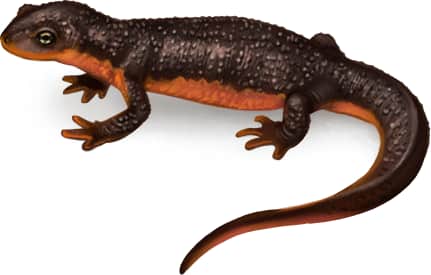
Breeding males lose their skin bumps and become smooth. Their tail also becomes flatter. Males have a broad dark band across their vent, which is thinner or absent in females.
Similar species
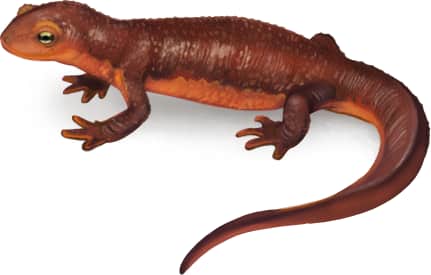
Very similar to the rough-skinned newt (*Taricha granulosa*) which has more yellow-orange underparts and light eyes. It could also be mistaken for the California newt (*Taricha torosa*).
Name and etymology
Genus
Taricha
Greek for preserved mummy.
Origin
Sources
- Gray, 1850. Cat. Spec. Amph. Coll. Brit. Mus., Batr. Grad., Part 2, p. 25
Taricha. Gray, 1850 - Cat. Spec. Amph. Coll. Brit. Mus., Batr. Grad., Part 2, p. 25
Species epithet
rivularis
Latin for brook, referencing it only breeds in streams.
Origin
Sources
- (Twitty, 1935). Copeia, p. 73 ↗
Taricha rivularis. (Twitty, 1935) - Copeia, p. 73
Explore more names in the etymology index.
More illustrations
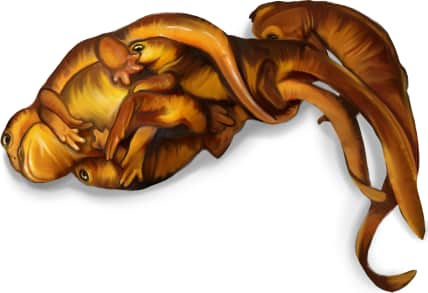
Newt Matting Ball
At a glance
Range
Endemic to most of the Northern Coast Ranges of California.
Habitat
Lives in and around rocky streams and rivers in coastal woodlands and redwood forest habitats. Newly transformed juveniles mo…
Guide
Reptiles and Amphibians of North America
Range map
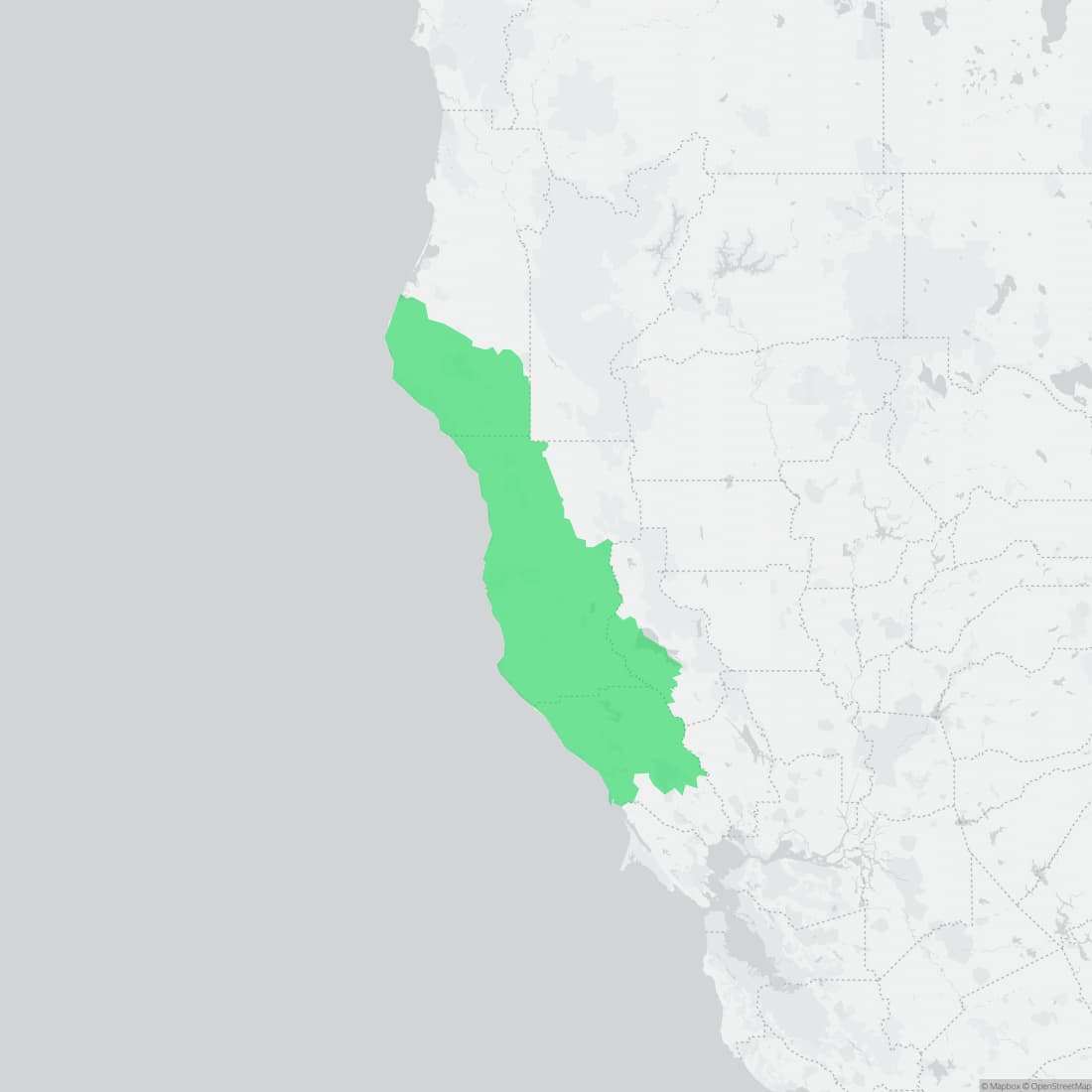
Approximate range. © Mapbox © OpenStreetMap