Sandstone Night Lizard
Xantusia gracilis
This specie of night lizard is small and flat bodied with a uniquely soft set of granular scales. It is a flat and narrow headed lizard with a short and slender body, usu…
How to identify
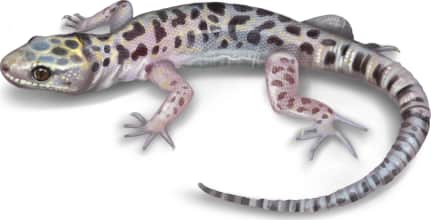
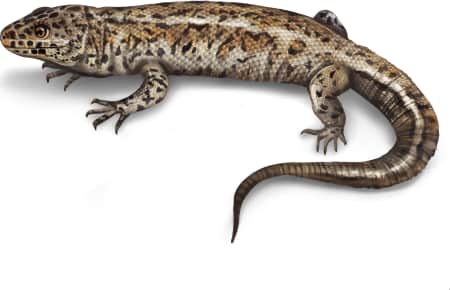
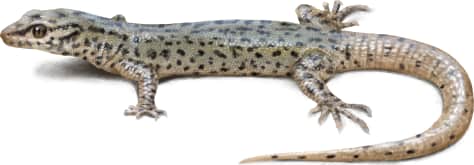
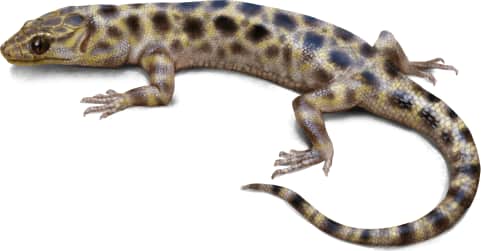
This specie of night lizard is small and flat bodied with a uniquely soft set of granular scales. It is a flat and narrow headed lizard with a short and slender body, usually 2 to 2.8 inches long from snout to vent. The head consists of a pair of lidless eyes with vertical pupils and folds. Their base coloration varies from white to yellow, with small, irregular and round spots on the dorsal part and on the tail. Also, the underside is white with tiny black markings on the forepart. Its distinguishing features include: limited number of scales around the upper arm and leg, few longitudinal rows of dorsal scales and very thin limbs leaving the male, specifically, with enlarged femoral pores. Summarily, this lizard is often referred to as the lighter version of Granite Night Lizard (xantusia henshawi).
Range
The Sandstone Night Lizard is a specie of lizard that is endemic to California, United States.
Habitat
The sandstone night lizard is classified “Nocturnal” as the reptile takes covering during the day under burrows and exfoliating holes and cracks in the sandstone. As a consequence, they are found to be more active from spring to fall and in turn, take refuge during winter. They dwell and burrow in sandstone and mudstone regions. In short, for this specie, an important requirement for habitation is the presence of rocky refuge. Typically, their diet consists of insects and plants. They spend most of their time in rocky burrows and crevices avoiding predators such as rock dwelling lizards, snakes, birds, etc. and so even reproductive activities take place secretly. They mate and lay eggs that eventually develop within 3months.
Similar species
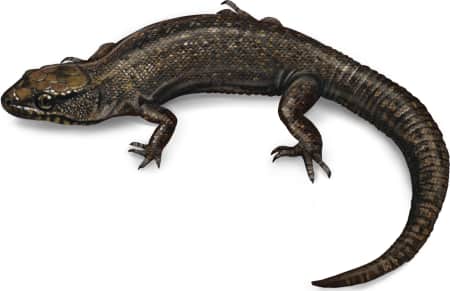
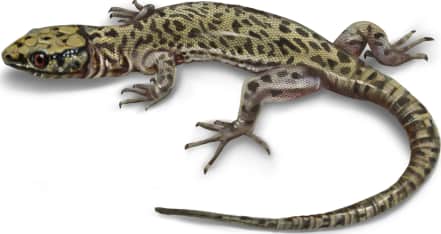
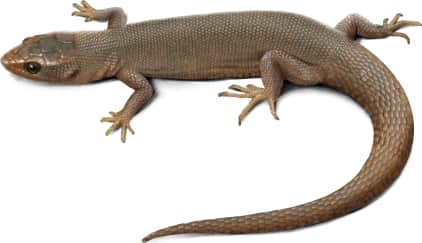
The Granite Night Lizard (Xantusia henshawi) has a flattened body and head covered with large folds of soft skin and fine granular scales. Expect when the tail has been detached and is regenerating, it has a long and thin tail. Interestingly, this lizard changes from a dark phase during the day to a light phase at night. At night, the base color is pale with large dark brown spots on the dorsal side and irregular spots on the tail. For the dark phase, the base color turns dark with pale white or yellow reticulations. The underside is white with tiny and dark speckling. The males specifically have enlarged pores towards the femur and a whitish oval patch on the front edge of the femoral pores distinguishing it from similar species. Desert Night Lizard (Xantusia vigilis) is small and slender. It has a soft skin with fine and gritty scales on the head and most part of the body. Its tail is long and detachable. It could be olive, gray or brown with dark markings that eventually form series of narrow stripes. From the eye to the shoulder is a narrow beige stripe taped in black while the ventral scales are whitish and are usually in 12 rows. Sierra Night Lizard (Xantusia sierrae) is a small sized lizard with a flattened body. The head is covered with large folds and plates but it still appears flat. Its skin is soft and the scales on the body are grainy. Generally, they are olive, grayish or brown in colour but have dark and interconnecting spots patterned like a net.
Name and etymology
Genus
Xantusia
Honoring John Xantus
Origin
Honors
Sources
- Baird, 1858. Proc. Acad. Nat. Sci. Philadelphia, Vol. 10, p. 255 ↗
Xantusia. Baird, 1858 - Proc. Acad. Nat. Sci. Philadelphia, Vol. 10, p. 255
Species epithet
gracilis
Latin for slender.
Origin
Sources
- Grismer and Galvan, 1986. Trans. San Diego Soc. Nat. Hist., Vol. 21, No. 10, p. 155 ↗
Xantusia henshawi gracilis. Grismer and Galvan, 1986 - Trans. San Diego Soc. Nat. Hist., Vol. 21, No. 10, p. 155
Explore more names in the etymology index.
At a glance
Range
The Sandstone Night Lizard is a specie of lizard that is endemic to California, United States.
Habitat
The sandstone night lizard is classified “Nocturnal” as the reptile takes covering during the day under burrows and exfoliati…
Guide
Reptiles and Amphibians of North America
Range map

Approximate range. © Mapbox © OpenStreetMap