Black Mountain Salamander
Desmognathus welteri
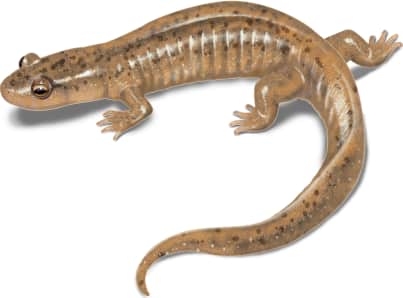
The Desmognathus welteri is one of the largest among the Desmognathus genus. They grow up to 170 mm in total length. They usually have 14 costal grooves. The background c…
How to identify
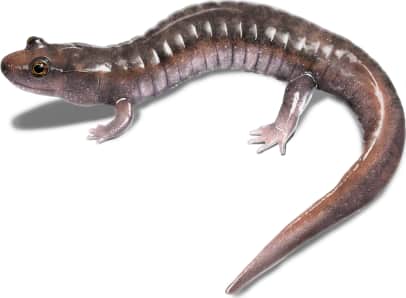
The Desmognathus welteri is one of the largest among the Desmognathus genus. They grow up to 170 mm in total length. They usually have 14 costal grooves. The background colour of the dorsum is usually light to dark brownish overlapped with alterable amounts of scattered dark brown to black vermiculations, small spot and streaks. Although some lack nearly all such markings. Instead, they are a uniform sandy colour. Most of these specie show two lines of light spots going along their side. There’s usually one at eye level stretching back onto the tail while the other one lies between the front and hind limbs. The male Desmognathus welteri are usually larger than females. They have a small mental gland at the apex of the jaws. They also have papillose cloacal lips.
Range
The Desmognathus welteri presently occupies the Cumberland Mountains and Cumberland Plateau in southwestern Kentucky. It can also be found in southern West Virginia, eastern Virginia, and north-central Tennessee.
Habitat
They are usually found along permanent, small – to medium-sized streams. Thee streams have moderate to steep gradients found in mesic forests at an elevation from 300 – 800 m. they can also be found on large rocks and the stream banks. They feed on adult dipterans, coleopterans, winged hymenopterans, larval dipterans and larval lepidopterans. Breeding takes place in spring and hatching occurs in September. They lay up to 4 clutches of eggs averaged at 26.
Similar species
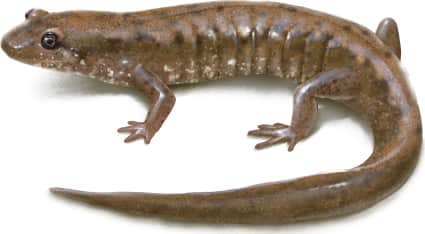
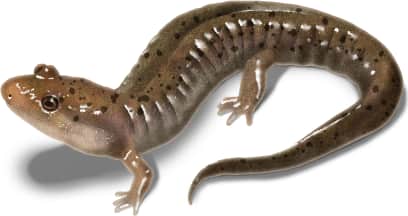
Desmognathus fuscus: Also known as Northern Dusky Salamander. This specie ranges from 64 – 141 mm in total length. It can be best differentiated from the Desmognatus welteri by its dark toe lips and large-keeled tail. It also can be differentiated by its lack of separation of dorsal and ventral colouration. Desmognathus monticola: Also Known as Seal Salamander. This specie ranges from 76 – 149 mm in total length. It can be differentiated from the Desmognathus welteri by its darker coloured dorsum with a roughly spotted pattern. Also, can be differentiated by its venter which is usually lightly pigmented with no mottling. Desmognathus auriculatus: Also known as Southern Dusky Salamander. This specie ranges from 76 – 162 mm in total length. They are usually dark brown or black dusky. Their bellies are usually speckled with white. Lastly, their sides have a conspicuous row of one or two round whitish or reddish spots.
Name and etymology
Genus
Desmognathus
Greek for jaw (gnathos) ligament (desmos).
Origin
Sources
- Baird, 1850. Journ. Acad. Nat. Sci. Philadelphia, Ser. 2, Vol. 1, p. 282 and p. 285 ↗
Desmognathus. Baird, 1850 - Journ. Acad. Nat. Sci. Philadelphia, Ser. 2, Vol. 1, p. 282 and p. 285
Species epithet
welteri
Honoring Wilfred August Welter.
Origin
Honors
Sources
- Barbour, 1950. Copeia, p. 277 ↗
Desmognathus welteri. Barbour, 1950 - Copeia, p. 277
Explore more names in the etymology index.
At a glance
Range
The Desmognathus welteri presently occupies the Cumberland Mountains and Cumberland Plateau in southwestern Kentucky. It can…
Habitat
They are usually found along permanent, small – to medium-sized streams. Thee streams have moderate to steep gradients found…
Guide
Reptiles and Amphibians of North America
Range map
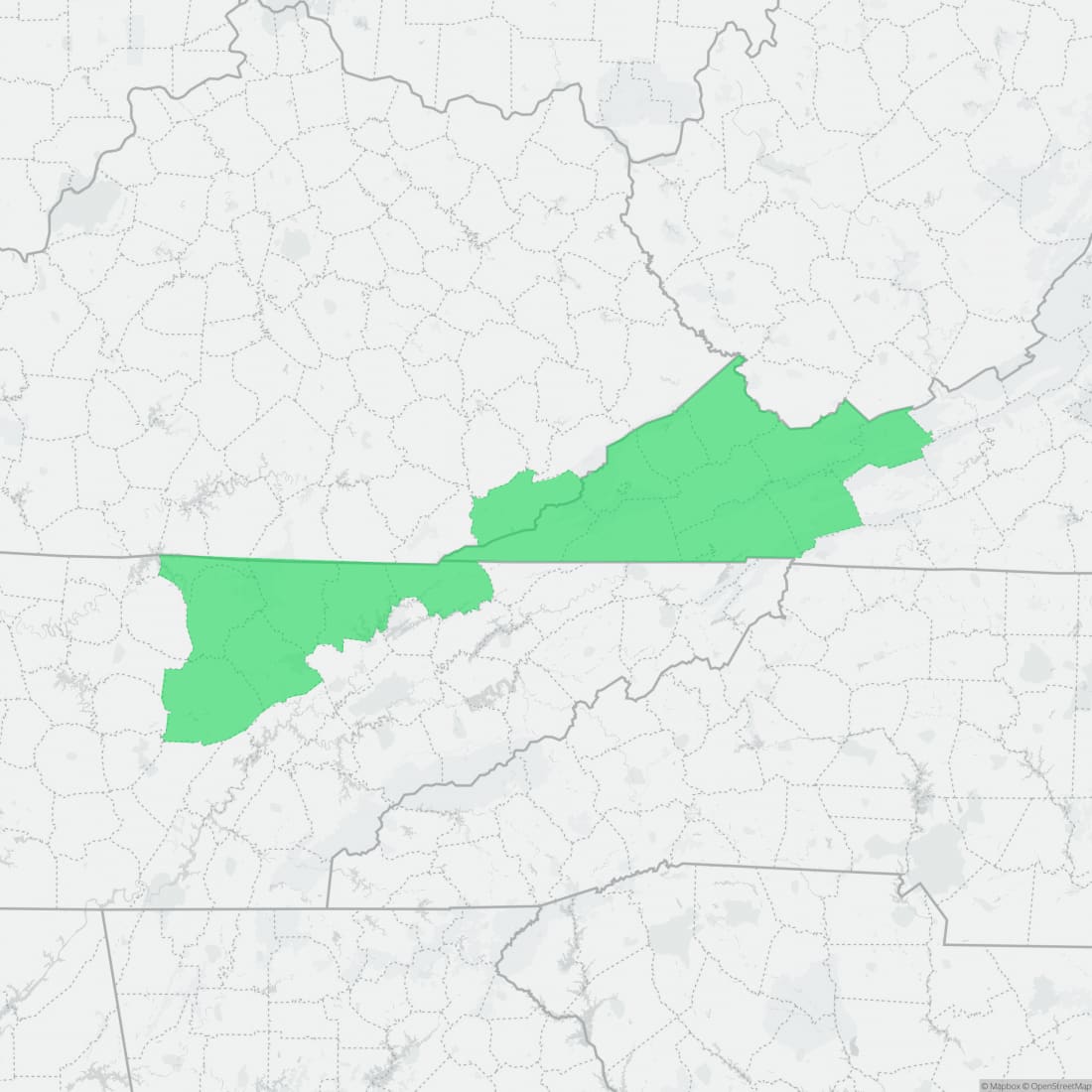
Approximate range. © Mapbox © OpenStreetMap