Ouachita Map Turtle
Graptemys ouachitensis
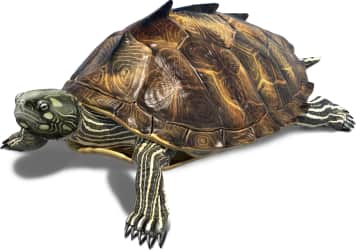
This turtle has a flattened shell with a central keel on the carapace, and serrated edges on the posterior marginal scutes. When viewed from above, it is wider in the bac…
How to identify
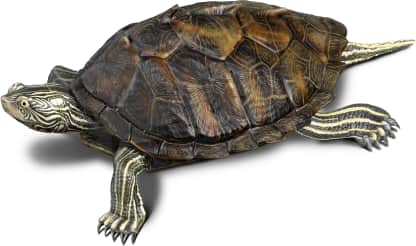
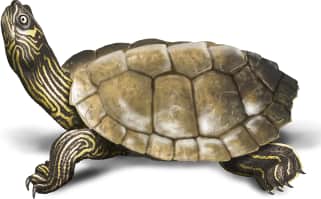
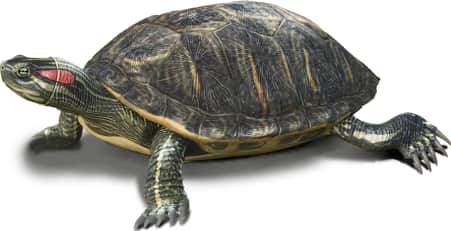
This turtle has a flattened shell with a central keel on the carapace, and serrated edges on the posterior marginal scutes. When viewed from above, it is wider in the back than the front. Females can reach 10 inches in carapace length, and are about twice the size of males. Juveniles have the namesake yellow map-like pattern on their carapace, which often fades with age. Adults are often muddy or algae covered and appear dull grey, brown, or dark green. When clean, the carapace is mottled dark brown and black. Its plastron is cream to yellow and unmarked. Its skin is dark grey to black with yellow stripes, and there are 3-4 yellow patches on each side of its face; one behind the eye, one under the eye, one on the bottom jaw, and sometimes one on the cheek. The 2 patches behind and beneath the eye sometimes merge to form a "C" shape.
Range
Native range follows the Mississippi and Ohio Rivers, with a branch into central Ohio, and eastern branches into southern Kentucky, most of Tennessee, and northern Alabama. It also stretches west through all of Arkansas, southern Missouri, western Kansas and Oklahoma, and northeastern Texas. Due to its prevalence in the pet trade, escapees have been observed in California, Florida, some northeastern states, Hawaii, and several European countries.
Habitat
This aquatic species prefers deep, wide sections of fast-flowing rivers with lots of submerged vegetation and emergent logs or rocks for basking. They are sometimes found in ponds or lakes close to rivers.
Variations
Some have many distinct yellow lines on their skin, while others have sparse lines. Juveniles have some brown shading on their plastron, which fades with age.
Similar species
Easy to confuse with the northern map turtle (*Graptemys geographica*) or false map turtle (*Graptemys pseudogeographica*). It can also be mistaken for the ever-present pond slider (*Trachemys scripta*).
Name and etymology
Genus
Graptemys
Greek for written (graptos) turtle (emys).
Origin
Sources
- Agassiz, 1857. Contr. Nat. Hist. U. S., Vol. 1, p. 436 ↗
Graptemys. Agassiz, 1857 - Contr. Nat. Hist. U. S., Vol. 1, p. 436
Species epithet
ouachitensis
Belong to the Ouachita Mountains, Arkansas.
Origin
Sources
- Cagle, 1953. Occ. Pap. Mus. Zool. Univ. Michigan, No. 546, p. 10 ↗
Graptemys ouachitensis. Cagle, 1953 - Occ. Pap. Mus. Zool. Univ. Michigan, No. 546, p. 10
Explore more names in the etymology index.
At a glance
Range
Native range follows the Mississippi and Ohio Rivers, with a branch into central Ohio, and eastern branches into southern Ken…
Habitat
This aquatic species prefers deep, wide sections of fast-flowing rivers with lots of submerged vegetation and emergent logs o…
Guide
Reptiles and Amphibians of North America
Range map
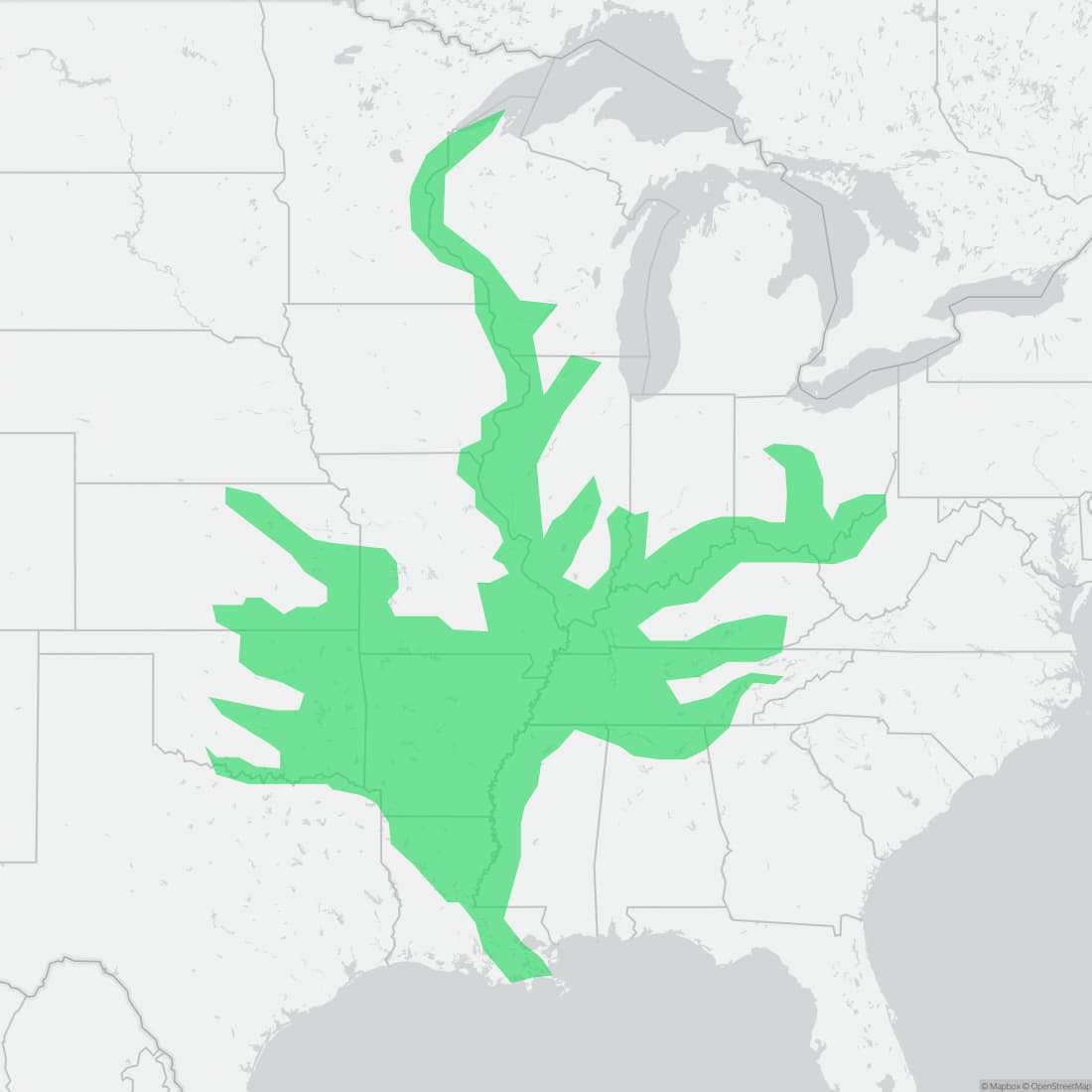
Approximate range. © Mapbox © OpenStreetMap