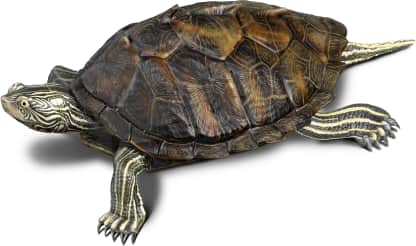
Northern Map Turtle
Graptemys geographica
This aquatic species is named for the map-like pattern on its carapace; an irregular network of thin connected lines that are typically yellow or orange on an olive brown…
How to identify
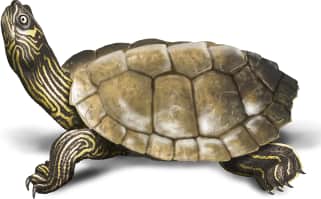
This aquatic species is named for the map-like pattern on its carapace; an irregular network of thin connected lines that are typically yellow or orange on an olive brown background. This pattern is more vibrant in juveniles, and fades with age. The turtle's skin is dark olive or black with a pattern of many thin yellow or greenish stripes, which are thinner around its face. Its upper mandible is pale yellow around the edges of the mouth. Its plastron is yellow with a central blotchy pattern along the scute seams, which fades away with age. The central carapace scutes are peaked to form a keel down its back, which is more pronounced in juveniles. The scutes on the posterior edge of the carapace are flared and serrated. tern
Range
Range branches throughout the northeastern and midwestern states, into southern Ontario and Quebec. It is most prevalent in areas surrounding the eastern Great Lakes, and southward throughout Ohio, Indiana, and most of Kentucky and Tennessee. It is also found in most of southern Michigan, northern Illinois, along the northern Mississippi River, and southwest into southern Missouri, most of Arkansas, and adjacent areas of Kansas and Oklahoma. In the northeast, it has patches of range in eastern Pennsylvania, New Jersey, southern New York, and Vermont.
Habitat
Northern map turtles inhabit large bodies of freshwater with lots of logs and floating debris for basking. They prefer rivers over ponds and lakes, and are more likely to be found in smaller rocky streams in the southern and western parts of their range.
Variations
At 7-10 inches in carapace length, females are much larger than their male counterparts, which only reach 4-6 inches in length. Females also have a wider head and carapace, a less pronounced carapacial keel, and a shorter, thinner tail.
Similar species
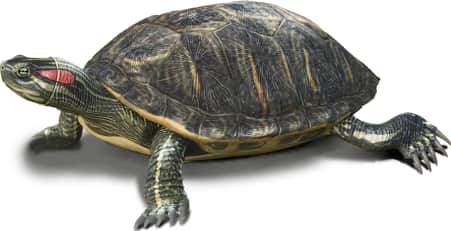
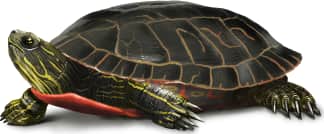
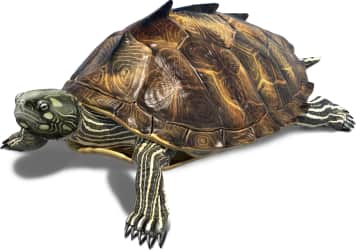
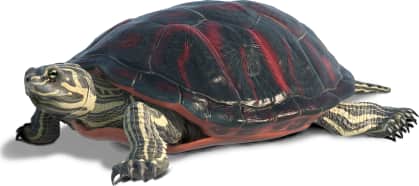
Most likely to be mistaken for the common pond slider (*Trachemys scripta*) or painted turtle (*Chrysemys picta*). Also resembles the Ouachita map turtle (*Graptemys ouachitensis*), northern red-bellied cooter (*Pseudemys rubriventris*), or false map turtle (*Graptemys pseudogeographica*), which can all overlap in certain areas.
Name and etymology
Genus
Graptemys
Greek for written (graptos) turtle (emys).
Origin
Sources
- Agassiz, 1857. Contr. Nat. Hist. U. S., Vol. 1, p. 436 ↗
Graptemys. Agassiz, 1857 - Contr. Nat. Hist. U. S., Vol. 1, p. 436
Species epithet
geographica
Greek for map (graph) of the (-ikos) world (geo)
Origin
Sources
- (Le Sueur, 1817). Journ. Acad. Nat. Sci. Philadelphia, Vol. 1, Pt. 1, p. 86, pl. 5 ↗
Graptemys geographica. (Le Sueur, 1817) - Journ. Acad. Nat. Sci. Philadelphia, Vol. 1, Pt. 1, p. 86, pl. 5
Explore more names in the etymology index.
At a glance
Range
Range branches throughout the northeastern and midwestern states, into southern Ontario and Quebec. It is most prevalent in a…
Habitat
Northern map turtles inhabit large bodies of freshwater with lots of logs and floating debris for basking. They prefer rivers…
Guide
Reptiles and Amphibians of North America
Range map
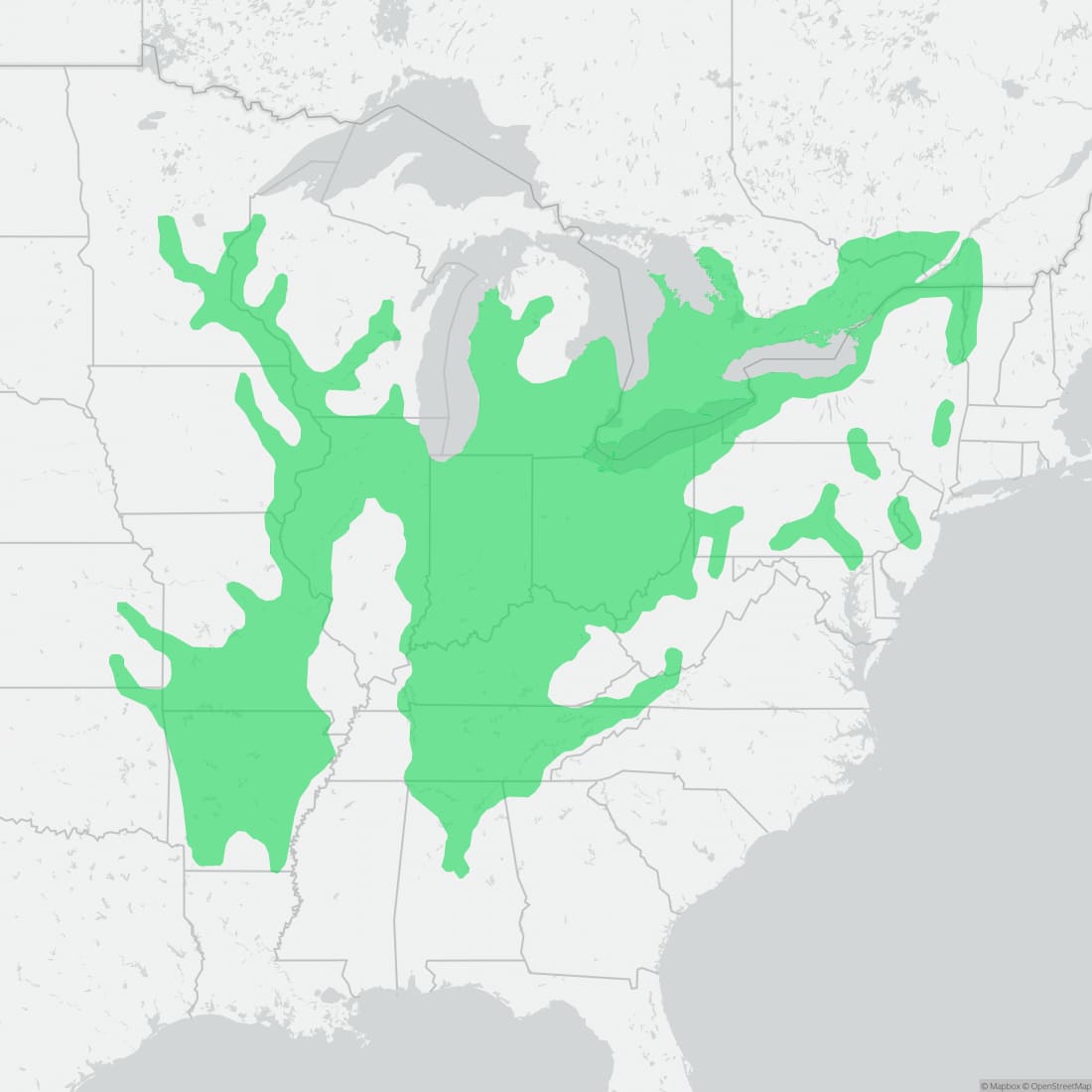
Approximate range. © Mapbox © OpenStreetMap