Northern Red-bellied Cooter
Pseudemys rubriventris
This smooth-shelled river turtle averages 11-12 inches in carapace length, with some females reaching up to 16 inches. It has a moderately flattened shell that is oval-sh…
How to identify
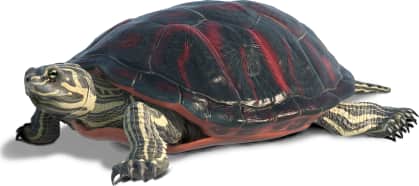
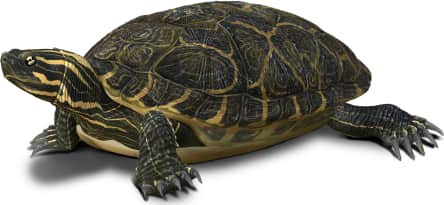
This smooth-shelled river turtle averages 11-12 inches in carapace length, with some females reaching up to 16 inches. It has a moderately flattened shell that is oval-shaped when viewed from above. Juveniles start out with an intricate pattern of yellow to red squiggly lines on their dark green carapace, which fade with age and become subtle and more visible when the dark greenish-grey shell is wet. Its plastron is yellow with dark blotches along the scute seams, which also fade with age until adults have a completely yellow, unmarked plastron. Its skin is primarily dark olive to black with thin yellow lines which are more prevalent on the throat and neck, and sparse on the top of the head and legs. The posterior edge of its carapace is very slightly serrated.
Range
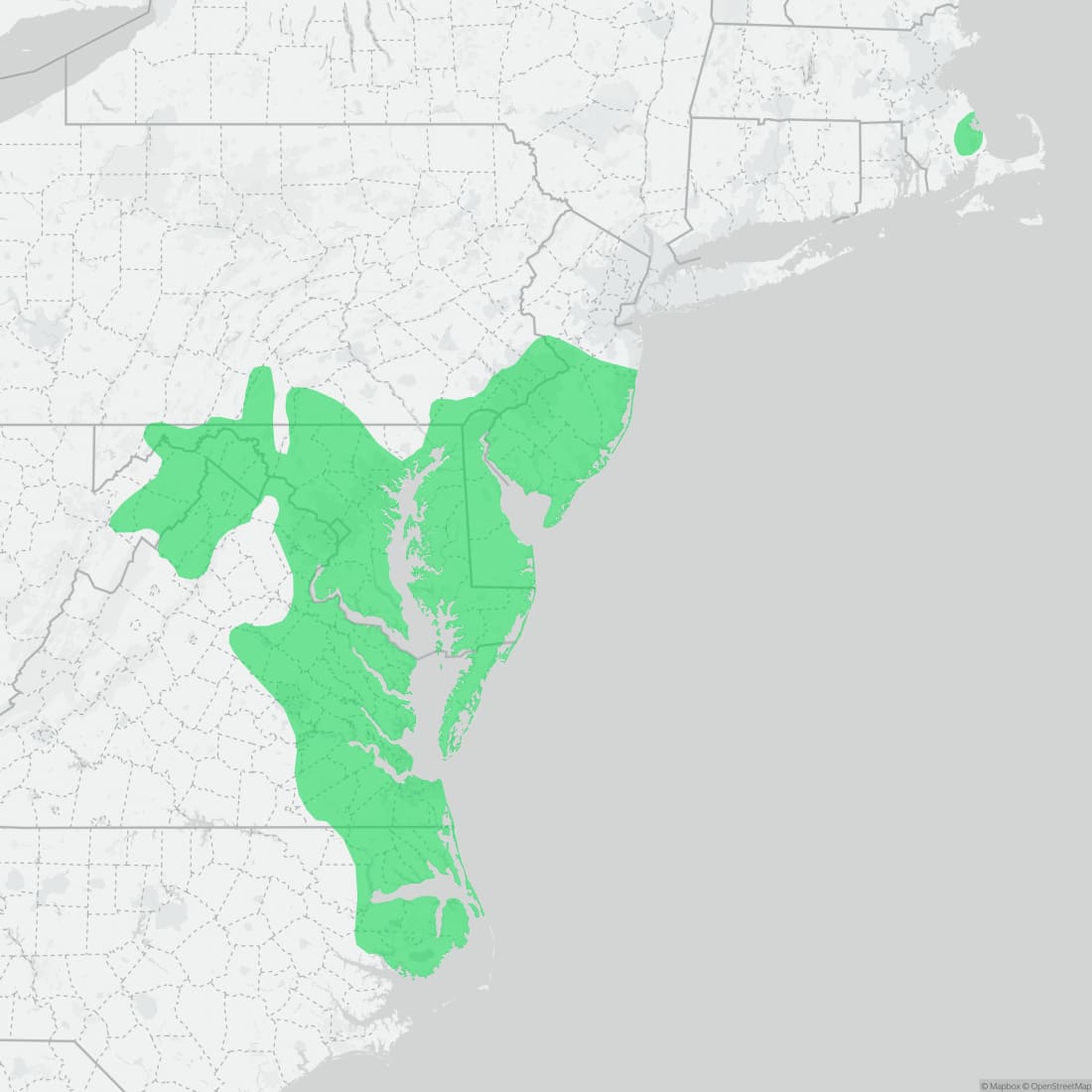
Range extends from southern New Jersey through Delaware, most of Maryland, eastern Virginia, and northeastern North Carolina. It also includes small adjacent areas of south central and southeastern Pennsylvania. A disjunct population exists in eastern Massachusetts.
Habitat
This species lives in and around freshwater lakes, ponds, and rivers with muddy bottoms. They prefer areas with lots of aquatic vegetation and floating debris for basking near deep water. They are more terrestrial during nesting season in June and July.
Variations
Females tend to be larger than males, with shorter, thinner tails. Carapace pattern ranges from yellow to red, and is more obvious on some adults.
Similar species
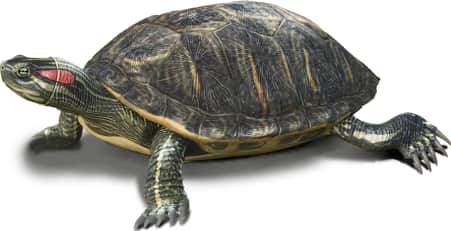
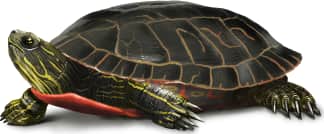
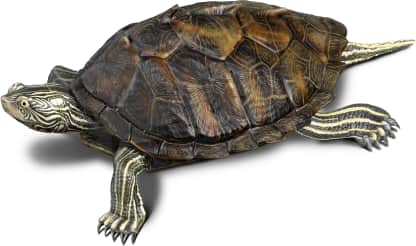
Most often mistaken for the common pond slider (*Trachemys scripta*), but also easy to confuse with the painted turtle (*Chrysemys picta*), river cooter (*Pseudemys concinna*), or northern map turtle (*Graptemys geographica*).
Name and etymology
Genus
Pseudemys
Greek for false (pseudo) turtle (emys).
Origin
Sources
- Gray, "1855" 1856. Proc. Zool. Soc. London, Jan. 22, 1856, p. 197 ↗
Pseudemys. Gray, "1855" 1856 - Proc. Zool. Soc. London, Jan. 22, 1856, p. 197
Species epithet
rubriventris
Latin for red (rubra) belly (ventris).
Origin
Sources
- (Le Conte, 1830). Ann. Lyc. Nat. Hist. New York, Vol. 3, p. 101 ↗
Pseudemys rubriventris. (Le Conte, 1830) - Ann. Lyc. Nat. Hist. New York, Vol. 3, p. 101
Explore more names in the etymology index.
At a glance
Size
40 cm
Range
Range extends from southern New Jersey through Delaware, most of Maryland, eastern Virginia, and northeastern North Carolina.…
Habitat
This species lives in and around freshwater lakes, ponds, and rivers with muddy bottoms. They prefer areas with lots of aquat…
Range map
Approximate range. © Mapbox © OpenStreetMap