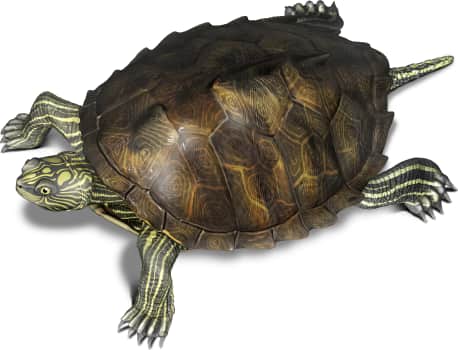
Sabine Map Turtle
Graptemys sabinensis
Sabine Map Turtles are medium to large size map turtles. They are one of the most specialized group of turtles with a unique body form. Its head is relatively small and i…
How to identify
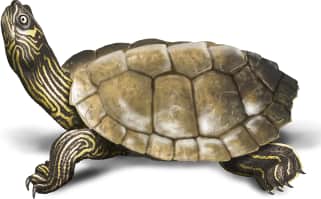
Sabine Map Turtles are medium to large size map turtles. They are one of the most specialized group of turtles with a unique body form. Its head is relatively small and is connected to a set of low vertebral spines that are strongly serrated on the rear. The eyes have light yellow spots behind and under, and also, there is a black stripe in the middle, on top of the absurdly small head. Carapace, that is, the shell structure is usually olive, dark brown or black in coloration with connected yellow markings. The underside or rather the vertebral surface of the shell varies from cream to yellow and at the same time, patterned with dark lines and curves. The males are noticeably smaller than females. The males can grow to be as large as 5 in (12cm) in carapace length while the females can grow to be up to 10 in (25cm) in carapace length. The males happen to have longer and wider tails than females.
Range
Sabine Map Turtles, like many other map turtles, have a relatively small range. They are endemic to the United States, specifically, to the Sabine River system in Texas and Louisiana.
Habitat
The Sabine Map Turtles primarily occupy seasides. They have a high preference towards the deep sections of rivers with mud and high quality basking sites. Sabine map turtle is omnivorous and feeds mainly on small aquatic animals (like insects), algae and aquatic plants. These turtles are cold blooded and so end up spending a significant part of their day basking relentlessly. Typically, they are found to be wary and difficult to approach during these periods.
Similar species
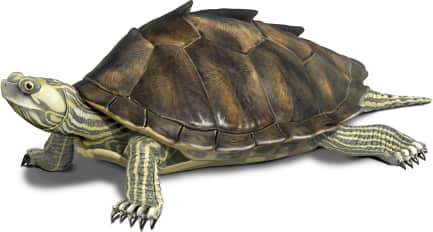
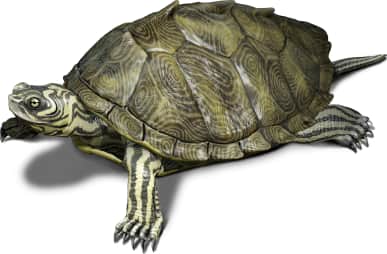
Cagle Map Turtle (graptemys caglei) The Calge Map Turtle is smaller than most map turtles although not the smallest. Its adult female may be as small as inches and the male, 3 inches. The carapace, that is, the shell, varies from olive-green to olive-brown with yellow marking like most map turtles. Apparently, there are three stripes between the eye and four curved stripes defining the jaw while the head in itself is amply patterned with light yellowish lines and spot. Also on the neck and throat are vividly patterned and yellowish stripes. Withal, it has webbed feet. False Map Turtle (graptemys pseudogeographica) False Map Turtle is known as the “sawback turtle” because of its unique shell shape. This particularly, makes it look different from other map turtles. It has a carapace that is brown and has several yellow marking just like the Sabine Map Turtle but it specifically, has a post orbital crescent that stops the neck line from reaching the eyes. Alabama map turtle (graptemys pulchra) Like every other map turtle, the Alabama Map Turtle has a keeled carapace but differentiating it from other map turtles is a black stripe that runs down the centre of its back with bumps thrusting out from it. Although this feature wears down with age, it still serves as a visible distinguishing feature. Amazingly, Alabama Map Turtle has extremely large heads and they can be olive or green in colour, with slightly visible dark stripes. Also, their feet are webbed.
Name and etymology
Genus
Graptemys
Greek for written (graptos) turtle (emys).
Origin
Sources
- Agassiz, 1857. Contr. Nat. Hist. U. S., Vol. 1, p. 436 ↗
Graptemys. Agassiz, 1857 - Contr. Nat. Hist. U. S., Vol. 1, p. 436
Species epithet
sabinensis
Belonging to the Sabine River, Louisiana.
Origin
Sources
- Wikipedia: Graptemys sabinensis ↗
“Graptemys sabinensis.” Wikipedia. https://en.wikipedia.org/wiki/Ouachita_map_turtle
Explore more names in the etymology index.
At a glance
Range
Sabine Map Turtles, like many other map turtles, have a relatively small range. They are endemic to the United States, specif…
Habitat
The Sabine Map Turtles primarily occupy seasides. They have a high preference towards the deep sections of rivers with mud an…
Guide
Reptiles and Amphibians of North America
Range map
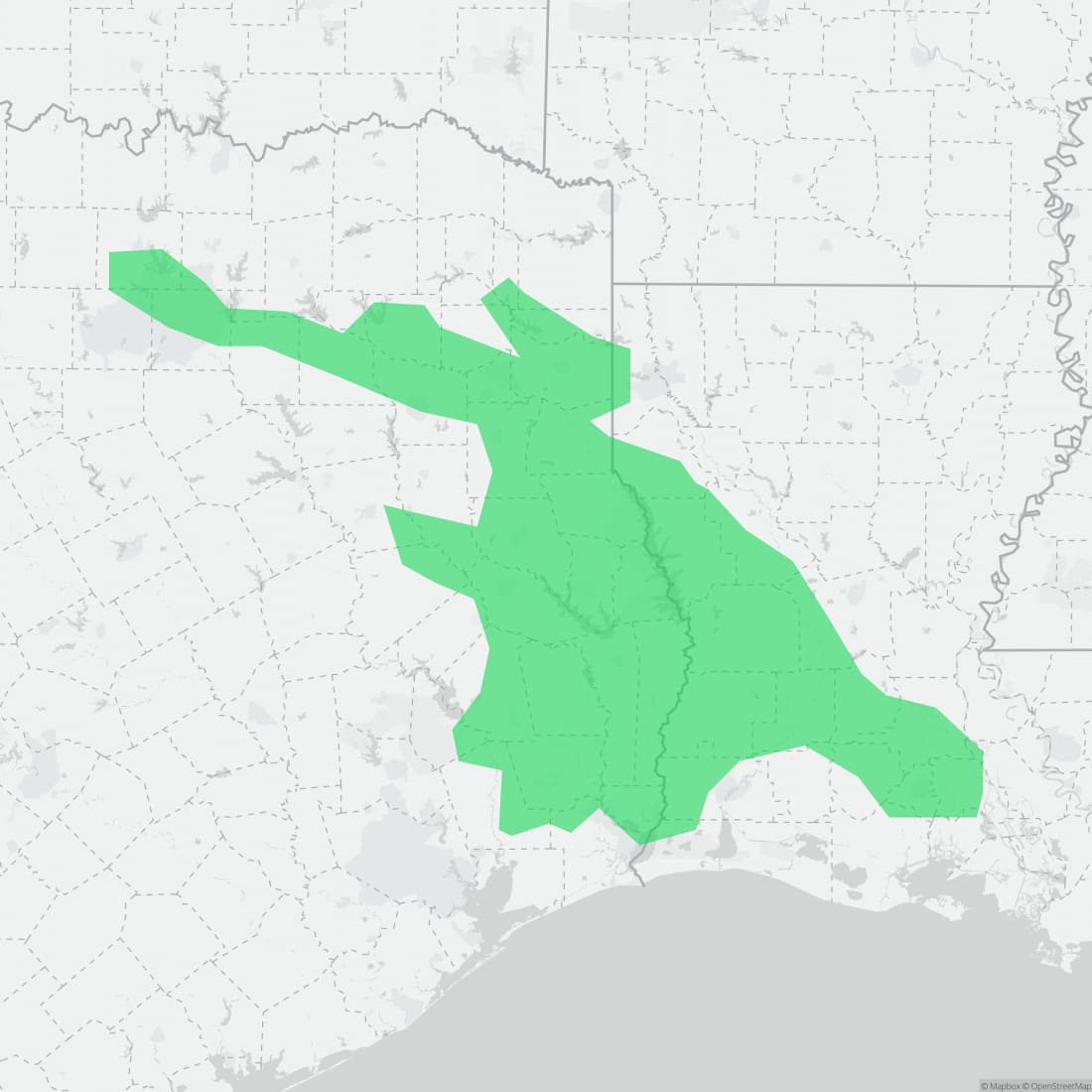
Approximate range. © Mapbox © OpenStreetMap