
Oregon Slender Salamander
Batrachoseps wrighti
A thin-bodied salamander with a long, round tail and scrawny legs. It averages 3.5-4.5 inches in total length and has obvious costal grooves. It has a small, narrow head…
How to identify
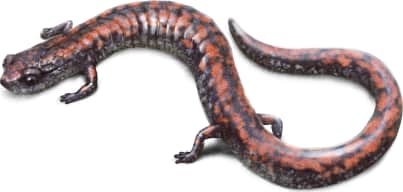
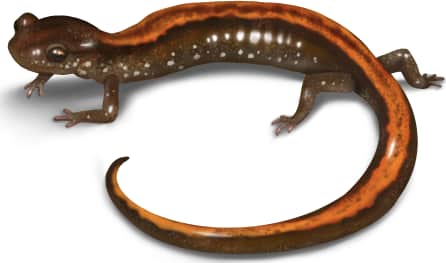
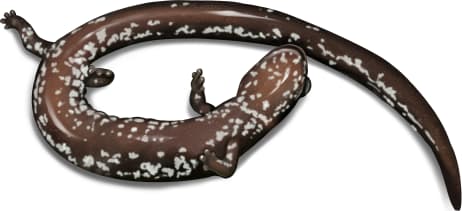
A thin-bodied salamander with a long, round tail and scrawny legs. It averages 3.5-4.5 inches in total length and has obvious costal grooves. It has a small, narrow head with an angular snout. It typically has a blotchy red or reddish brown dorsal stripe, and dark grey to black sides with white speckling that extends onto the dark ventrum.
Range
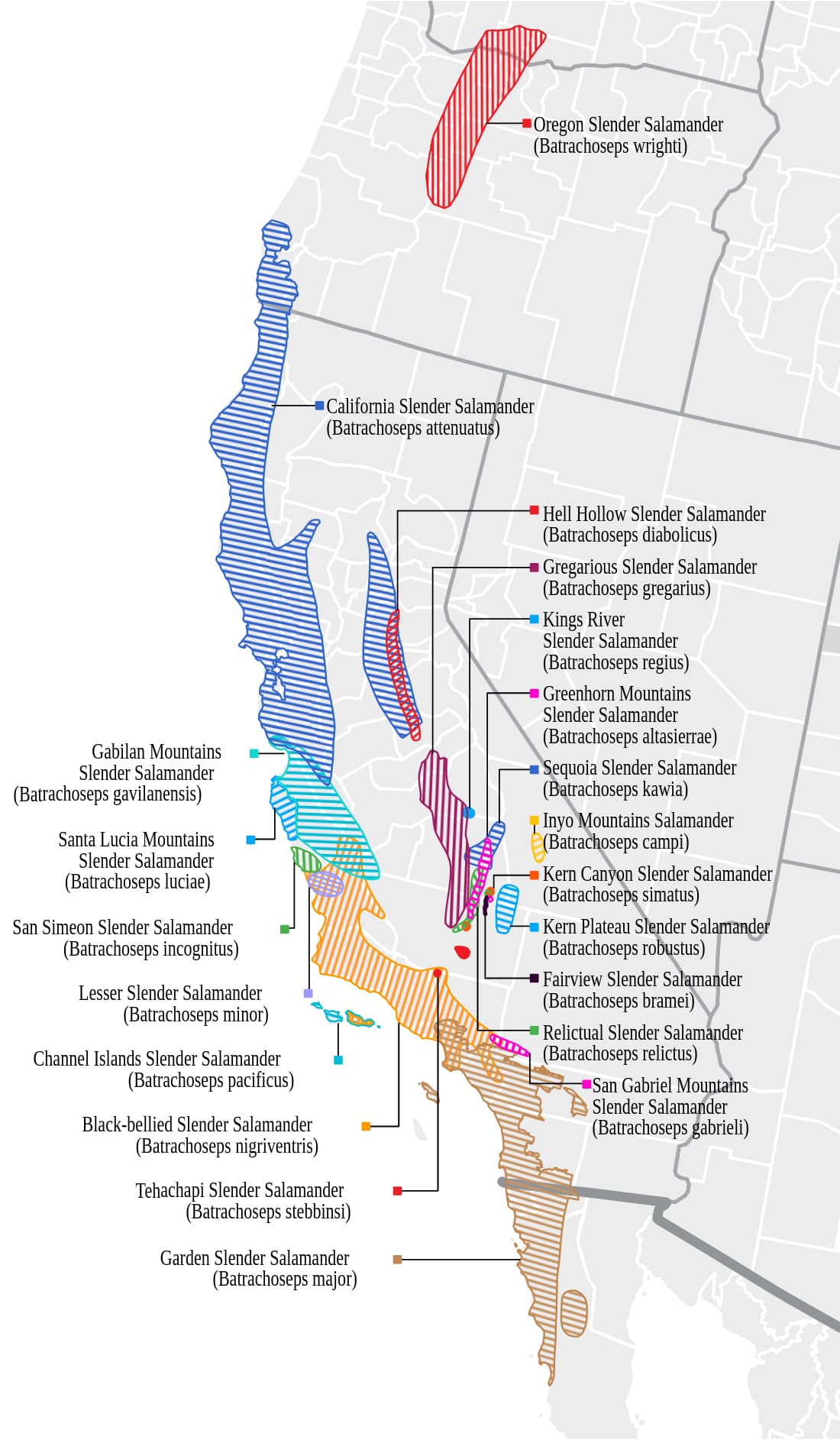
Narrow range in the Cascade Mountains of north central Oregon.
Habitat
This species is most often found in old-growth fir, maple, and cedar forests with closed canopies on western slopes of the Cascade range. It likes to hide in rotting logs, and will also live on talus slopes.
Variations
Some lack the reddish dorsal stripe and are dark all over.
Similar species
Most similar to the western red-backed salamander (*Plethodon vehiculum*).
Name and etymology
Genus
Batrachoseps
Greek for amphibian (batrachos) lizard (seps).
Origin
Sources
- Bonaparte, 1841. Iconogr. Fauna Italica, Vol. 2, Fasc. 26, fol. 131, not paged
Batrachoseps. Bonaparte, 1841 - Iconogr. Fauna Italica, Vol. 2, Fasc. 26, fol. 131, not paged
Species epithet
wrighti
Honoring Albert H. Wright and Margaret R. Wright
Origin
Honors
Sources
- Wikipedia: Batrachoseps wrighti ↗
“Batrachoseps wrighti.” Wikipedia. https://en.wikipedia.org/wiki/Oregon_slender_salamander
Explore more names in the etymology index.
More illustrations
At a glance
Range
Narrow range in the Cascade Mountains of north central Oregon.
Habitat
This species is most often found in old-growth fir, maple, and cedar forests with closed canopies on western slopes of the Ca…
Guide
Reptiles and Amphibians of North America
Range map
Approximate range. © Mapbox © OpenStreetMap