Ozark Zigzag Salamander
Plethodon angusticlavius
This slim-bodied salamander has a flat head with a rounded snout, and skinny legs. It averages 3.5 cm in snout to vent length, with a round tail about the same length as…
How to identify
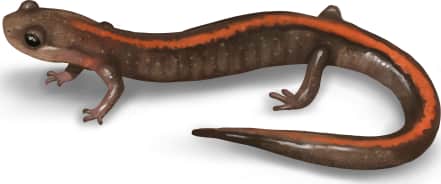
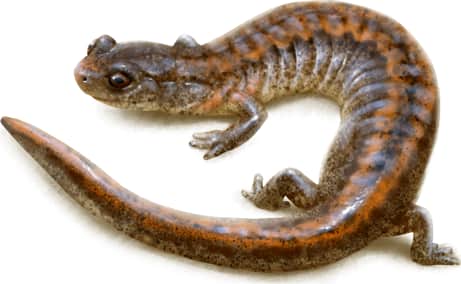
This slim-bodied salamander has a flat head with a rounded snout, and skinny legs. It averages 3.5 cm in snout to vent length, with a round tail about the same length as its body. It has a yellow to red medium-width stripe down the center of its back and tail, which is not completely solid or defined; it looks like a line of spray paint. The rest of its body is grey-brown with tiny white speckles, which are more prevalent on its sides. Its ventrum is light grey with dense white speckling.
Range
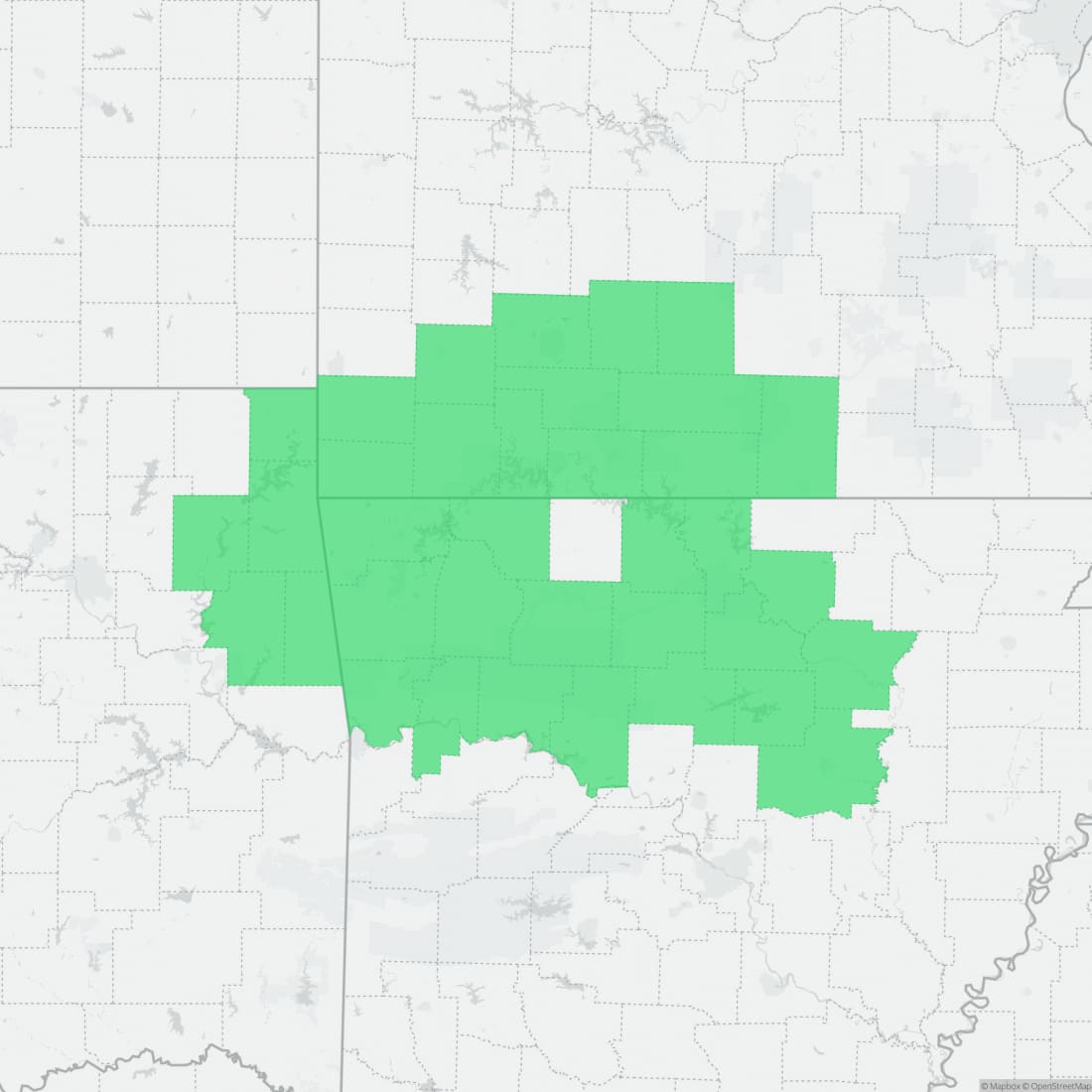
Northwestern Arkansas, southwestern Missouri, and northeastern Oklahoma.
Habitat
This species is found in moist leaf debris, talus slopes, and rocky caves in forest habitats. Rocky cedar glades are commonly used by adults during courtship.
Variations
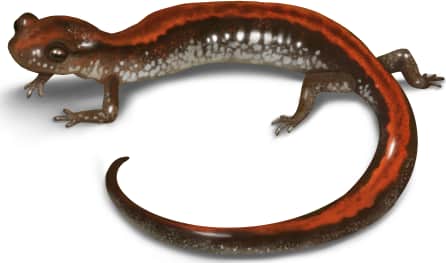
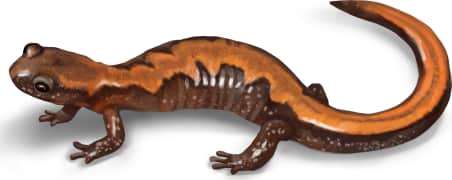
Most are slender, but some have a more stout figure. Its dorsal stripe is usually orange, but can be tan, yellow, or red. It can also be patchy or absent.
Similar species
Most likely to be misidentified as the southern red-backed salamander (*Plethodon serratus*), Webster's salamander (*Plethodon websteri*), or northern zigzag salamander (*Plethodon dorsalis*).
Name and etymology
Genus
Plethodon
Greek for full of (plethore) teeth (odon).
Origin
Sources
- Tschudi, "1838" 1839. reprinted in Classif. Batr., Mem. Soc. Sci. Nat. Neuchatel, p. 92 ↗
Plethodon. Tschudi, "1838" 1839 - reprinted in Classif. Batr., Mem. Soc. Sci. Nat. Neuchatel, p. 92
Species epithet
angusticlavius
Latin for narrow (angustus) stripes (clavus)
Origin
Sources
- Grobman, 1944. Ann. New York Acad. Sci., Vol. 45, p. 266
Plethodon angusticlavius. Grobman, 1944 - Ann. New York Acad. Sci., Vol. 45, p. 266
Explore more names in the etymology index.
At a glance
Range
Northwestern Arkansas, southwestern Missouri, and northeastern Oklahoma.
Habitat
This species is found in moist leaf debris, talus slopes, and rocky caves in forest habitats. Rocky cedar glades are commonly…
Guide
Reptiles and Amphibians of North America
Range map
Approximate range. © Mapbox © OpenStreetMap